


The Half Life of Agent Infrastructure Is Now Months

Box CTO Ben Kus says agent stacks now expire in months, not years, and teams must build to swap models, retrieval and sandboxes continuously.

7 min read
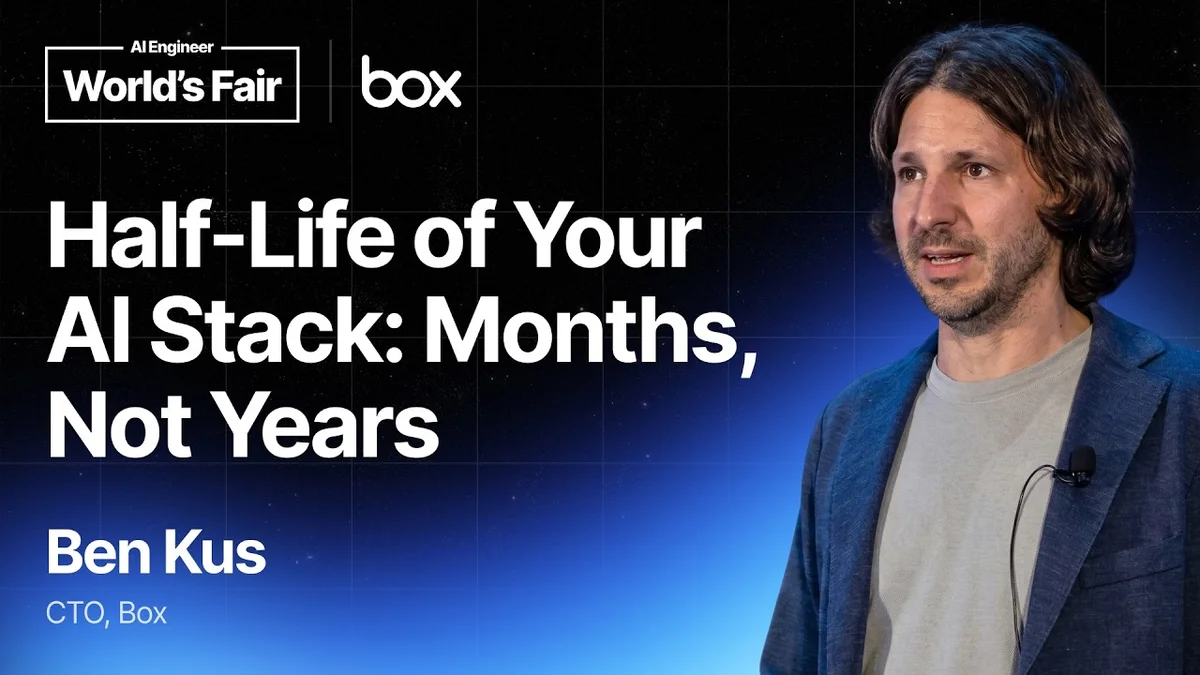
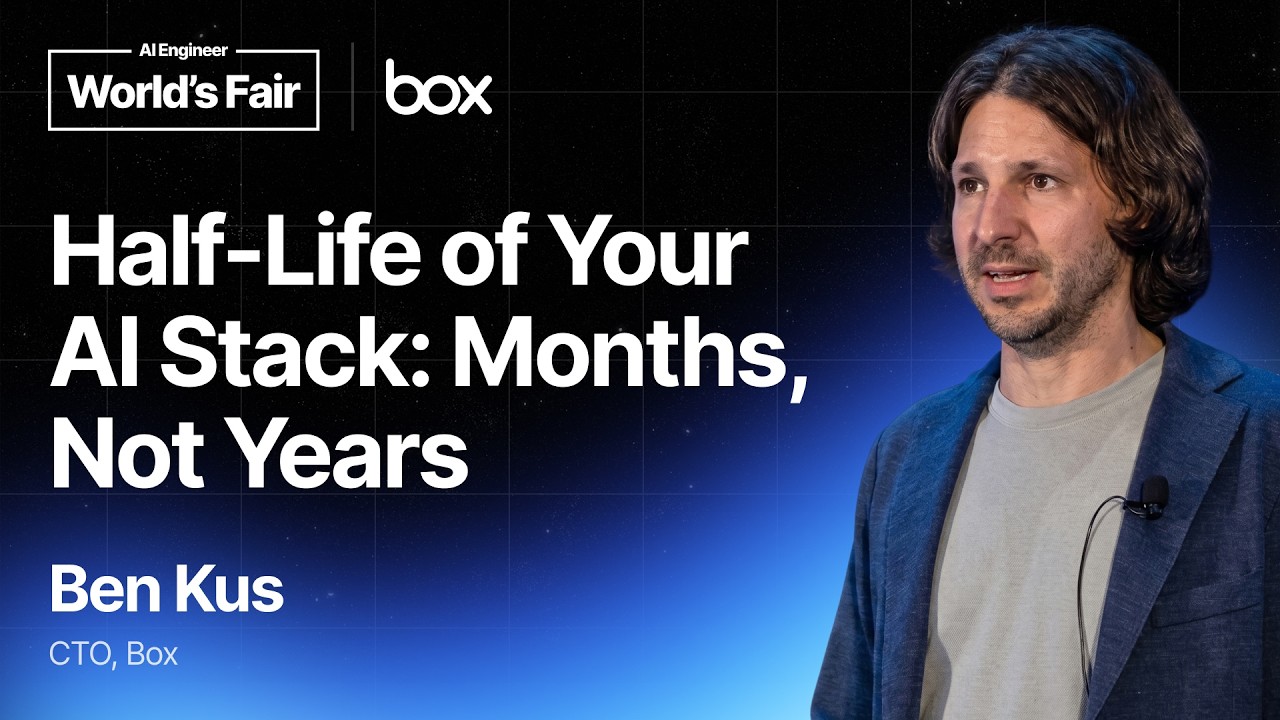
Box CTO Ben Kus presenting on agent infrastructure at AI Engineer World Fair
Ben Kus says agent infrastructure now turns over in months, forcing teams to rebuild for change.· AI Engineer
Visual TL;DR
Old playbookDriver
pick a stack, go deep, switch rarely was once generic enterprise advice
Graph-based agentic approachCore
nodes as LLMs and edges as workflows, Box CTO's key idea
From the articleA year ago at the same conference, Kus pitched a graph-based agentic approach as the key to agents.
Half-life collapsedContext
agent infrastructure now expires in months rather than years
From the articleThe half life of agent infrastructure has collapsed from years to months.
Rapid model churnDriver
adaptive selection across big frontier and small open-weight models
Build to swap continuouslyOutcome
swap models, retrieval, and sandboxes on a quarterly cadence
From the articleSecond, build abstractions that let you swap the underneath.
Old playbookDriver
pick a stack, go deep, switch rarely was once generic enterprise advice
Graph-based agentic approachCore
nodes as LLMs and edges as workflows, Box CTO's key idea
From the articleA year ago at the same conference, Kus pitched a graph-based agentic approach as the key to agents.
Box at scaleCore
more than an exabyte of data, trillions of tokens served
From the article 7 mentionsInstruction following at scale unlocked what he calls the new agent models.
Half-life collapsedContext
agent infrastructure now expires in months rather than years
From the articleThe half life of agent infrastructure has collapsed from years to months.
Already feeling datedEffect
the graph approach pitched last year now needs constant rebuilding
Rapid model churnDriver
adaptive selection across big frontier and small open-weight models
Build to swap continuouslyOutcome
swap models, retrieval, and sandboxes on a quarterly cadence
From the articleSecond, build abstractions that let you swap the underneath.
Warning to foundersOutcome
teams must now rebuild what worked just last quarter
From the articleFor founders, the implication is uncomfortable and clarifying.
Contents(4)

The half life of agent infrastructure has collapsed from years to months. Box CTO Ben Kus told the AI Engineer World Fair that teams must now rebuild what worked just last quarter.

The Half Life of Agent Infrastructure Is Now Months - AI Engineer
The Half Life of Agent Infrastructure Is Now Months, from AI Engineer

Kus runs infrastructure for Box (NYSE:BOX), which holds more than an exabyte of data. He counts tens of millions of users, hundreds of billions of files, and now trillions of tokens heading to 10 trillion.

That scale frames his warning. Generic enterprise advice used to be to pick a stack, go deep, and switch rarely.

What changed since last year?

A year ago at the same conference, Kus pitched a graph-based agentic approach as the key to agents. Nodes were LLMs. Edges were workflows the agent traverses.

He still likes the idea. He says it is already dated.

He ran through the churn rapid-fire. For models: train your own, then use frontier models from OpenAI or Anthropic, then host open-weight models, then bring your own key, now do adaptive model selection across big and small models.

For agents: single-shot LLM calls became chain-of-thought reasoning, then graph-based agents, then planner agents as popularized by Claude, then dedicated sub-agents, then generic recursive agents with skills, then agent sandboxes where agents write and execute code, now bring-your-own harness.

For retrieval: BM25 gave way to RAG with embeddings and approximate nearest neighbor, then graph retrieval, then hybrid lexical plus semantic with rank fusion, now agentic search where agents hunt and reason over data themselves.

Why the old playbook fails now

Kus has lived through internet, mobile, and cloud shifts. Those platforms kept stable primitives. HTTP endured. iOS and Android endured.

Generative AI has not. Almost everything powering it is changing at once, and faster than he has ever seen.

He pegs a turning point to the jump from Opus 4 to Opus 4.5. Instruction following at scale unlocked what he calls the new agent models. Hardware getting faster and cheaper pushed token usage off the charts at the same time.

The result is a different half-life. Databases like MySQL can stay for 3 to 5 years. Agent stacks expire in months.

He told a story that lands for any engineering manager. An engineer got agentic search working with deep research. Then Kus said rebuild it on the new looping deep agent pattern. Two months later, with a product shipping Tuesday, he said rebuild again Wednesday.

Engineers hate it. Startups who bet on one approach get disrupted by the next wave. Buyers signing three-year deals find the approach obsolete. VCs backing the consensus winner watch the consensus move.

At Box that means a standing six-month review for every AI choice. For everything else, the cycle is three years.

Second, build abstractions that let you swap the underneath. Box has an agent abstraction where the customer experience stays constant while models, retrieval, and execution change below it.

Third, let evals decide. Do not chase papers or CEO demos. Grade cost, speed, quality, and capabilities on fixed eval sets. If the new approach wins on what customers care about, switch. If not, keep iterating.

Why this matters for founders and platforms

The talk reframes the moat. It is not a graph, a skill library, or a harness. It is adaptability itself.

That favors teams who instrument evals and observability early, and who abstract model and tool calls from day one. It punishes teams who hardwire to one model or one retrieval trick.

It also shifts vendor selection. Kus said buyers used to judge roadmaps on what is available now. Now he looks back. How did the vendor handle the last three reinventions in the last year? Those who reinvented well are more likely to keep up.

That is a subtle but sharp filter. Many AI infrastructure vendors have already pivoted from fine-tuning to RAG to hybrid search to agent platforms in 18 months. The ones who did it without breaking customers have a real credential.

For founders, the implication is uncomfortable and clarifying. The company that dominates tomorrow may have been born this year, Kus believes. But its current stack will not be the one that gets it there.

According to AI Engineer, the full talk expands on Box's sandbox agents and unstructured content strategy. Kus invited follow-ups at the Box booth for teams wrestling with the same swap-out problem.

© 2026 StartupHub.ai. All rights reserved. Do not enter, scrape, copy, reproduce, or republish this article in whole or in part. Use as input to AI training, fine-tuning, retrieval-augmented generation, or any machine-learning system is prohibited without written license. Substantially-similar derivative works will be pursued to the fullest extent of applicable copyright, database, and computer-misuse laws. See our terms.