

Telegram's Agentic Bots Explained

Telegram is enabling users and businesses to create sophisticated agentic bots directly within the app through managed bots and business integrations.

Telegram agentic bots interface showing chat and user selection features
Explore the diverse features of Telegram's agentic bots, from chat interactions to monetization.

Telegram is quietly becoming a significant platform for agentic bots, allowing users to create and manage their own specialized AI assistants directly within the messaging app.

Managed Bots: Your Personal AI Factory

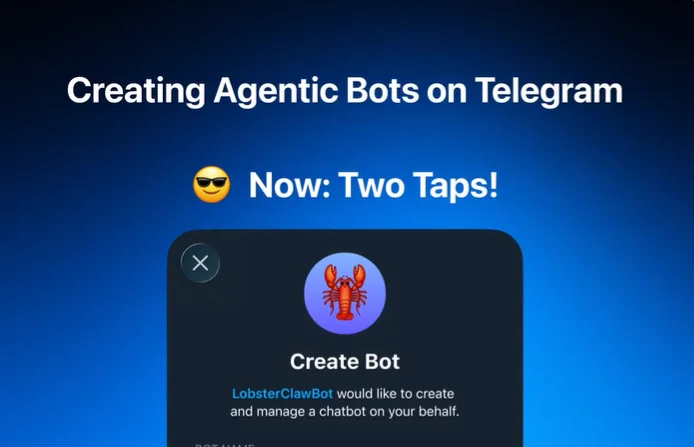
At its core, Telegram's 'Managed Bots' feature enables one bot to create and oversee other bots. This is the foundation for users to spin up their own personalized AI agents, business tools, or custom productivity bots with minimal effort.

Developers can build a 'manager bot' which, when shared via a special link, guides users through the creation of their own bot, pre-filling details like username and display name.

Bots for Business: Streamlining Operations

For businesses, bots can now integrate deeply with Telegram Business accounts. This 'Business Mode' allows bots to automate private chat management and client interactions, acting on behalf of the business owner.

This integration streamlines customer service, handles routine queries, and automates workflows, all within the familiar Telegram interface.

Bot-to-Bot Communication: The Agentic Backbone

Crucial for advanced AI functionalities, Telegram supports bot-to-bot communication. This allows bots to interact with each other, forming the complex chains necessary for sophisticated agentic tasks.

This communication can occur in group chats through mentions or replies, or via business accounts. Developers must implement safeguards against infinite loops when enabling this feature.

Telegram's approach democratizes the creation of agentic bots.

© 2026 StartupHub.ai. All rights reserved. Do not enter, scrape, copy, reproduce, or republish this article in whole or in part. Use as input to AI training, fine-tuning, retrieval-augmented generation, or any machine-learning system is prohibited without written license. Substantially-similar derivative works will be pursued to the fullest extent of applicable copyright, database, and computer-misuse laws. See our terms.