


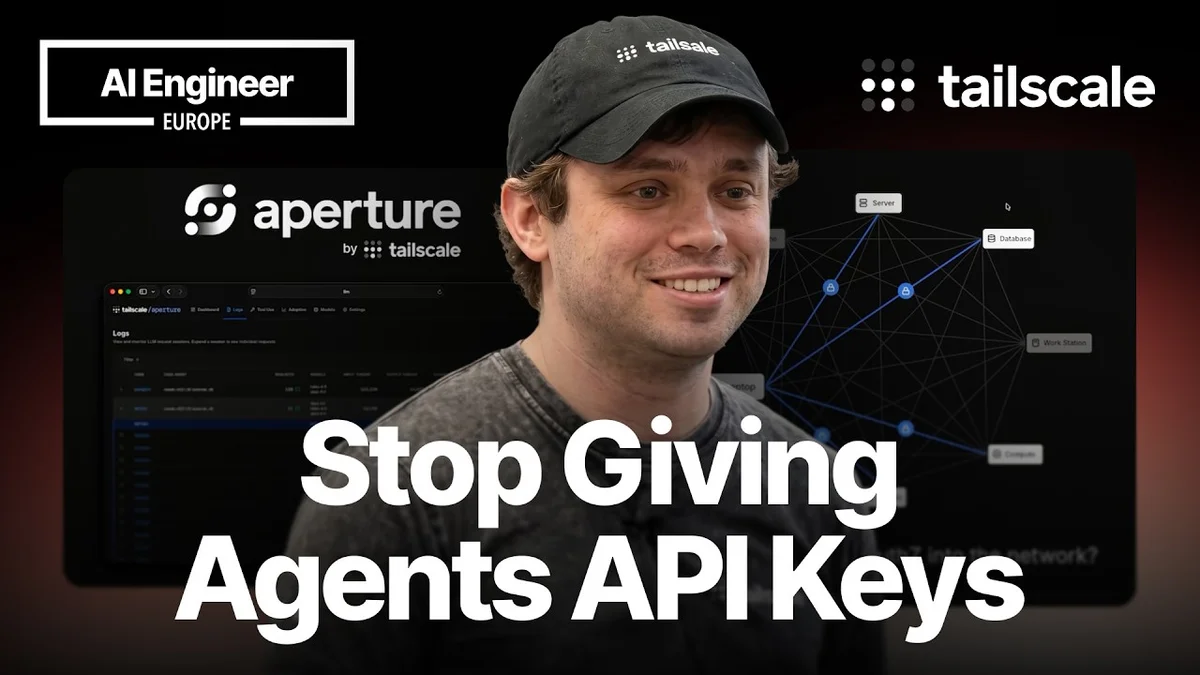
Remy Guercio, representing Tailscale, explored a novel concept at AI Engineer Europe: "What if the network was the sandbox?" This provocative question invites a shift in perspective, moving beyond traditional sandboxing methods to leverage the network itself as a controlled environment for AI agents. Guercio's presentation delved into the practical implications of this idea, showcasing how Tailscale's infrastructure can facilitate secure and efficient AI development and deployment.
Redefining the Sandbox for AI Agents
Guercio began by dissecting the fundamental components of a sandbox: a boundary and a set of permissions. He argued that traditional approaches, such as virtual machines or containers, while effective, can be cumbersome and may not fully address the dynamic nature of modern AI development. The proposed network-centric sandbox, facilitated by Tailscale, aims to offer a more flexible and integrated solution.
"What if we built the components of AuthN and AuthZ into the network?" Guercio posed, suggesting that by embedding identity and access control at the network layer, it becomes possible to manage AI agents and their interactions more effectively. In this model, each connection within the network is secured and governed by defined permissions, allowing for fine-grained control over what agents can access and how they can interact with other resources.
Leveraging Tailscale for Networked Sandboxing
Guercio highlighted Tailscale's capabilities in enabling this network-as-a-sandbox paradigm. By utilizing WireGuard, Tailscale creates secure, private networks that can segment AI agents and restrict their access to only necessary resources. This approach allows for the creation of isolated environments without the need for complex network configurations or the overhead of traditional sandboxing solutions.
He demonstrated how Tailscale's platform can manage individual agent identities and their associated permissions. For instance, a specific AI agent, identified by its Tailscale identity, can be granted access to a particular set of data or models, while being denied access to others. This granular control is crucial for ensuring the security and integrity of AI development workflows, especially in complex or sensitive environments.