

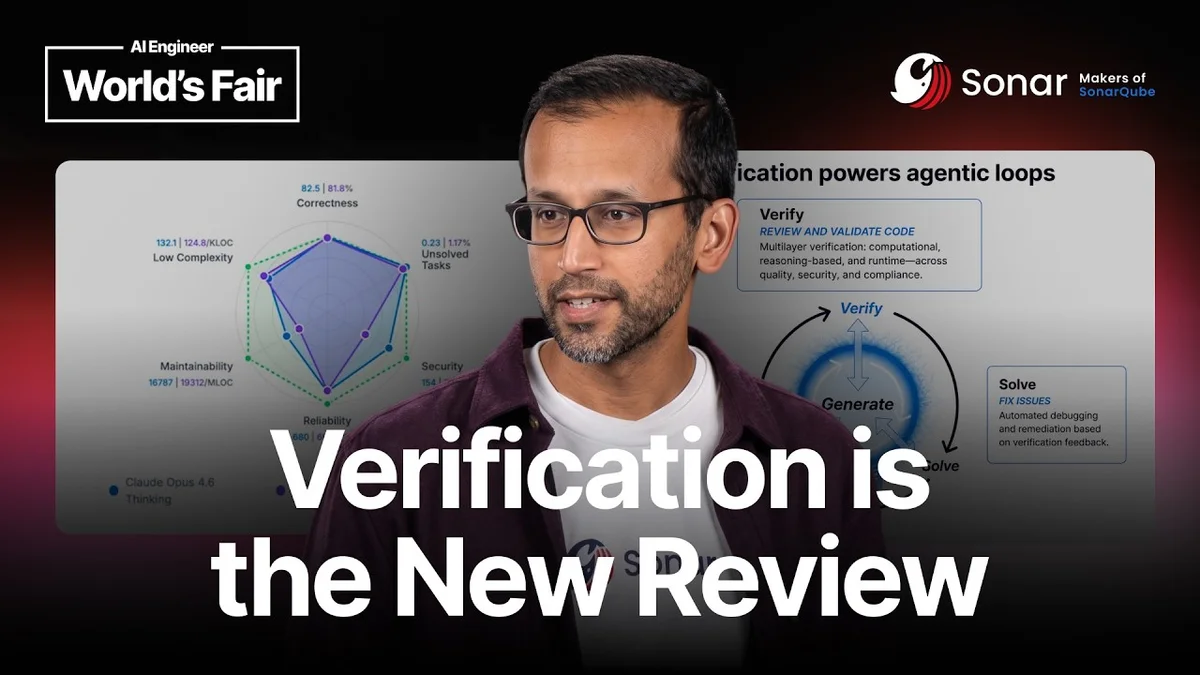
Sonar: AI Coding Needs Verification, Not Just Generation

Anirban Chatterjee of Sonar discusses the challenges and solutions for AI-driven software development, emphasizing the need for verification and governance.

Anirban Chatterjee speaking on stage about AI coding verification
AI Engineer
Visual TL;DR
AI Coding Productivity ParadoxDriver
initial productivity spike followed by decline due to increased warnings and complexity
AI Falls ShortDriver
AI tools introduce mistakes and lack crucial context for enterprise-grade software
Human Review CompromisedDriver
manual review of AI-generated code is inefficient and prone to missing issues
From the articleWhile human review is a traditional verification method, Chatterjee highlighted a Wharton study suggesting its limitations when augmented by AI.
Sonar's SolutionsCore
SonarQube, Gitarr, Sonar Vortex, and Remediation Agent for verification
From the article 5 mentionsAnirban Chatterjee, Director of Product Marketing at Sonar, spoke at the AI Engineer World's Fair, highlighting the critical need for verification and governance in the age of AI-driven software development.
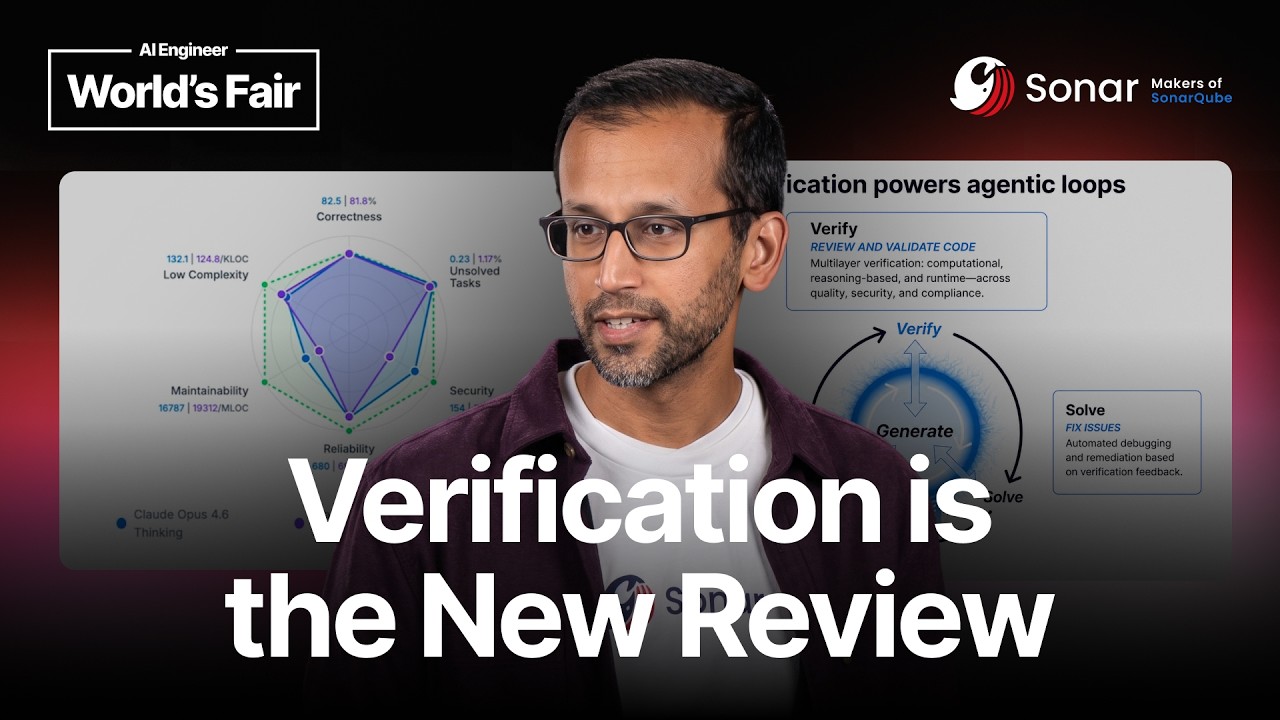
Automated VerificationEffect
tools provide continuous code quality, security, and governance for AI-generated code
From the article 9+ mentions"We need to backstop that somehow with an automated verification tool," Chatterjee asserted, underscoring the need for automated systems to ensure quality and consistency.
High-Quality SoftwareOutcome
ensuring scalable, trustworthy, and maintainable software in AI-driven development
From the article 3 mentionsHe emphasized that while AI tools can accelerate coding, they introduce risks that must be managed to ensure high-quality, scalable, and trustworthy software.
AI Needs VerificationContext
critical need for verification and governance, not just generation, in AI coding
From the article 9+ mentionsAnirban Chatterjee, Director of Product Marketing at Sonar, spoke at the AI Engineer World's Fair, highlighting the critical need for verification and governance in the age of AI-driven software development.
Contents(6)

Anirban Chatterjee, Director of Product Marketing at Sonar, spoke at the AI Engineer World's Fair, highlighting the critical need for verification and governance in the age of AI-driven software development. He emphasized that while AI tools can accelerate coding, they introduce risks that must be managed to ensure high-quality, scalable, and trustworthy software.

Sonar: AI Coding Needs Verification, Not Just Generation - AI Engineer
Sonar: AI Coding Needs Verification, Not Just Generation, AI Engineer

The Productivity Paradox of AI Coding

Chatterjee referenced a Carnegie Mellon study that analyzed GitHub projects using AI coding tools like Cursor. The study revealed a temporary spike in productivity, lasting about three months, followed by a decline. This dip was attributed to a persistent increase in static analysis warnings and code complexity, which ultimately slowed developers down.

This observation points to a crucial distinction in quality needs based on application criticality. For experimental or non-critical internal applications, the quality gap from AI tools might be acceptable. However, for enterprise-level or mission-critical systems supporting numerous users and facing potential adversarial threats, the default quality from AI is insufficient. This gap creates what Chatterjee termed "verification debt," requiring human engineers to bridge it before deployment.

Why AI Falls Short: Mistakes and Missing Context

Chatterjee explained that even advanced AI models, while capable of incredible work, are still prone to errors. "They are error-prone, and any of their mistakes could prove catastrophic for your organization," he stated. A key reason for these errors is the models' lack of contextual understanding. They don't grasp the broader codebase, business objectives, or historical context that human engineers possess.

To address this, Sonar has developed an LLM leaderboard to benchmark AI models across various coding tasks, evaluating correctness, complexity, maintainability, reliability, and security. This data helps developers understand where different models excel and where they need improvement, allowing for more informed tool selection.

Human Review: A Compromised Solution?

While human review is a traditional verification method, Chatterjee highlighted a Wharton study suggesting its limitations when augmented by AI. The study found that participants followed AI advice 92.7% of the time when it was correct, but alarmingly, they also followed incorrect AI advice nearly 80% of the time. This "cognitive surrender" is exacerbated in complex coding scenarios with multiple AI agents contributing code, overwhelming human reviewers.

"We need to backstop that somehow with an automated verification tool," Chatterjee asserted, underscoring the need for automated systems to ensure quality and consistency.

The Agent Centric Development Cycle (ACDC) Framework

Sonar's approach to this challenge is centered around the Agent Centric Development Cycle (ACDC), which involves three phases: Guide, Verify, and Solve.

  • Guide: Providing agents with context and constraints upfront to improve code quality from the start.
  • Verify: Implementing multi-layered, computational, reasoning-based, and runtime verification across quality, security, and compliance aspects.
  • Solve: Utilizing automated debugging and remediation based on verification feedback, potentially allowing agents to fix their own mistakes.

This framework ensures that AI-generated code is not only functional but also shippable and maintainable.

Sonar's Solutions: SonarQube, Gitarr, Sonar Vortex, and Remediation Agent

Chatterjee introduced SonarQube as a zero-trust, multi-layered verification platform already used by millions of developers, capable of analyzing code across various languages and identifying issues related to syntax, data flow, architecture, and control flow.

He also announced Sonar's recent acquisition of Gitarr, a company specializing in AI code review and automated CI workflows. Gitarr can automate pull request reviews, flag quality issues, suggest fixes, and even merge PRs autonomously.

Furthermore, Sonar launched Sonar Vortex, a capability that integrates LLM-based code generation with real-time, in-loop verification. This allows agents to identify and fix issues as they write code, preventing propagation. The Remediation Agent was also highlighted as a tool to autonomously address technical debt and legacy code, freeing up developers for innovation.

Key Takeaways for AI-Driven Development

Chatterjee concluded with four key takeaways for organizations embracing AI in software development:

  1. Establish bounded autonomy guidelines: Grant agents freedom to generate code but enforce centralized verification and constraints.
  2. Implement the ACDC cycle: Provide context, verify with independent metrics, and enable agents to solve their own mistakes.
  3. Equip developers with orchestration tools: Focus on reviewing AI code and designing context frameworks as valuable activities.
  4. Standardize on a single verification platform: Eliminate blind spots and ensure consistent quality gates across all projects, teams, and AI coding tools.
© 2026 StartupHub.ai. All rights reserved. You may not republish this article in full without a license. Search engines and AI research tools may crawl and summarize for reference. Bulk reproduction or model training requires a license. See our terms.
Daniel Singer

Written by

Daniel Singer

Editor, StartupHub.ai

Daniel Singer is the editor of StartupHub.ai, a technology expert and thought leader on AI and its applications across sectors, from fintech and healthcare to developer tooling and consumer software. He writes and tests the tools covered here thoroughly and regularly, and built StartupHub.ai to give founders, operators and buyers a clearer read on what they are actually being sold.