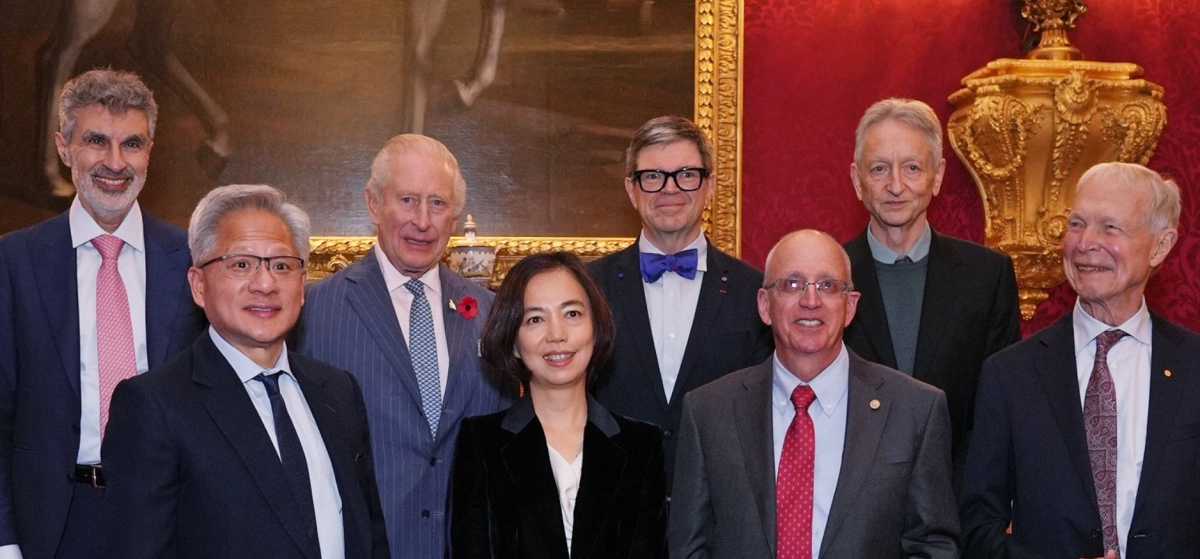
The Queen Elizabeth Prize for Engineering, often dubbed the "Nobel Prize for Engineering," has been awarded to seven pivotal figures whose work collectively underpins the modern artificial intelligence revolution. This year's Queen Elizabeth Prize AI recognizes the architects of machine learning, from foundational algorithms to the hardware and data that make today's AI systems possible.
The recipients, Yoshua Bengio, Bill Dally, Geoffrey Hinton, John Hopfield, Jensen Huang, Yann LeCun, and Fei-Fei Li, represent a cross-section of innovation that has transformed how machines learn, perceive, and interact with the world. Their combined efforts have moved AI from theoretical concepts to practical applications that are now embedded in everything from our smartphones to scientific discovery.
At the heart of this recognition are the conceptual breakthroughs in artificial neural networks. Professors Yoshua Bengio, Geoffrey Hinton, John Hopfield, and Dr. Yann LeCun have long championed these brain-inspired models, establishing the algorithmic bedrock that is now the dominant paradigm in machine learning. Their relentless pursuit of these complex systems laid the groundwork for deep learning, enabling AI to tackle problems once thought intractable. As Dr. Yann LeCun, a recipient and Meta's Chief AI Scientist, shared, "Very honoured to receive the Queen Elizabeth Prize for Engineering from HM King Charles III, along with Yoshua Bengio, Bill Dally, Geoffrey Hinton, John Hopfield, Jensen Huang, and Fei-Fei Li. As an engineer as well as a scientist, receiving what has been described as 'the Nobel Prize for Engineering' is an incredible honor."
Today, The King presented The Queen Elizabeth Prize for Engineering at St James's Palace, celebrating the innovations which are transforming our world.
, The Royal Family (@RoyalFamily) November 5, 2025
🧠 This year’s prize honours seven pioneers whose work has shaped modern artificial intelligence.
🔗 Find out more:… pic.twitter.com/EyqTjPSazi
But algorithms alone don't power an AI revolution. The sheer computational demands of modern machine learning require immense processing power, a challenge met by Jensen Huang, CEO of NVIDIA, and Dr. Bill Dally. Their leadership in developing Graphics Processing Units (GPUs) and subsequent architectural advances transformed these components from gaming hardware into the indispensable engines of AI. Without their vision, the scaling of neural networks to process vast datasets would have remained largely theoretical, severely limiting the practical application of AI.
The Data That Fuels AI's Fire
Equally critical to AI's ascent is the availability of high-quality, large-scale datasets. Dr. Fei-Fei Li's pioneering work in this area, most notably the creation of ImageNet, proved instrumental. ImageNet, a massive database of millions of labeled images, provided the crucial training and benchmarking resource that allowed computer vision algorithms to learn and improve at an unprecedented rate. Her emphasis on data as a foundational element for machine learning enabled models to generalize and perform complex tasks, accelerating progress across the entire field.