


Samuel Colvin, CEO and founder of Pydantic, recently joined the Latent Space podcast to discuss the intricacies of building LLM agents, emphasizing the crucial role of type safety and well-defined APIs in achieving reliable and efficient execution.
Introducing Samuel Colvin and Pydantic AI
Samuel Colvin is a prominent figure in the Python ecosystem, renowned for his work on Pydantic, a data validation library that leverages Python type hints. Pydantic has become a cornerstone for many developers building data-intensive applications, offering a robust and developer-friendly way to ensure data integrity. As the CEO and founder of Pydantic AI, Colvin is now applying these principles to the burgeoning field of LLM agents, aiming to bring the same level of structure and reliability to AI-driven workflows.
The LLM Agent Landscape: Challenges and Opportunities
Colvin began by acknowledging the rapid advancements in the LLM space, noting the increasing interest in agents that can interact with external tools and perform complex tasks. He highlighted that while LLMs are powerful at generating code and understanding natural language, translating that into reliable agent behavior requires careful engineering. The conversation focused on several key areas:
Code Execution Environments for LLM Agents
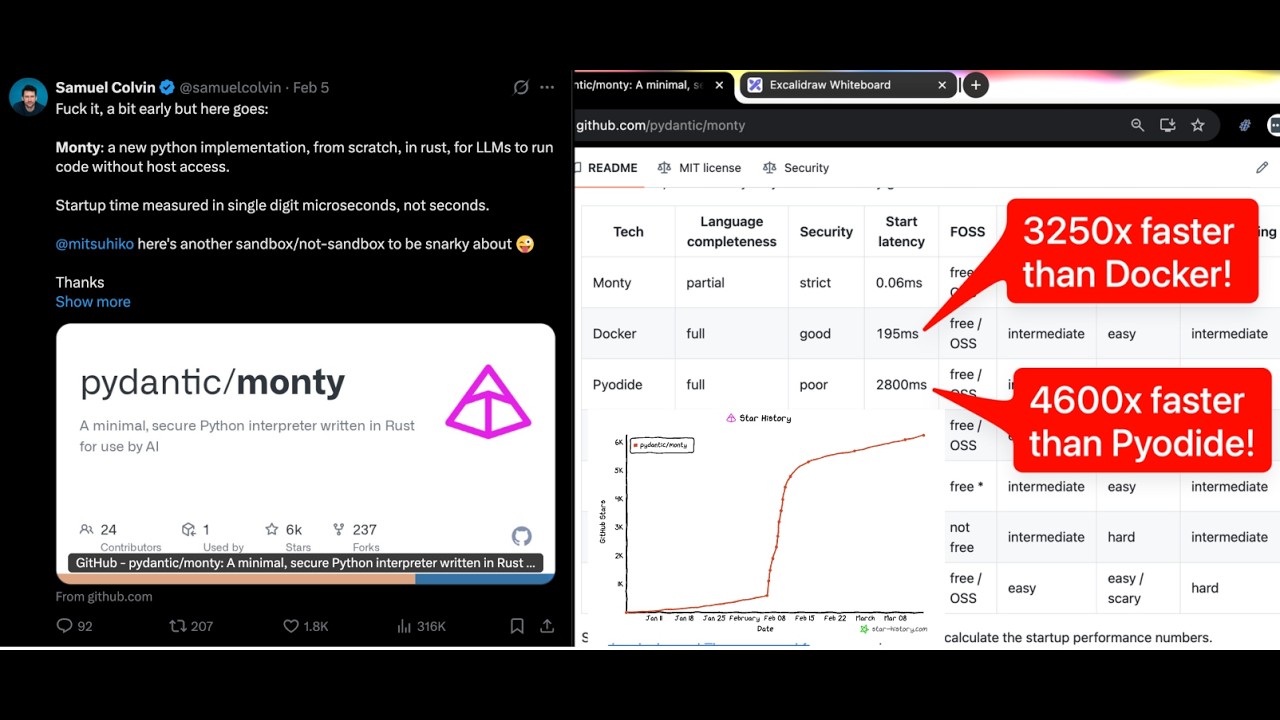
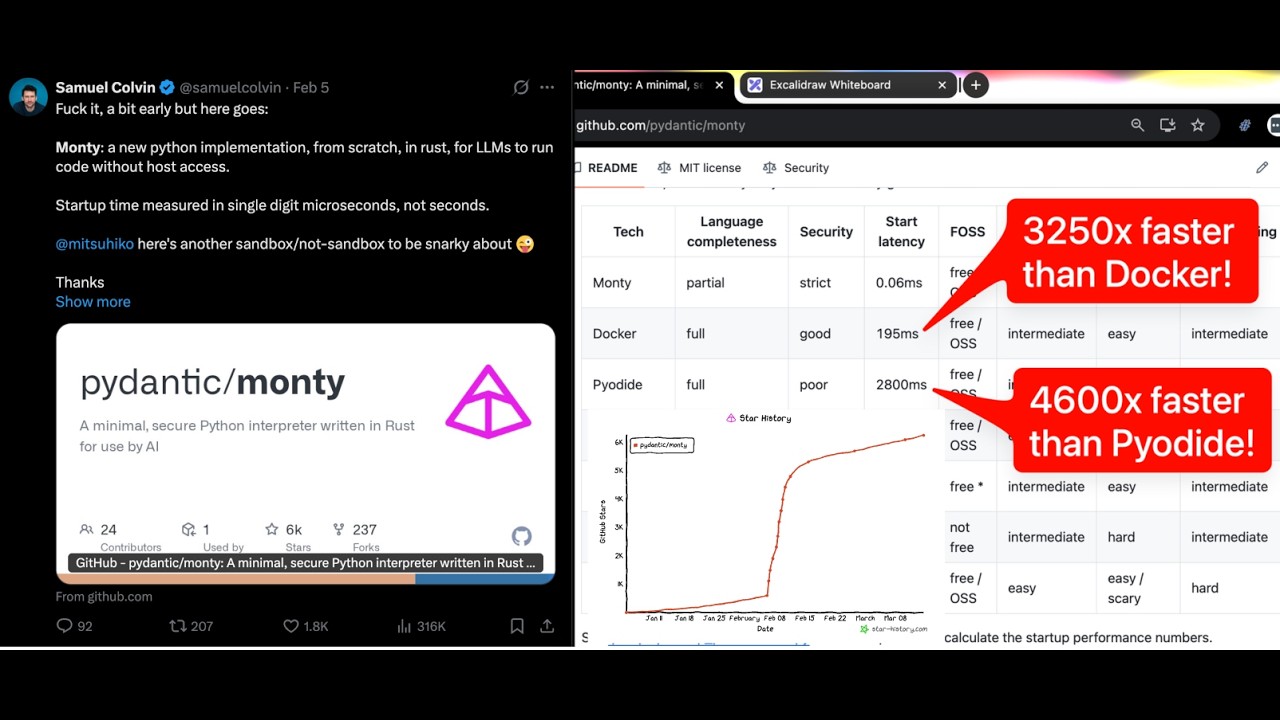
A significant portion of the discussion revolved around the different environments available for executing code generated by LLMs. Colvin presented a comparative analysis of several options, including:
- Monty: Described as a partial solution with strict security controls and efficient startup times, but limited library support.
- Docker: A more comprehensive solution offering full language completeness and strong security, but with higher startup latency and complexity.
- Pyodide: While offering full Python compatibility compiled to WebAssembly, it suffers from poor security and slow startup times.
- starbark-rust: Characterized by a configuration language rather than Python, with limited language completeness and good security.
- WASM/Wasmer: Offers partial language completeness and strict security, with moderate latency and setup complexity.
- Sandboxing Service: A full solution with strict security but high setup complexity and latency.
- YOLO Python: Noted for its speed and ease of setup, but with non-existent security and difficult file mounting.
Colvin emphasized that the choice of environment depends heavily on the specific use case, balancing factors like security, latency, language support, and ease of use. He pointed out that Pydantic AI's own solution, 'Monty,' aims to strike a balance, offering a performant and secure way to run LLM-generated code without the overhead of heavier solutions like Docker.