

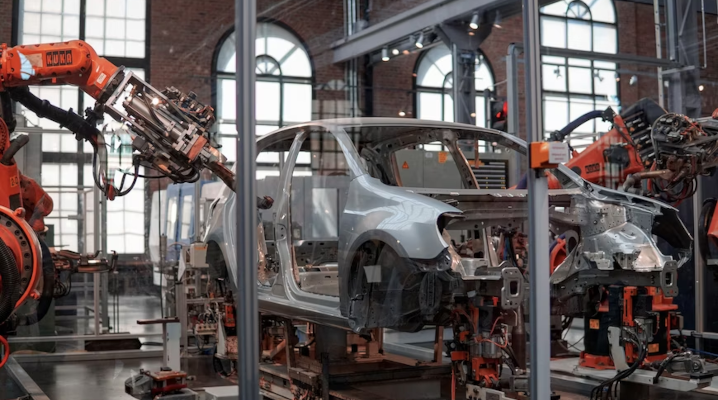
Three companies named "Physics AI" the same week and raised $15.8 billion between them

Prometheus, PhysicsX, and Mistral each independently reached for the same new term in the same week -- and collectively raised $15.8B. Plus: the AI IPO wave nobody noticed.

Prometheus AI industrial engineering lab, Jeff Bezos, raises $12 billion Series B
Prometheus, the industrial AI startup backed by Jeff Bezos, raised $12B Series B at a $41B valuation in June 2026. Image: SiliconAngle

When an investor at one company's pitch uses a phrase you've never heard before, it's a curiosity. When three separate companies in the same week each independently reach for exactly the same phrase to describe what they're building, that's a category being born.

This week, Prometheus (Jeff Bezos, $12B Series B), PhysicsX ($300M Series C), and Mistral AI ($3.5B in new capital) each described their work using a term that barely registered in the startup lexicon six months ago: "physics AI." Not "industrial AI" -- a phrase that has been kicking around for a decade. Not "manufacturing automation." Physics AI: the specific claim that the AI system understands the underlying physical laws governing how things break, heat up, deform, or fail, rather than pattern-matching on historical outputs.

Collectively those three raises represent $15.8 billion deployed in seven days. That's not a coincidence of timing. It's a category crystallizing in real time, while a parallel story -- one of the busiest IPO weeks in tech since 2021 -- played out almost entirely beneath the algorithm's radar.

Related startups

The numbers

Metric Week of June 8 Week of June 1 Change
Total rounds 75 111 -32%
Total capital deployed $54.8B $86.3B -36%
Median check size $30M $20M +50%
Largest single round $12B (Prometheus) Not disclosed --
AI-related capital share ~84% ~85% Stable

The top-line looks like a down week. But the compression happened entirely at the low end. The 50% jump in median check size -- from $20M to $30M -- means larger bets are holding firm while seed and pre-seed slowed. There were six seed rounds and six pre-seed rounds this week totaling roughly $53M combined. The prior week had more activity in those ranges. Investors are not pulling back broadly; they're being more selective about what gets a first check.

An industrial engineering thesis worth $15.8 billion

PhysicsX announced its $300M Series C on June 8, led by Temasek, with Siemens, NVIDIA, Applied Materials, and General Catalyst participating. The company is building what it calls "Large Physics Models" -- the physics equivalent of an LLM, pretrained on the underlying math of materials science, thermodynamics, and fluid dynamics rather than human-generated text. Its pitch to industrial engineers: simulations that currently take weeks now take hours. Revenue doubled year-over-year; the customer count tripled in 12 months.

Two days later, Prometheus announced its $12B Series B at a $41B valuation -- a company with roughly 150 employees across San Francisco, London, and Zurich, co-led by Jeff Bezos and Stanford scientist Vik Bajaj. The company's stated goal is the creation of an "artificial general engineer" -- a system capable of taking a complex physical product, like a jet engine, from concept through production. JPMorgan, BlackRock, Goldman Sachs, DST Global, and Arch Venture Partners wrote the checks. Combined with its $6.2B launch round last year, Prometheus has now raised $18B total.

Then on June 12, Mistral AI leaked terms for a €3B ($3.5B) fundraise that SiliconAngle specifically noted was happening "amid a physics AI push." Mistral plans to develop AI products specifically for industrial engineers, and may open-source some of its planned physics AI models. The round would value Mistral at approximately €20B -- nearly double its previous €11.7B valuation.

The unified thesis across all three: the next major frontier in AI value creation isn't generating text or images, but giving AI systems a deep enough grasp of physical causality that they can do engineering work. The problem is that engineering knowledge doesn't exist in cleanly structured form in public text corpora. Training requires simulation outputs, sensor readings, CAD files, and materials databases -- which is why this is a genuinely distinct bet from generative AI, not just a rebrand. Note what's absent from all three announcements: manufacturing robotics. These are design and engineering intelligence tools, targeting the human engineers who design the things that robots will eventually build.

France's surge and Mistral's pivot

Country capital allocation shifted sharply this week. France captured $7.9B -- up from $195M the prior week, a 40x jump driven almost entirely by Mistral. The US held at roughly $40B. China dropped from $7.4B to $3B, represented by Moonshot AI's $2B raise at a $30B valuation. Germany rose from $817M to $1.7B on the back of Neura Robotics.

Mistral's reframe matters beyond the raw funding number. The company began as a French counterweight to OpenAI -- similar architecture, more open-source philosophy, European headquarters. Its early public positioning was about AI sovereignty: European companies should have a European frontier lab to rely on. That framing attracted early checks at a €2B valuation in 2023 and worked well enough to sustain three years of growth.

Three years later, the sovereignty pitch is table stakes in European AI. Multiple European frontier labs now exist. Mistral's new industrial-engineering angle -- positioning toward the same territory PhysicsX occupies -- is a narrowing of focus into space where European industrial incumbents (Airbus, Safran, Siemens, Renault) are natural and accessible enterprise customers. Temasek, who led PhysicsX's round, is also reportedly among Mistral's new investors. The overlap is not accidental.

The IPO gate cracked open

The exit side of this week was equally remarkable and received far less attention than it deserved. At least eight companies reached or filed for public markets between June 8 and June 15:

  • EngineAI filed confidentially for a Hong Kong IPO. The Shenzhen humanoid robot maker opened its 12,000-square-metre factory on June 1, with a production line turning out one T800 robot every 15 minutes. Unitree, which filed for a $7B IPO separately, is close behind.
  • Enflame Technology (Chinese AI chip company, Shanghai-listed) IPO June 15.
  • MetaX Integrated Circuits (Chinese AI chip company) IPO June 12 in Hong Kong.
  • Einride (Swedish autonomous electric trucks) went public June 10.
  • Bending Spoons (Italian SaaS consolidator) listed June 8.
  • Zepto (Indian quick-commerce) listed June 8.
  • Patsnap (IP analytics) listed June 15.
  • Xiaohongshu (China's "Little Red Book") set for June 30 listing.

The most-discussed "IPO" of the week -- Cursor, the AI coding assistant that crossed $2B ARR in February -- isn't actually going public independently. SpaceX is acquiring it for $60B, tied to SpaceX's own forthcoming IPO. Cursor's ARR trajectory ($500M in June 2025, $1B by November, $2B by February 2026) made it effectively too valuable to list at startup-scale; the acquisition creates a massive line item for SpaceX's public offering instead. OpenAI separately acquired Ona (formerly Gitpod), a German cloud startup that provides persistent sandbox environments for AI agents -- specifically to let Codex agents keep running when developers close their laptops.

The two Chinese AI chip company IPOs -- Enflame and MetaX -- deserve separate attention. Both are serious domestic challengers to NVIDIA's dominance in AI accelerators. Their simultaneous Hong Kong listings suggest a window: US export controls on advanced chips remain in flux, Chinese capital markets are absorbing AI stories aggressively, and both companies have now reached the scale needed for a credible public story. If both list successfully at meaningful valuations, it establishes a funding path for China's remaining AI semiconductor companies currently stuck in late-stage private rounds.

What the $24M Jedify round reveals about where enterprise AI is actually stuck

Strip away the mega-rounds this week and look at where the smaller checks went. Three separate companies raised on a thesis that could be summarized as: raw agent capability isn't the enterprise bottleneck anymore -- reliability is.

Jedify raised $24M to give AI agents "business context" -- structured knowledge about how a specific company's processes, products, and customers work, so agents don't fail on task-specific edge cases that aren't in the general training distribution. ChatSee raised $6.5M specifically to build "failure memory" for enterprise AI agents: when an agent fails at a task, the system diagnoses why and prevents the same failure class in future runs. RelAI raised $6.9M for "verifiable continuous learning" -- agents that improve over time in an auditable way.

Together with OpenAI's Ona acquisition and PhoenixAI's $80M raise for an "agentic AI-ready database," these moves form a consistent pattern. Enterprises have begun deploying AI agents at meaningful scale and discovered that the failure modes are unglamorous: agents hallucinate context they don't have, fail on tasks they've done before because they carry no memory of prior failure, and stop working when they lose a cloud connection. The reliability-layer thesis -- that the persistent infrastructure around agents will be worth more than the agent runtime itself -- is now being funded at multiple points across the stack simultaneously.

Robots with wallets: the Neura Robotics round is stranger than it looks

Neura Robotics raised $1.4B -- Europe's largest-ever humanoid robotics round -- from a set of investors that doesn't fit any conventional template: Tether Holdings (the stablecoin issuer), NVIDIA, Amazon, Qualcomm, Bosch, and Schaeffler. The $7B post-money valuation makes Neura the only European humanoid company in the upper tier of the global race. Standard Bots raised a separate $200M specifically to manufacture robots in the US, explicitly positioning against China supply chain risk.

The Tether involvement is the most unusual piece. Stablecoin issuers do not normally lead Series C rounds in robotics companies. Tether's stated plan is to give each Neura robot a digital wallet so it can be "paid for work and make electronic payments autonomously." Neura is targeting 5 million humanoid robots by 2030. If taken seriously, that's 5 million Tether-linked wallets requiring ongoing USDT liquidity -- making this less a robotics investment and more an infrastructure bet on the thesis that robots will function as economic agents in a tokenized labor market. Whether or not that thesis proves sound, it's the first time a major stablecoin issuer has made a direct equity bet on the physical AI stack. It won't be the last.

Separately, Addverb -- an Indian robotics company backed by Mukesh Ambani's Reliance -- raised $100M to compete directly with Chinese warehouse automation suppliers. The US-India-Germany triangle forming in humanoid and industrial robotics is a structural response to the concentration of manufacturing robotics IP in China and Japan.

Microtrends worth watching

  • Legal AI is sprinting quietly. Sandstone raised $30M for in-house corporate legal teams, Courtroom emerged from stealth with a pre-seed for AI jury simulation in trial prep, and Duely raised €1.1M for AI-driven M&A legal services. Three independent bets on narrow legal workflows in a single week suggests the broad "legal AI" category is fragmenting into specific tooling, which is typically what happens just before a wave of acquisitions by larger legal software companies.
  • AMD compute is becoming a real thesis, not just a hedge. TensorWave raised $350M Series B at a $1.55B valuation to build global AMD GPU-based AI compute infrastructure. The explicit "AMD-powered" positioning is a direct bet that NVIDIA's pricing power will drive enterprise buyers toward alternatives. This is the largest AMD-infrastructure round we've seen; whether the thesis holds depends on AMD's H300/MI400 roadmap execution.
  • AI for insurance underwriting is converging. Parsewise (document processing for underwriting decisions), Happiness Insurance (AI-driven parametric insurance), and Tesora (actuarial workbenches for P&C carriers) all appeared in new startup registrations this week. Three teams independently arriving at insurance underwriting as the target vertical is a reliable early signal of a market heating up below the visibility threshold.

What might happen next week

Two specific predictions, each of which could be wrong:

Prediction one: Mistral will announce a named "Large Physics Model" product within 60 days. The timing of their raise -- alongside PhysicsX closing its Series C and Prometheus publicly announcing its AGE framing -- is too coordinated to be coincidental. Mistral's past pattern is to release model announcements close behind fundraising news, and "physics AI" models would give them a clean differentiation story from OpenAI and Anthropic that the general-purpose generative AI market doesn't provide.

Prediction two: A second Chinese humanoid robot company will file for a Hong Kong or US IPO before the end of July. EngineAI's confidential filing appears to have been the signal others were waiting for. Unitree has already been reported as preparing documentation; at least two other Shenzhen-based humanoid manufacturers have achieved the scale necessary for a credible listing story. The window is open. They will move through it.

Sources

© 2026 StartupHub.ai. All rights reserved. Do not enter, scrape, copy, reproduce, or republish this article in whole or in part. Use as input to AI training, fine-tuning, retrieval-augmented generation, or any machine-learning system is prohibited without written license. Substantially-similar derivative works will be pursued to the fullest extent of applicable copyright, database, and computer-misuse laws. See our terms.