


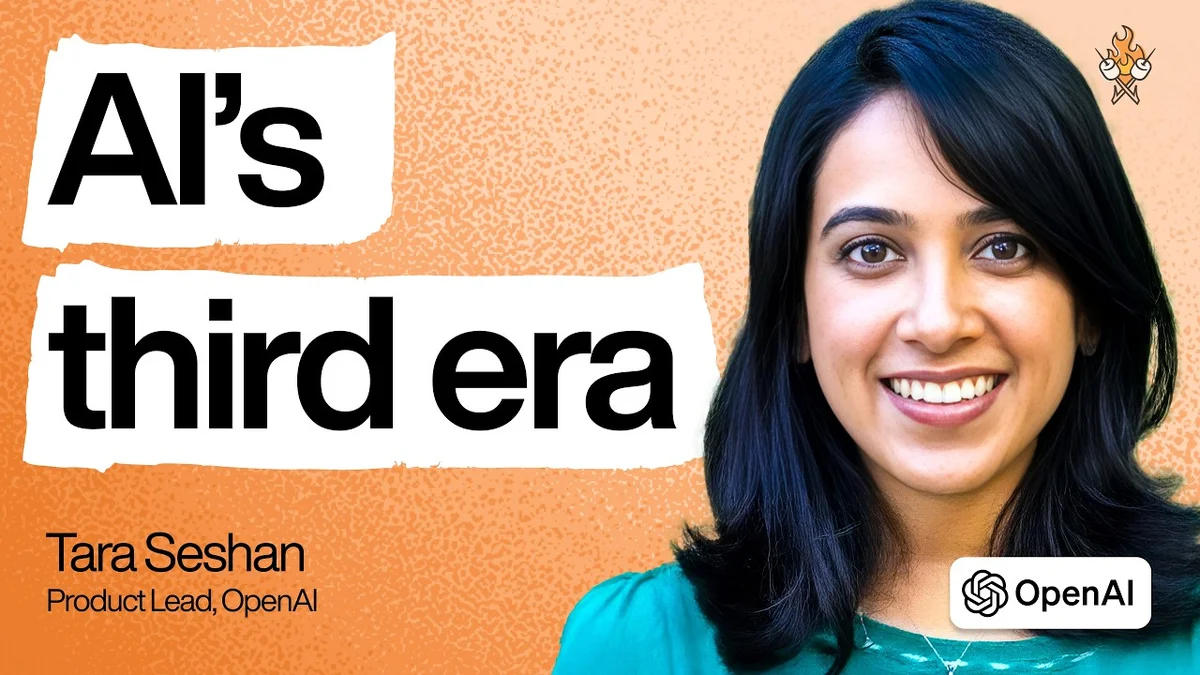
Persistent AI Coworkers Are OpenAI's Third Era

OpenAI's Tara Seshan says persistent AI coworkers follow chat and agents, with products built for models 2-3 months ahead.

8 min read
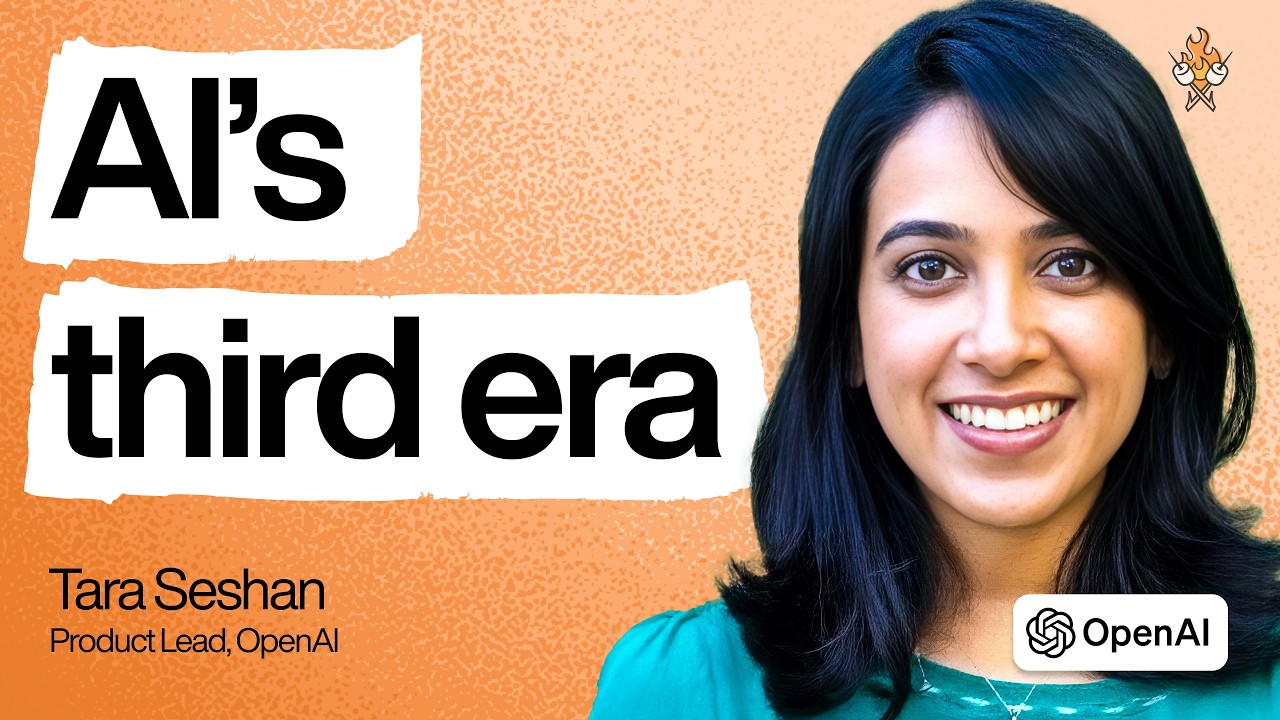
OpenAI product lead Tara Seshan discusses persistent AI coworkers on Lenny's Podcast
Tara Seshan on Codex, ChatGPT Work, and the 2 to 3 month build horizon· Lenny's Podcast
Visual TL;DR
Era 1: ChatContext
openai's first era of consumer products was simple chat interfaces
From the article 6 mentionsPersistent AI coworkers are OpenAI's third era after chat and agents, product lead Tara Seshan told Lenny's Podcast.
Tara SeshanCore
leads codex and chatgpt work, openai's fastest growing product
From the article 9+ mentionsPersistent AI coworkers are OpenAI's third era after chat and agents, product lead Tara Seshan told Lenny's Podcast.
Era 2: AgentsContext
second era introduced agents working alongside users on tasks
From the article 9+ mentionsSeshan frames era one as chat and era two as agents working with users.
Era 3: CoworkersContext
persistent ai coworkers collaborate over longer shared loops
From the article 5 mentionsEra three is a persistent coworker that gets work done with you, collaboratively and over time.
Era 1: ChatContext
openai's first era of consumer products was simple chat interfaces
From the article 6 mentionsPersistent AI coworkers are OpenAI's third era after chat and agents, product lead Tara Seshan told Lenny's Podcast.
Tara SeshanCore
leads codex and chatgpt work, openai's fastest growing product
From the article 9+ mentionsPersistent AI coworkers are OpenAI's third era after chat and agents, product lead Tara Seshan told Lenny's Podcast.
Era 2: AgentsContext
second era introduced agents working alongside users on tasks
From the article 9+ mentionsSeshan frames era one as chat and era two as agents working with users.
Build 2-3 Months AheadDriver
seshan designs products assuming next model capability jump
From the articleThe only way to build is for two to three months out, tight to research, with the model as the center of the product.
Era 3: CoworkersContext
persistent ai coworkers collaborate over longer shared loops
From the article 5 mentionsEra three is a persistent coworker that gets work done with you, collaboratively and over time.
PM Mindset ShiftOutcome
product managers now plan for models not yet shipped
Steer, Not RowContext
agents act more like teammates helping steer direction together
From the articleThe next interface is multiplayer, where groups of humans steer groups of agents together with shared data access.
Multiplayer WorkEffect
shared context across multiple people on the same agent
From the article 9+ mentionsWatch for multiplayer agent primitives, shared memory, and enterprise connectors that make cloud agents truly useful for finance, operations, and research teams.
Contents(16)

Persistent AI coworkers are OpenAI's third era after chat and agents, product lead Tara Seshan told Lenny's Podcast.

Persistent AI Coworkers Are OpenAI's Third Era - Lenny's Podcast
Persistent AI Coworkers Are OpenAI's Third Era, from Lenny's Podcast

She leads Codex and ChatGPT Work, the company's fastest growing product for knowledge workers.

What is the third era?

Seshan frames era one as chat and era two as agents working with users.

Era three is a persistent coworker that gets work done with you, collaboratively and over time.

That means agents that feel like teammates, with shared context, longer loops, and joint steering across people.

Who is Tara Seshan and why does her view matter?

Seshan spent six years at Stripe as one of its first five product managers and was repeatedly ranked in Stripe's top three.

She later led product at Watershed, founded a company, was a Thiel Fellow, and was a Lenny's Newsletter Fellow.

At OpenAI she works alongside engineering manager Andrew Amberino and owns two surfaces that define how knowledge work ships inside ChatGPT.

Why build for two to three months ahead?

Seshan said you fail if you build for where models are now and you fail if you build for where they will be in a year.

The only way to build is for two to three months out, tight to research, with the model as the center of the product.

That tight coupling shows in how she describes roadmap alignment with researchers on specific capabilities like coding and writing.

What changed in product management?

In slower markets, rigorous strategy docs predicted competitor moves and won.

In this market, being prolific and empirical beats being academic or theoretical.

The core PM job narrows to sharp hypothesis definition, fast tests with users, and feeding results back into the loop.

Steering versus rowing

Seshan describes future work as steering, not rowing, where agents do the rowing and people set direction.

Abstraction rises from tab completion to goal level direction and then higher, but humans still make the opinionated call.

That opinion is the differentiator when everyone has the same tools, much like authorship in film.

From solo agents to multiplayer work

Most work today is one human with one agent and spawned subagents.

Internally teams were sharing Codex thread screenshots on Slack to prove how a number was reached.

The next interface is multiplayer, where groups of humans steer groups of agents together with shared data access.

Codex, ChatGPT, and Work mode explained

Seshan laid out three modes today: Chat mode for search and conversation, Work mode for knowledge work, and Codex mode for development.

Work mode is Codex under the hood with the coding UI removed, so worktrees and chain of thought detail are hidden.

The north star is no toggles at all, where the system picks the right harness and model from a single prompt.

Ship utility, then polish

For a billion monthly ChatGPT users, OpenAI chose to ship Work inside chat on web and desktop rather than wait for polish.

Seshan said done is better than perfect when conviction is high that agents transform work, and iteration after launch beats waiting.

Decomplexifying harnesses and model choices matters more to adoption than pixel perfection at this stage.

Why vibes shifted toward Codex

Seshan credited no strategy change for Codex momentum, only the same loop: dogfood, or mainline, the app all day and listen.

The team that built the desktop experience fixed their own pain and shipped, and external perception caught up later.

She framed that as humans, not models, driving quality through obsession with user signals.

What actually blocks persistent agents?

Intelligence gains matter, but Seshan stressed prosaic blockers like local data access and cloud infrastructure.

An isolated cloud agent without Google Docs, Slack, and databases is as limited as a new hire locked in a room.

Reliability and system access determine end effectiveness as much as longer context or stronger reasoning.

The ambition imperative

With rote tasks automated, ambition becomes the scarce input.

Seshan said the best users expand what is in range and then realize more of what is in their heads, like the old unicorn PM who could code, design and price.

PM craft now includes elevating others' ambition and reminding teams the ceiling is meaningfully higher.

Memes that run product

Three phrases shape shipping: is this maximally accelerated, are you mainlining it yet, and feeling the AGI.

Mainlining replaces dogfooding and means using the product to do real work all day and bringing taste to the feedback.

Feeling the AGI keeps the mission present in product decisions without pretending a secret master plan exists in a locked room.

Culture without a playbook

Seshan expected a treasure trove of secret strategy on arrival and found the opposite.

OpenAI is founder like, with very limited top down direction and thin distance between product teams and the market.

That founder distance to users speeds the cycle where ideas become public product or public messaging within weeks.

Why this matters

If work becomes steering fleets of persistent agents, the interface winners are those that solve collaboration, permissions, and provenance across many agents at once.

Incumbents with distribution like ChatGPT can push agents to a billion users in one move, while developer led tools must win on depth and trust with engineers.

The 2 to 3 month horizon also reorders roadmap bets, favoring teams that can ship, measure, and rewrite quickly over those that bet on a 12 month plan.

How OpenAI compares

StartupHub.ai data shows OpenAI raised $100B in 2026 at a post-money valuation of $850B.

That scale separates it from tracked peers Anthropic, Alphabet Inc. (NASDAQ:GOOGL) DeepMind, You, Prometheus, SpaceXAI and Imbue, where capital and distribution shape how fast persistent coworker experiences can spread.

Even with that scale, Seshan argues advantage still rests on taste, speed, and daily use, not just model IQ.

What to watch next

Watch whether Work collapses into ChatGPT as a single box that chooses harness and model automatically.

Watch for multiplayer agent primitives, shared memory, and enterprise connectors that make cloud agents truly useful for finance, operations, and research teams.

If those ship before competitors normalize them, the third era stops being a demo and starts being how teams actually work.

© 2026 StartupHub.ai. All rights reserved. Do not enter, scrape, copy, reproduce, or republish this article in whole or in part. Use as input to AI training, fine-tuning, retrieval-augmented generation, or any machine-learning system is prohibited without written license. Substantially-similar derivative works will be pursued to the fullest extent of applicable copyright, database, and computer-misuse laws. See our terms.