

OpenAI's Ryan Lopopolo on Harnessing AI for Software Engineering

OpenAI's Ryan Lopopolo discusses how AI agents are reshaping software engineering, emphasizing the shift towards human oversight and strategic prompt design.

4 min read
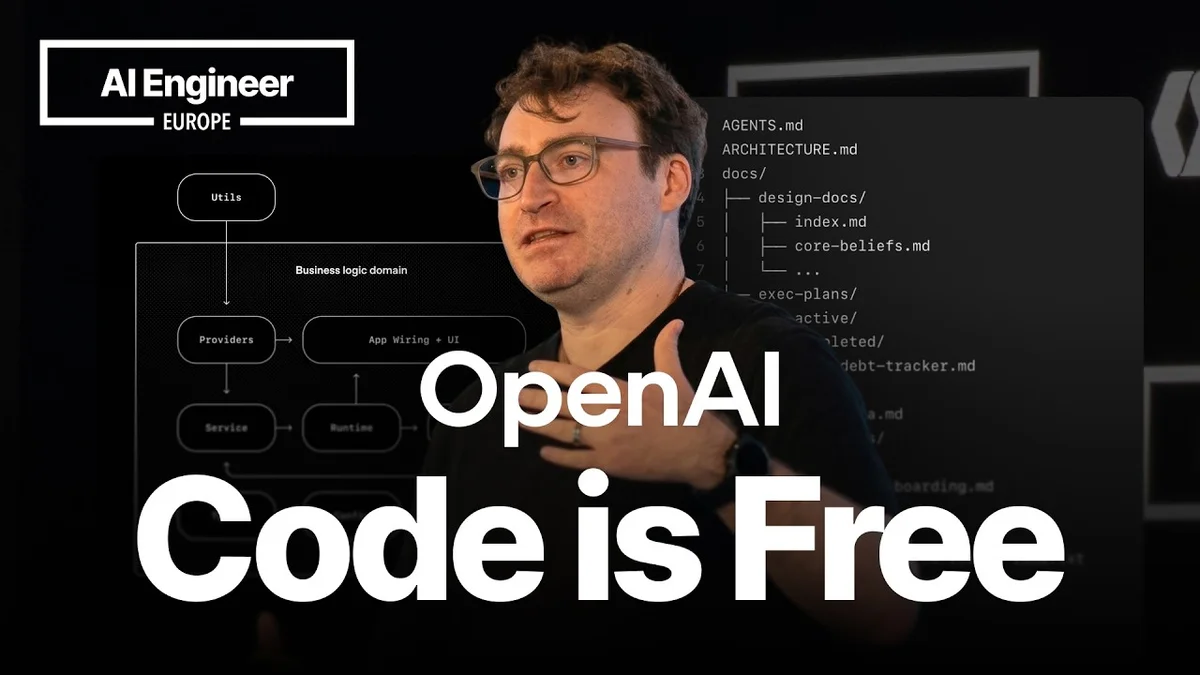
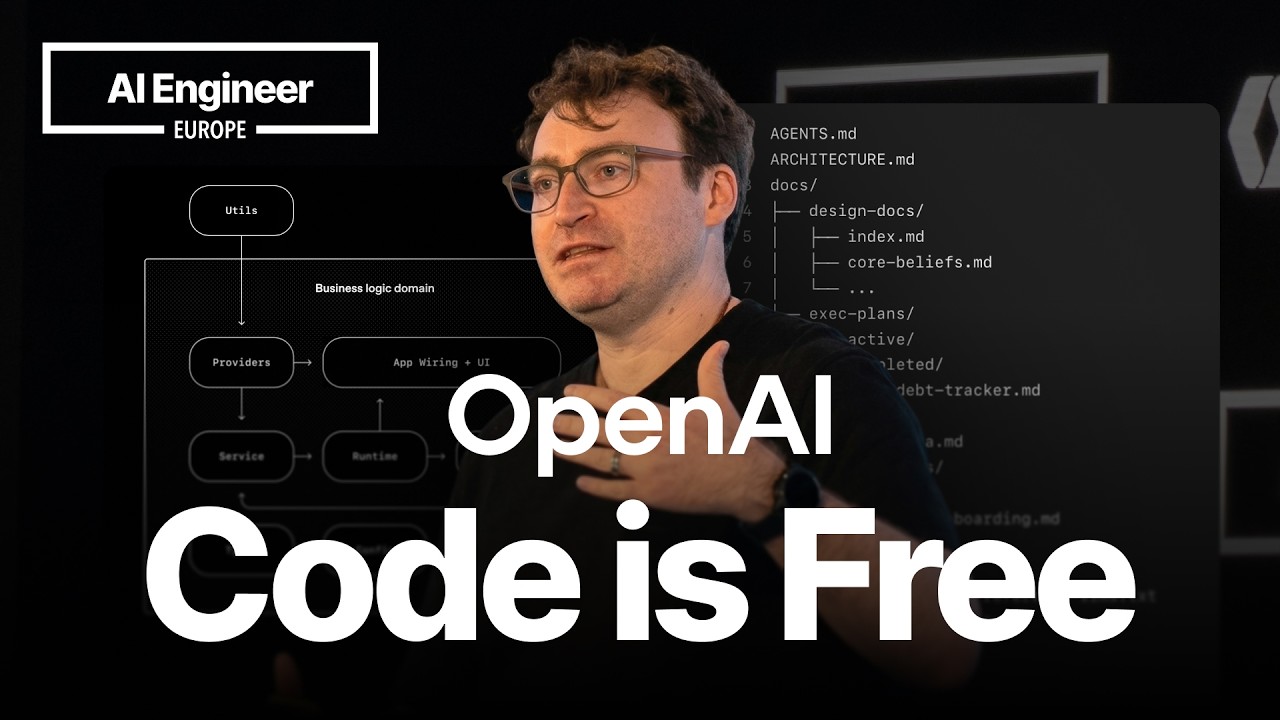
Ryan Lopopolo of OpenAI on stage discussing AI agent software engineering
Image credit: AI Engineer Europe· AI Engineer

In a pivotal moment for the AI development community, Ryan Lopopolo, a Member of Technical Staff at OpenAI, took the stage at the AI Engineer Europe conference to discuss a paradigm shift in how software is created. Lopopolo, who has been instrumental in building AI agents at OpenAI, shared insights into the evolving role of engineers in an era where AI agents are increasingly capable of handling complex tasks.
OpenAI's Ryan Lopopolo on Harnessing AI for Software Engineering - AI Engineer
OpenAI's Ryan Lopopolo on Harnessing AI for Software Engineering — from AI Engineer

Harnessing Engineering: A New Era

Lopopolo began by stating a bold thesis: "The way we build software has changed." He elaborated that in the past six months alone, AI agents have demonstrated a remarkable ability to take over tasks previously thought to be exclusively human domains, advancing at a rapid pace. This evolution means that the core constraints are no longer the models themselves, but rather the human resources and the available context windows.

He highlighted that the modern AI engineer's role has shifted from writing code directly to strategically guiding and unblocking these powerful agents. "Your role is to unblock your team," Lopopolo emphasized, suggesting that engineers are now tasked with the crucial responsibility of ensuring AI agents can perform their functions efficiently and reliably. The key, he explained, is to "productively deploy these resources into our code and into our teams."

Related startups

The Three Pillars of Change

Lopopolo outlined three core reasons for this transformation, all occurring in late 2024:

  • The models are good enough: Advanced AI models have reached a level of capability where they can perform many software engineering tasks autonomously.
  • Code is free: The abundance of code and the ability of AI to generate it has made code itself a less scarce resource.
  • Your role is to unblock your team: The critical human contribution now lies in strategic guidance, problem-solving, and ensuring the effective integration and operation of AI agents.

He noted that the emergence of GPT-4.5 Turbo was a significant milestone, enabling AI agents to perform the full scope of software engineering tasks with high reliability and over extended time horizons. This shift means that the scarcity is no longer in the code itself, but in the human elements: time and attention.

Redefining the AI Engineer's Role

Lopopolo stressed that in a world where human time is scarce, engineers must focus on maximizing their leverage. This involves a shift from manual coding to a more strategic approach: "We need to make them legible to the agents that are driving the implementation," he stated. The goal is to create systems where agents can be steered effectively, leading to more predictable and reliable outcomes.

He shared his personal experience at OpenAI, where his team has been building agents for the past nine months. This work has led to a deeper understanding of how to "operationalize the way you work, the code you live in, and the processes on your teams." The core idea is to move from a model where implementation is the bottleneck to one where the human engineer acts as a strategic director, orchestrating the capabilities of AI agents.

Key Challenges and Opportunities

Lopopolo identified three key resources that are now the most critical in this new paradigm:

  • Human time: The finite nature of human availability is the primary constraint.
  • Human and model attention: Capturing and directing the focus of both humans and AI agents is paramount.
  • Model context window: The amount of information a model can process at once remains a crucial factor in its effectiveness.

He posited that the true challenge for engineers is to learn how to "productively automate it and move that synchronous human time into higher leverage activities." This involves building systems that allow humans to focus on the most impactful aspects of the development process, such as strategic decision-making and complex problem-solving, while AI agents handle the more repetitive and time-consuming tasks.

The Future of Software Development

Lopopolo concluded by emphasizing that the skills required for AI engineers are evolving. The ability to write effective prompts, design robust agent architectures, and understand how to leverage AI models for maximum impact are becoming essential. "You can just prompt things," he quipped, highlighting the shift from manual coding to prompt engineering and strategic oversight. The future, he suggested, is about building systems that enable AI agents to perform their tasks reliably, freeing up human engineers to focus on higher-level strategic contributions and creative problem-solving.

The core message resonated throughout the talk: the dawn of AI agents necessitates a fundamental rethinking of software engineering practices, demanding adaptability, strategic thinking, and a focus on augmenting AI capabilities rather than simply writing code.

© 2026 StartupHub.ai. All rights reserved. Do not enter, scrape, copy, reproduce, or republish this article in whole or in part. Use as input to AI training, fine-tuning, retrieval-augmented generation, or any machine-learning system is prohibited without written license. Substantially-similar derivative works will be pursued to the fullest extent of applicable copyright, database, and computer-misuse laws. See our terms.