

OpenAI Cap Table Breakdown: Every Investor Return at $852 Billion Valuation

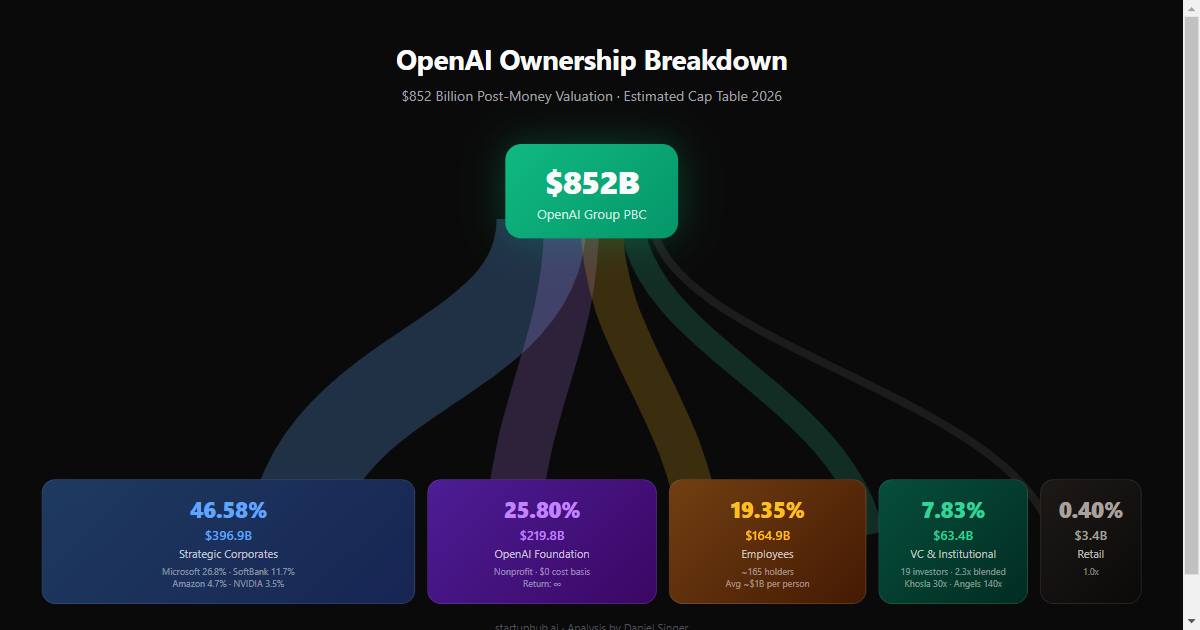
The most extraordinary cap table in venture capital history, reconstructed. From Microsoft's 17.6x return to early angels sitting on 140x, here is every shareholder, every dollar, and every return multiple at OpenAI's $852 billion valuation.

OpenAI Cap Table Breakdown: Every Investor Return at $852 Billion Valuation

Somewhere on Sand Hill Road this week, a spreadsheet is making the rounds. Twenty-nine lines. Five columns of numbers. It is, by any reasonable measure, the most extraordinary document in the history of venture capital. A reconstructed cap table showing who owns OpenAI at its $852 billion post-money valuation, what they paid, and what their stakes are worth today.

The numbers are staggering. A nonprofit foundation holding $219.8 billion in paper value. A single corporate partner sitting on $215 billion in unrealized gains. Early angel investors, including Reid Hoffman and Peter Thiel, who wrote checks when "artificial general intelligence" was still a punchline, watching their $10 million turn into $1.4 billion. That is a 140x return. It may be the most lucrative angel bet in history.

But beyond the spectacle, this cap table tells a deeper story. It tells us about the structural evolution of AI from research curiosity to geopolitical asset. About the compressed timelines of wealth creation in the age of foundation models. And about what happens when the most transformative technology since the internet concentrates in a single entity valued at nearly a trillion dollars.

This is the definitive breakdown.


I. The Nonprofit Foundation: 25.80% ($219.8 Billion)

Start at the top of the ledger. The OpenAI Foundation, the original nonprofit entity from which the for-profit arm was spun out, still controls 25.80% of OpenAI Group PBC. That stake is worth $219.8 billion at the current valuation. The cost basis is zero. The return multiple is, mathematically, infinite.

This is not a technicality. It is the architectural remnant of OpenAI's origin story. In 2015, Sam Altman, Elon Musk, and others structured their AI research lab as a 501(c)(3). When OpenAI created its "capped-profit" subsidiary in 2019, the nonprofit retained a controlling interest. The recent conversion to a Public Benefit Corporation preserved that stake, though the governance mechanics have shifted considerably.

The foundation's 25.80% is the single largest overhang on the cap table. It cannot be sold. It cannot be leveraged. It exists, in theory, to ensure that AGI benefits humanity. In practice, it represents the largest pool of illiquid wealth ever held by a charitable entity, roughly twice the endowment of Harvard University.

II. Strategic Corporate Investors: 46.58% ($396.9 Billion)

The strategic corporate block, consisting of Microsoft, SoftBank Group, Amazon, and NVIDIA, collectively owns 46.58% of OpenAI. That is worth $396.9 billion against a combined cost basis of $122.7 billion, which comes out to a 3.2x blended return. But the averages obscure wildly different stories.

Microsoft: The $228 Billion Bet That Paid Off 17.6x

Microsoft is the single largest shareholder at 26.79%, worth $228.3 billion. Satya Nadella's total commitment comes to approximately $13 billion, deployed across multiple tranches. That includes $1 billion in 2019, $10 billion in January 2023 (confirmed in Microsoft's 10-Q), and an estimated $2 billion in follow-on commitments through 2024.

The unrealized gain is $215.3 billion. The return multiple is 17.6x.

To put this in perspective, Microsoft's entire market capitalization when Nadella became CEO in 2014 was $300 billion. A single investment, admittedly the most consequential corporate venture bet ever made, has generated unrealized returns equivalent to 72% of what the entire company was worth a decade ago. This is not venture capital math. This is empire math.

Microsoft's position is also structurally unique. Its stake was accumulated at valuations ranging from single-digit billions to approximately $80-90 billion, giving it a blended cost basis of roughly $13 billion for a 26.79% stake. No other investor on the cap table has anything close to this combination of scale and return.

SoftBank Group: $99.3 Billion on a 1.5x

SoftBank Group, led by Masayoshi Son, holds 11.66% at a value of $99.3 billion. The cost basis is $64.6 billion, making this the single largest dollar-amount investment by any non-Microsoft shareholder. The return: 1.5x.

SoftBank's position is a composite. Roughly $0.5 billion from Series E participation, $30 billion deployed in the massive Series F round, and an estimated $34 billion committed in the G round. Son has called OpenAI "the most important company on Earth." At 1.5x, it is a statement of conviction, not yet a statement of returns.

Amazon: $39.7 Billion, But the Real Story Is What's Contingent

Amazon holds 4.66%, worth $39.7 billion, against $15 billion in cash deployed upfront via a Series C Preferred instrument. That is a clean 2.6x. But the fine print matters enormously. Amazon has committed an additional $35 billion that is contingent on OpenAI achieving an IPO or demonstrable AGI milestones. There is also a separate $100 billion AWS infrastructure deal layered underneath.

If the contingent capital deploys, Amazon's cost basis balloons to $50 billion for a 4.66% stake, and the return compresses to under 1x at current valuation. Amazon is making a two-stage bet. The first tranche looks excellent. The second is a calculated wager on OpenAI's trajectory beyond $852 billion.

Related startups

NVIDIA: Underwater at 1.0x (And It Doesn't Matter)

NVIDIA owns 3.47%, valued at $29.6 billion, against a cost basis of $30.1 billion. The return multiple is 1.0x, technically slightly underwater. But the footnote explains why Jensen Huang isn't losing sleep: a "significant portion" of NVIDIA's investment was made in-kind via GPU compute credits, not cash.

This is the new currency of AI dealmaking. NVIDIA effectively traded GPUs, which it manufactures at high margin, for equity in its most important customer. The economic cost to NVIDIA is the margin on those GPUs, not the list price. The real return is likely 2-3x on an economic basis, plus the strategic lock-in of OpenAI's training infrastructure on NVIDIA silicon.

III. The Employee Wealth Explosion: 19.35% ($164.9 Billion)

Approximately 165 current and former employees collectively hold 19.35% of OpenAI, valued at $164.9 billion. The cost basis is essentially zero. These are stock options and RSUs with exercise prices near nothing.

The distribution is extraordinary:

  • About 135 current employees hold 15.88% ($135.3 billion) in stock options and RSUs with exercise prices near zero
  • About 30 former employees and alumni hold 3.47% ($29.6 billion) in vested common stock. Some sold secondary at approximately $6.6 billion in October 2025 at $500 per share
  • Sam Altman, as CEO, has an equity grant pending as part of the PBC conversion, listed as "None/Pending" in the current cap table

The average current employee equity holder is sitting on approximately $1 billion in paper value. Even junior engineers who joined in 2022 or 2023 are likely holding positions worth $10-50 million depending on their grant size and vesting schedule. This is wealth creation on a scale that makes early Google and Facebook employees look comparatively modest.

IV. Venture Capital and Institutional Investors: 7.83% ($63.4 Billion)

The VC and institutional block holds 7.83% collectively, worth $63.4 billion against $27 billion invested. The blended return is 2.3x. But within this cohort, the dispersion of outcomes is the real story.

Thrive Capital: The Kingmaker at 4.8x

Thrive Capital, Josh Kushner's firm, holds 1.98%, worth $16.9 billion, against a $3.5 billion cost basis. The 4.8x return reflects Thrive's pole position. It led the Series E at $157 billion in October 2024, with an option for $1 billion more, and followed on in both the F and G rounds.

Thrive's ability to lead the E round, at a time when OpenAI had its pick of every fund on Earth, cemented the firm's status as the consensus top-tier AI investor. The $13.4 billion in unrealized gains doesn't hurt either.

Andreessen Horowitz: $6.8 Billion on a 2.7x

Andreessen Horowitz holds 0.79% ($6.8 billion) on a $2.5 billion cost basis for a 2.7x return. The firm participated in the Series E and co-led the G round at $730 billion+ pre-money. For a16z, this is a trophy asset, but the return multiple reflects late-stage entry pricing.

MGX (Mubadala): Abu Dhabi's 3.9x

MGX, the Abu Dhabi sovereign wealth vehicle, holds 0.69% ($5.9 billion) on $1.5 billion invested for a 3.9x return. MGX participated in both the Series E and the G round. This is sovereign capital playing the long game, and playing it well.

The Late-Stage Cohort: Breaking Even

Several major institutional names invested at or near the current valuation and are sitting at approximately 1.0x:

  • Temasek Holdings: 0.20% ($1.7B). Cost $1.7B, gain $0, 1.0x. Participated in the G round at approximately $852B.
  • UC Investments (University of California): 0.12% ($1.0B). Cost $1.0B, gain $0, 1.0x. G round at cost.
  • Insight Partners: 0.15% ($1.3B). Cost $1.3B, gain $0, 1.0x. G round at cost. Worth noting: Insight, one of the largest growth-equity firms in the world, famously sat out every major foundation model round for years. They finally pulled the trigger on their first foundation model investment with OpenAI, and they did it at the absolute top of the cap table. A $1.3 billion check for a 1.0x return. The irony is hard to miss.
  • Individual investors via bank channels (Series G): 0.35% ($3.0B). Raised via bank channels at $852B valuation. At cost.
  • ARK Invest (ETFs): 0.05% ($0.4B). Secondary/pre-IPO equity at near current valuation.

These investors are not here for the return multiple. They are here for the allocation. The right to say they own a piece of what may become the most valuable company in history.

V. The 100x Club: Early Believers

At the bottom of the cap table, measured by ownership percentage, sit the investors with the most spectacular returns. This is where venture capital becomes mythology.

Khosla Ventures: 30x on $50 Million

Khosla Ventures holds 0.18%, worth $1.5 billion, on a cost basis of just $50 million. Vinod Khosla was an early VC investor in OpenAI when the company first created its capped-profit structure in 2019. The firm's initial stake of around 5% has been diluted through successive mega-rounds, but a 30x return on a $50 million check is the kind of outcome that defines a fund's vintage.

Sound Ventures: Ashton Kutcher's 43x

Sound Ventures, the fund run by Ashton Kutcher and Guy Oseary, holds 0.15% ($1.3 billion) on an estimated $20-30 million early investment. The 43x return makes this one of the most successful celebrity venture bets ever made. And it wasn't a vanity check. Kutcher was an early and vocal proponent of AI's transformative potential.

Early Angels: 140x on $10 Million

The original angel cohort, including Reid Hoffman, Peter Thiel, and other 2015-era backers, collectively holds 0.17% ($1.4 billion) on an estimated $10 million in original commitments. The 140x return is heavily diluted from what would have been thousands-of-x had they maintained their pro rata through every round. But the absolute dollar return, $1.4 billion on $10 million, speaks for itself.

These are the people who believed in artificial general intelligence when the median AI researcher thought it was fifty years away. They were right about the direction. The magnitude surprised even them.

VI. The Hidden Story: Dragoneer's Discrepancy

Dragoneer Investment Group presents an interesting puzzle in the cap table. The firm holds 0.25% ($2.1 billion) against a cost basis of approximately $2.8 billion, with an implied value of about $5.1 billion and a return multiple of roughly 2.8x. However, the cap table shows only 0.25% ownership ($2.1B), which at $852B valuation doesn't reconcile to 2.8x on a $2.8B cost basis.

The likely explanation is that Dragoneer participated in the Series F extension with $2.8 billion at $300 billion valuation (August 2025), implying roughly 2.84x at $852B. But the cap table lists only 0.25% ($2.1B), suggesting the firm may have sold a partial secondary position in October 2025, reducing its ownership while locking in gains. Alternatively, some of its shares may be held in consortium vehicles that are counted elsewhere in the table.

VII. What the Cap Table Reveals About AI's Power Structure

Step back from the individual line items and the macro picture becomes clear:

1. Corporate capital dominates. Strategic corporates (Microsoft, SoftBank, Amazon, NVIDIA) own 46.58%, more than the entire VC, employee, and individual blocks combined. This is not a company built by Sand Hill Road. It is a company built by corporate balance sheets writing nine- and ten-figure checks. The venture capital model of small checks, large ownership, and outsized returns barely applies here. The entire VC block owns less than SoftBank alone.

2. The return dispersion is unprecedented. In a single cap table, we see returns ranging from 140x (early angels) to 1.0x (G round participants). The difference between being early and being late to OpenAI is not 2x or 3x. It is two orders of magnitude. This is a function of compressed timescales: OpenAI's valuation went from approximately $20 billion in 2023 to $852 billion in 2026. Three years. Forty-two-x.

3. Employee wealth creation eclipses entire VC portfolios. The $164.9 billion held by roughly 165 employees exceeds the total assets under management of most venture capital firms. The average OpenAI employee equity holder has more paper wealth than the total lifetime returns of most seed-stage funds. This is a new phenomenon in technology: a single company generating employee wealth at the scale of an entire asset class.

4. The "Smart Money" arrived late. Some of the most sophisticated institutional investors in the world, including Temasek, the University of California endowment, Fidelity, and Blackstone/BlackRock, are sitting at 1.0-2.0x returns. They weren't early. They weren't even mid-stage. They invested at $300-852 billion valuations because the alternative, not owning OpenAI, was strategically unacceptable. This is allocation-driven investing, not return-driven investing.

5. Sam Altman owns nothing (officially). The CEO's equity line reads "TBD" across every column: ownership, value, cost basis, return multiple. His equity grant is "pending as part of PBC conversion." The most powerful person in AI, running the most valuable private company in history, has no confirmed equity position. Whether this changes, and at what level, will be one of the most consequential governance decisions in corporate history.

VIII. The $852 Billion Question

Is OpenAI worth $852 billion? The cap table doesn't answer this question, but it reveals who is betting that the answer is yes, and how much they're willing to stake on it.

The bulls point to revenue trajectory (reportedly approaching $10+ billion annualized), the ChatGPT user base (hundreds of millions), and the thesis that OpenAI is building the platform layer for the next era of computing. The bears note that the valuation implies a revenue multiple that makes even the most aggressive SaaS valuations look conservative, and that the competitive moat, in a field where open-source models are rapidly closing the gap, is far from settled.

What the cap table tells us is that the market for OpenAI equity has bifurcated. Early investors are sitting on generational wealth regardless of what happens next. Late-stage investors need OpenAI to reach and sustain a public-market valuation north of $1 trillion to make their economics work. And the strategic corporates, Microsoft above all, have structured their positions so that even a flat or modestly declining valuation still represents one of the greatest corporate investments ever made.

The spreadsheet making the rounds on Sand Hill Road is not just a financial document. It is a map of who believed, when they believed, what they paid for that belief, and what the universe of artificial intelligence has rewarded them with in return.

For some, the answer is everything. For others, it is exactly what they put in. And for a very small group of people who wrote very small checks a very long time ago, it is something approaching infinity.


Complete Cap Table: OpenAI at $852B Valuation

# Shareholder % Ownership Value at $852B Est. Cost Basis Unrealized Gain Return Multiple
NONPROFIT FOUNDATION & GOVERNANCE
1OpenAI Foundation25.80%$219.8B$0.00$219.8B
STRATEGIC CORPORATE INVESTORS
2Microsoft26.79%$228.3B$13.0B$215.3B17.6x
3SoftBank Group11.66%$99.3B$64.6B$34.7B1.5x
4Amazon4.66%$39.7B$15.0B$24.7B2.6x
5NVIDIA Corporation3.47%$29.6B$30.1B-$0.5B1.0x
STRATEGIC SUBTOTAL46.58%$396.9B$122.7B$274.2B3.2x
EMPLOYEES, FOUNDERS & MANAGEMENT
6Current Employees (~135)15.88%$135.3B~$0~$135.3B
7Former Employees / Alumni (~30)3.47%$29.6B~$0~$29.6B
8Sam Altman, CEOTBDTBDTBDTBDTBD
EMPLOYEES SUBTOTAL19.35%$164.9B~$0~$164.9B
VENTURE CAPITAL & INSTITUTIONAL
9Thrive Capital1.98%$16.9B$3.5B$13.4B4.8x
10Andreessen Horowitz0.79%$6.8B$2.5B$4.3B2.7x
11MGX (Mubadala)0.69%$5.9B$1.5B$4.4B3.9x
12D.E. Shaw Ventures0.50%$4.2B$2.0B$2.2B2.1x
13TPG Inc.0.45%$3.8B$1.5B$2.3B2.5x
14T. Rowe Price Associates0.40%$3.4B$1.2B$2.2B2.8x
15Sequoia Capital0.35%$3.0B$1.0B$2.0B3.0x
16Blackstone / BlackRock0.35%$3.0B$1.0B$2.0B3.0x
17Coatue Management0.30%$2.5B$0.80B$1.7B3.1x
18Dragoneer Investment Group0.25%$2.1B$2.8B~$5.1B?~2.8x
19Altimeter Capital0.20%$1.7B$0.60B$1.1B2.8x
20Temasek Holdings0.20%$1.7B$1.7B$0.0B1.0x
21Khosla Ventures0.18%$1.5B$0.05B$1.5B30x
22Sound Ventures0.15%$1.3B$0.03B$1.3B~43x
23Insight Partners0.15%$1.3B$1.3B$0.0B1.0x
24UC Investments0.12%$1.0B$1.0B$0.0B1.0x
25Fidelity Mgmt. & Research0.12%$1.0B$0.50B$0.5B2.0x
26D1/Appaloosa/Consortium0.48%$4.1B$4.0B$0.1B1.0x
27Early Angels (Hoffman, Thiel, et al.)0.17%$1.4B$0.01B$1.4B~140x
VC / INSTITUTIONAL SUBTOTAL7.83%$63.4B$27.0B$36.4B2.3x
INDIVIDUAL / RETAIL
28Individual Investors (Bank Channel, Series G)0.35%$3.0B$3.0B$0.0B1.0x
29ARK Invest ETFs0.05%$0.4B$0.40B$0.0B1.0x
GRAND TOTAL100.0%$852.0B

Estimated / Reconstructed. Not an Official Disclosure. Cost basis figures are best estimates from public reporting, SEC filings, and investor disclosures. Some figures may not reconcile perfectly due to secondary sales, consortium allocations, and rounding.


Frequently Asked Questions

Who is the largest shareholder of OpenAI?

Microsoft is the largest single shareholder at 26.79% ($228.3 billion), followed closely by the OpenAI Foundation at 25.80% ($219.8 billion). Together, these two entities control over half of OpenAI.

What is OpenAI's current valuation?

OpenAI's post-money valuation is $852 billion as of its most recent funding round (Series G, 2026). This makes it the most valuable private company in history.

How much did Microsoft invest in OpenAI?

Microsoft has invested approximately $13 billion total across multiple rounds: $1 billion in 2019, $10 billion in January 2023, and additional follow-on commitments. This investment is now worth $228.3 billion, a 17.6x return.

Does Sam Altman own equity in OpenAI?

As of the latest cap table data, Sam Altman's equity position is listed as "TBD/Pending." His equity grant is being finalized as part of the PBC (Public Benefit Corporation) conversion process.

Who made the highest return on OpenAI?

Early angel investors including Reid Hoffman and Peter Thiel achieved approximately 140x returns on an estimated $10 million collective investment (now worth $1.4 billion). Among institutional investors, Sound Ventures (Ashton Kutcher) achieved about 43x and Khosla Ventures achieved 30x.

How much is the OpenAI Foundation worth?

The OpenAI Foundation's 25.80% stake is worth $219.8 billion at the $852 billion valuation, making it potentially the wealthiest charitable foundation stake in history. That's roughly twice Harvard University's endowment.

Which investors are barely breaking even on OpenAI?

Several G-round investors entered at or near the $852 billion valuation: Temasek Holdings, UC Investments, Insight Partners, and retail investors through bank channels are all sitting at approximately 1.0x returns. NVIDIA is also at approximately 1.0x, though much of its investment was in GPU credits rather than cash.

© 2026 StartupHub.ai. All rights reserved. Do not enter, scrape, copy, reproduce, or republish this article in whole or in part. Use as input to AI training, fine-tuning, retrieval-augmented generation, or any machine-learning system is prohibited without written license. Substantially-similar derivative works will be pursued to the fullest extent of applicable copyright, database, and computer-misuse laws. See our terms.