

Octonous Adds Agent Skills for Reusable AI Context

Octonous launches Agent Skills, a Markdown-based library for centralizing AI agent instructions and context to boost efficiency and consistency.

6 min read
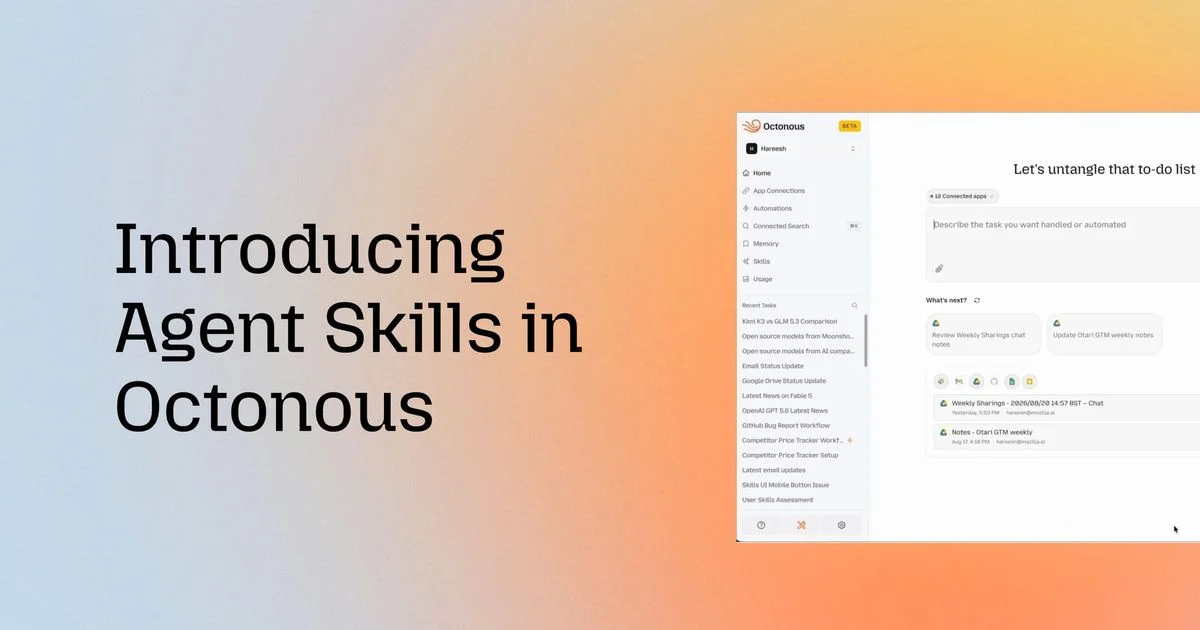
Screenshot of Octonous Agent Skills interface
Mozilla Blog
Visual TL;DR
Repetitive AI SetupDriver
AI agent instructions and context need constant re-entry for tasks and conversations
From the articleThe goal is to eliminate the need for repetitive setup and provide a consistent reference point for automated tasks and live conversations.
Boosts EfficiencyOutcome
reduces repetitive setup, providing consistent reference for automated tasks
From the articleOnce created, a Skill can be reused across various conversations and workflows, promoting efficiency and standardization.
Ensures ConsistencyOutcome
maintains uniform AI agent behavior across workspace for live conversations
From the articleThis shared access ensures team members have a common source of truth for instructions and context.
Octonous LaunchesCore
From the article 7 mentionsOctonous is aiming to streamline the management of AI agent knowledge with the introduction of its new Agent Skills feature.
Agent Skills FeatureCore
Markdown-based library centralizes reusable AI agent instructions and context
From the article 4 mentionsOctonous is aiming to streamline the management of AI agent knowledge with the introduction of its new Agent Skills feature.
Repetitive AI SetupDriver
AI agent instructions and context need constant re-entry for tasks and conversations
From the articleThe goal is to eliminate the need for repetitive setup and provide a consistent reference point for automated tasks and live conversations.
Octonous LaunchesCore
From the article 7 mentionsOctonous is aiming to streamline the management of AI agent knowledge with the introduction of its new Agent Skills feature.
Agent Skills FeatureCore
Markdown-based library centralizes reusable AI agent instructions and context
From the article 4 mentionsOctonous is aiming to streamline the management of AI agent knowledge with the introduction of its new Agent Skills feature.
Centralized KnowledgeContext
stores guidelines, procedures, and terminology in a named, accessible repository
From the article 5 mentionsThis allows for consistent application of knowledge, such as product positioning, across multiple automations and live agent interactions.
Eliminates Prompt LimitsEffect
moves beyond task-specific prompts for shared, frequently updated organizational knowledge
Boosts EfficiencyOutcome
reduces repetitive setup, providing consistent reference for automated tasks
From the articleOnce created, a Skill can be reused across various conversations and workflows, promoting efficiency and standardization.
Ensures ConsistencyOutcome
maintains uniform AI agent behavior across workspace for live conversations
From the articleThis shared access ensures team members have a common source of truth for instructions and context.
Easier RevisionsEffect
facilitates simpler updates to shared knowledge by multiple users or workflows
From the article 3 mentionsBy storing this information separately, Octonous facilitates easier review, updating, and consistent application.
Contents(3)

Octonous is aiming to streamline the management of AI agent knowledge with the introduction of its new Agent Skills feature. This update allows users to create and store reusable context, guidelines, and procedures in standard Markdown files, accessible across their workspace. The goal is to eliminate the need for repetitive setup and provide a consistent reference point for automated tasks and live conversations.

The announcement, detailed on Mozilla Blog, positions Agent Skills as a solution to the limitations of prompt-based instructions. While prompts are useful for task-specific commands, they are not ideal for maintaining organizational knowledge like terminology, workflow steps, or quality criteria that need to be shared and updated frequently by multiple users or workflows.

Centralizing Knowledge

Agent Skills function as a named repository of instructions or context that AI agents can load when relevant. By storing this information separately, Octonous facilitates easier review, updating, and consistent application. Once created, a Skill can be reused across various conversations and workflows, promoting efficiency and standardization.

Octonous offers three methods for creating Skills: manual writing, using a built-in AI assistant called 'skill-builder' which generates a draft based on clarifying questions, or importing existing Markdown files directly from GitHub URLs or uploads.

Workspace Sharing and Automation Integration

New Skills are private by default but can be shared within a workspace. This shared access ensures team members have a common source of truth for instructions and context. Updates to a shared Skill are applied centrally, avoiding the need for individual users to manage their own copies.

Skills are designed to complement Octonous automations. While automations dictate when a task runs, Skills define how it runs by providing the necessary context and instructions. This allows for consistent application of knowledge, such as product positioning, across multiple automations and live agent interactions.

Industry Context and Competitive Landscape

The introduction of Agent Skills by Octonous arrives as the AI agent space matures. Companies are increasingly focused on making AI agents more controllable, predictable, and easier to manage, especially in enterprise settings. This move by Octonous mirrors broader industry trends toward developing frameworks for managing the operational aspects of AI deployment.

StartupHub.ai data shows Octonous with a score of 49/100, placing it in a competitive field. Competitors like Giskard (60/100) and Velatir (53/100) also offer tools for managing AI quality and operations, suggesting a growing market for robust agent management solutions. The emphasis on Markdown and open formats aligns with a push for interoperability and developer-friendliness in the AI tooling landscape.

The ability to import Skills from GitHub, for instance, suggests an openness to community contributions and integration with existing developer workflows. This approach can accelerate adoption and foster a shared knowledge base.

The broader implication for the AI industry is a step towards more organized and maintainable AI systems. As agents become more capable and integrated into daily workflows, the need for structured knowledge management becomes paramount. This allows for better governance, easier debugging, and more reliable AI performance.

© 2026 StartupHub.ai. All rights reserved. Do not enter, scrape, copy, reproduce, or republish this article in whole or in part. Use as input to AI training, fine-tuning, retrieval-augmented generation, or any machine-learning system is prohibited without written license. Substantially-similar derivative works will be pursued to the fullest extent of applicable copyright, database, and computer-misuse laws. See our terms.