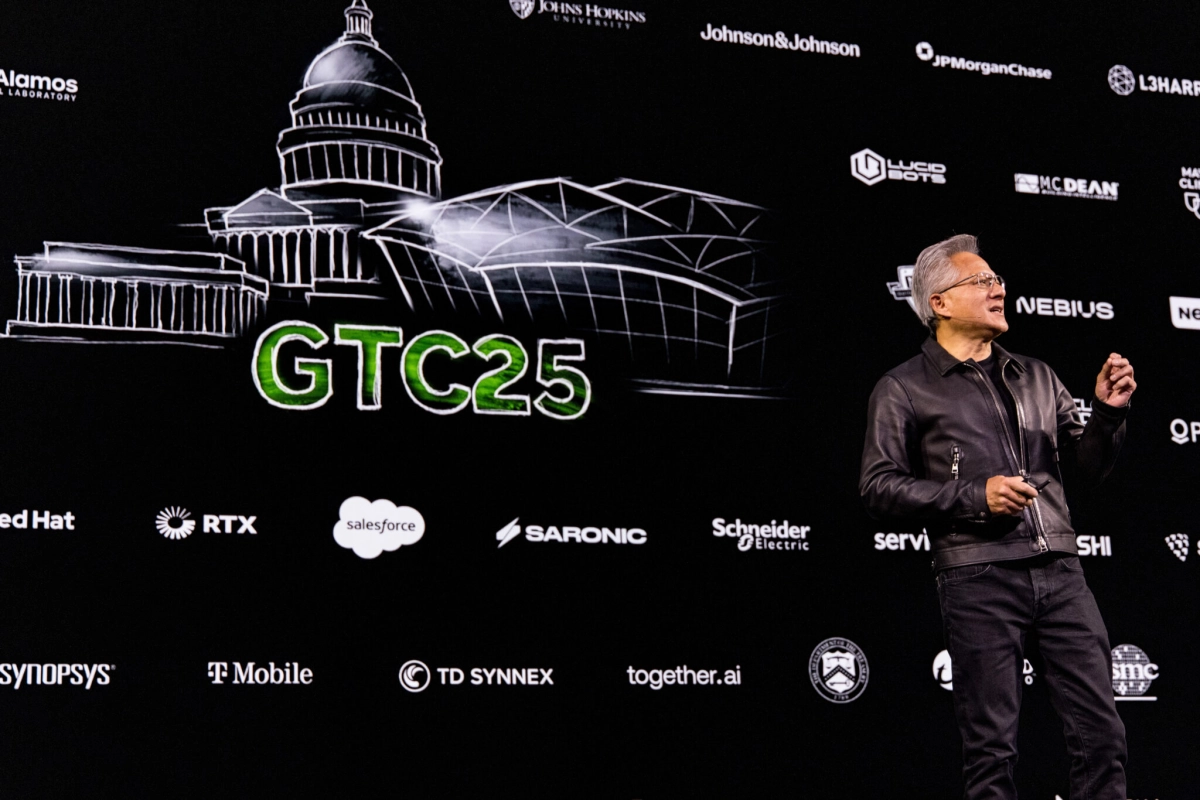
NVIDIA's GTC Washington, D.C., keynote delivered a sweeping vision for America’s AI century, moving beyond mere silicon to outline a national blueprint for AI infrastructure. CEO Jensen Huang declared a new era of "physical AI" and digital twins, positioning NVIDIA as the foundational architect for reindustrializing the nation. This isn't just about faster chips; it's about embedding intelligence into every facet of the economy, from telecommunications to healthcare, fundamentally reshaping national capabilities and global competitiveness.
Huang's address underscored a strategic pivot towards national-level AI deployment, emphasizing a U.S.-anchored AI-native 6G stack with NVIDIA ARC, integrated by Nokia, and quantum leadership via NVQLink. This move is not solely commercial; it represents a critical national security and economic imperative to control fundamental communication and advanced computing technologies, reducing reliance on foreign infrastructure. According to the announcement, the deployment of 100,000 NVIDIA Blackwell GPUs for the Solstice system at Argonne National Laboratory, alongside 10,000 for Equinox, signifies an unprecedented government investment in sovereign AI capabilities, setting a new standard for public-private partnerships in advanced computing. This deep integration of NVIDIA's technology into the very fabric of national infrastructure extends beyond typical enterprise adoption, establishing state-level strategic assets vital for long-term technological leadership.
The concept of "AI factories" as purpose-built platforms for generating, moving, and serving tokens at massive scale redefines the modern data center, shifting from general-purpose computing to specialized AI production. Huang's declaration that "AI is work," not merely a tool, highlights a fundamental shift in how computing resources are conceptualized and deployed, driven by "extreme codesign" across chips, systems, software, and models. The introduction of the NVIDIA BlueField-4 DPU, delivering 6x the compute of its predecessor, and the Omniverse DSX blueprint for gigascale AI factories, validated at the AI Factory Research Center in Manassas, Virginia, provides a practical, scalable approach to building the physical infrastructure required for this new industrial revolution. This paradigm shift will inevitably drive new career paths in AI engineering, robotics, and quantum science, profoundly reshaping the future workforce and demanding new educational frameworks.
Expanding AI's Reach Across Industries
NVIDIA's strategy extends deep into vertical markets, demonstrating how its full-stack approach translates into tangible advancements across diverse sectors, moving AI from theoretical potential to practical application. In healthcare, the NVIDIA Clara open models, including CodonFM for therapeutic design and La-Proteina for accelerated protein structure prediction, are significantly advancing drug discovery and medical imaging, as evidenced by collaborations with the NIH and Johnson & Johnson MedTech's MONARCH platform for surgical innovation. The partnership with Uber, targeting 100,000 autonomous vehicles by 2027 and leveraging DRIVE Hyperion 10, illustrates a clear, aggressive path to commercializing Level 4 autonomy, transforming urban mobility. These targeted applications showcase NVIDIA's commitment to moving AI from research labs into real-world, high-impact deployments, fundamentally altering operational paradigms in these critical industries and creating new market opportunities.
The commitment to open models like Nemotron for agentic AI, Cosmos for synthetic data generation, Isaac GR00T for robotics skills, and Clara for biomedical workflows is crucial for fostering a vibrant, accessible ecosystem, empowering startups and researchers globally. This open approach, coupled with strategic partnerships with industry giants such as CrowdStrike for "speed of light" cybersecurity and Palantir for large-scale data processing, ensures broad adoption and integration of NVIDIA's comprehensive AI stack across enterprise and government. Furthermore, the NVIDIA GH200 Grace Hopper Superchip's record-setting performance in financial services benchmarks, demonstrating significantly lower latency and higher energy efficiency, validates NVIDIA's hardware leadership in demanding, real-time inference workloads. This combination of open access, strategic alliances, and unparalleled performance solidifies NVIDIA's position as the dominant force in the evolving AI landscape, driving innovation from the cloud to the edge.