


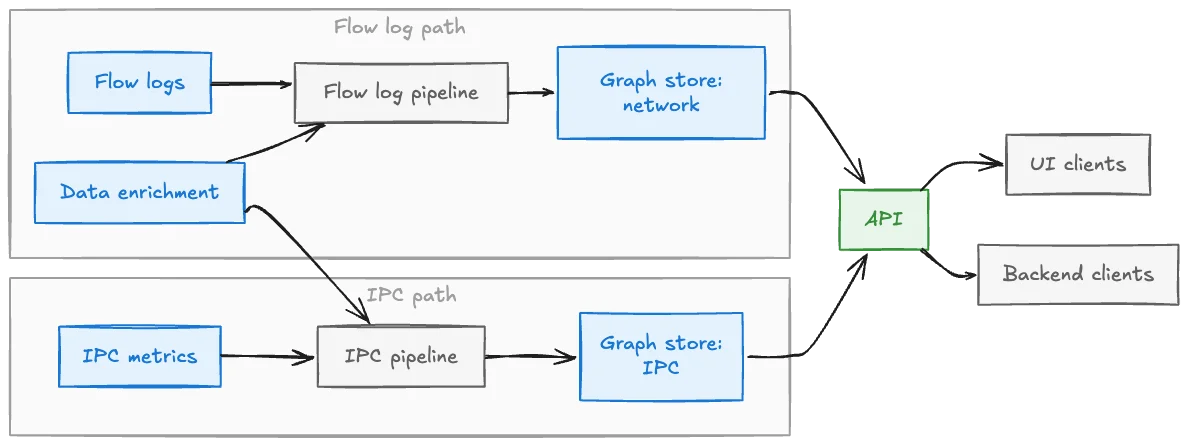
Visual TL;DR
Stale Service MapsDriver
traditional batch processing delivered outdated service dependency views for incident response
Streaming-First ArchitectureCore
continuously ingests millions of network flow records and IPC metrics per second
From the article 2 mentionsThis led to the development of a streaming-first architecture, detailed on the Netflix Tech Blog.
Three-Stage PipelineCore
distributed architecture processes data through initial, network resolution, and final aggregation stages
From the article 7 mentionsThe network layer ingestion relies on a three-stage distributed aggregation pipeline.
Stage 1: Initial AggregationContext
aggregates raw network flow records and IPC metrics from various sources
Real-Time ObservabilityEffect
provides topology updates within tens of minutes for live events and rapid incident response
From the article 3 mentionsNetflix engineers grappled with the challenge of creating a unified, real-time view of their sprawling service dependencies.
Stage 2: Network ResolutionContext
resolves network intermediaries to identify direct service-to-service communication paths
From the articleThe IPC pipeline, unlike the network flow log pipeline, requires only a single stage because its data is already correctly partitioned at the application level, eliminating the need for intermediary resolution.
Unified Service MapOutcome
visualizes complex service dependencies at scale for comprehensive system understanding
From the article 2 mentionsThe core innovation is a distributed service map pipeline designed for scale and real-time updates.
Stage 3: Final AggregationContext
enriches aggregated data with service metadata for a complete dependency view
