

Meta-Harness: AI Optimizes AI Development

Researchers unveil Meta-Harness, a novel AI system that automates harness optimization, leading to faster and more capable LLMs.

3 min read
Meta-Harness: AI Optimizes AI Development
Matthew Berman

In a significant leap forward for AI development, researchers from Stanford, MIT, and KRAFTON have introduced Meta-Harness, a system designed to automate the optimization of Large Language Model (LLM) harnesses. This innovative approach promises to streamline the creation of more effective and efficient AI models by allowing them to learn and improve their own operational code.

Meta-Harness: AI Optimizes AI Development - Matthew Berman
Meta-Harness: AI Optimizes AI Development — from Matthew Berman

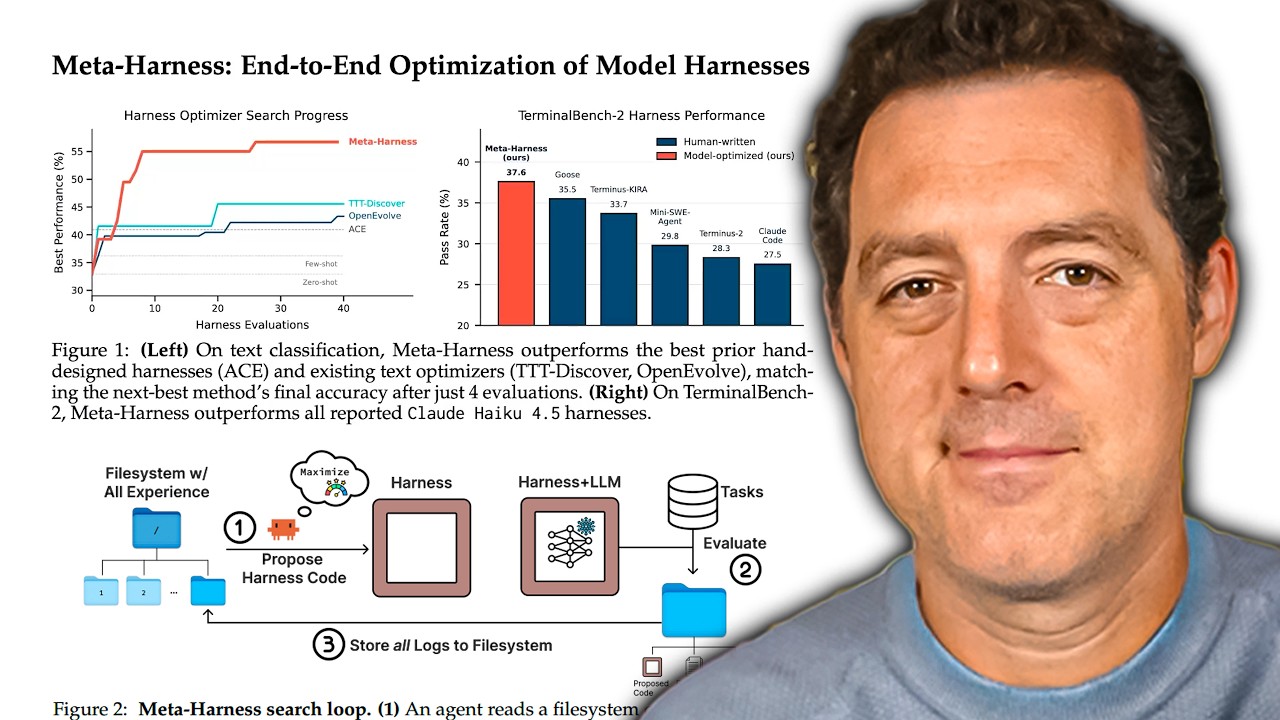
The core idea behind Meta-Harness is to enable LLMs to iteratively propose, evaluate, and log new harnesses, creating a self-improving loop. This process is crucial because, as the paper highlights, the performance of LLM systems depends not only on their model weights but also on their harnesses – the code that determines what information to store, retrieve, and present to the model. Traditionally, these harnesses are designed manually, a process that is often inefficient and yields suboptimal results.

The Meta-Harness system acts as a coding agent, leveraging a language-model-based system to invoke developer tools and modify code. This allows it to search for optimal harnesses by exploring the vast landscape of possibilities within the code. The system's ability to learn from its own experiences, storing source code, evaluation scores, and execution traces, allows it to progressively refine its approach.

Related startups

Key Innovations and Performance

The researchers demonstrated Meta-Harness's effectiveness across three distinct task domains: online text classification, mathematical reasoning, and agentic coding. In each domain, they compared Meta-Harness against existing text optimizers, finding that it consistently outperformed them. For instance, on text classification tasks, Meta-Harness achieved a 48.6% accuracy, surpassing the next best method by over 10 points. Similarly, on math reasoning tasks, it achieved a 4.7-point average gain over a no-retriever baseline.

The paper details how Meta-Harness achieves these improvements through a combination of techniques, including leveraging full filesystem access and enabling the proposer to inspect and validate edits directly through interaction with the codebase. This allows the system to learn from a rich history of prior code and execution traces, optimizing its search for better harnesses.

A key finding is that Meta-Harness is significantly more efficient than existing methods, achieving better results with fewer evaluations and less computational cost. For example, in one experiment, Meta-Harness matched the best prior text optimizers (OpenEvolve, TTT-Discover) with 10x fewer full evaluations and achieved final accuracy surpassing them by more than 10 points.

The Self-Improvement Loop

The core innovation of Meta-Harness lies in its ability to create a self-improving loop. The system begins by proposing an initial harness, which is then evaluated based on its performance. The results of this evaluation are used to inform the next iteration, where the system proposes a refined harness. This iterative process, guided by the feedback signal, allows Meta-Harness to continuously improve its performance over time.

This approach is particularly powerful because it mirrors human learning and problem-solving. Just as humans learn from experience and adapt their strategies, Meta-Harness learns from its own interactions with the code and the environment, progressively becoming more capable. This self-improvement mechanism is a crucial step towards more autonomous and efficient AI development.

Implications for the AI Industry

The development of Meta-Harness has significant implications for the AI industry. By automating the complex and time-consuming task of harness optimization, it has the potential to accelerate the development of more powerful and capable AI models. This could lead to breakthroughs in various fields, from natural language processing to scientific discovery.

Furthermore, the success of Meta-Harness suggests a future where AI systems can not only perform tasks but also actively contribute to the improvement of their own underlying infrastructure. This opens up exciting possibilities for a more collaborative and efficient relationship between humans and AI in the development process.

© 2026 StartupHub.ai. All rights reserved. Do not enter, scrape, copy, reproduce, or republish this article in whole or in part. Use as input to AI training, fine-tuning, retrieval-augmented generation, or any machine-learning system is prohibited without written license. Substantially-similar derivative works will be pursued to the fullest extent of applicable copyright, database, and computer-misuse laws. See our terms.