


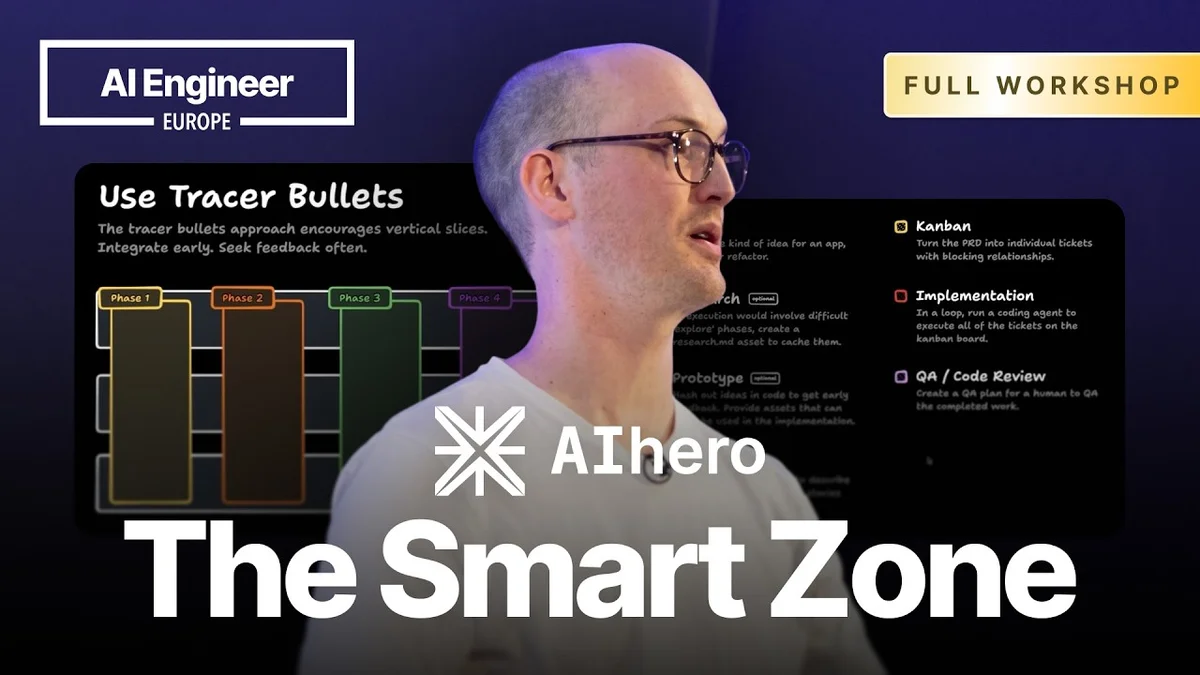
In a recent AI Engineer Europe talk, Matt Pocock, a prominent figure in the AI development community and creator of the popular "grill-me" skill, emphasized the importance of structured planning when working with large language models (LLMs). Pocock, known for his pragmatic approach to AI and his role in developing AI tools, outlined a framework for how developers can effectively guide LLMs through complex tasks.
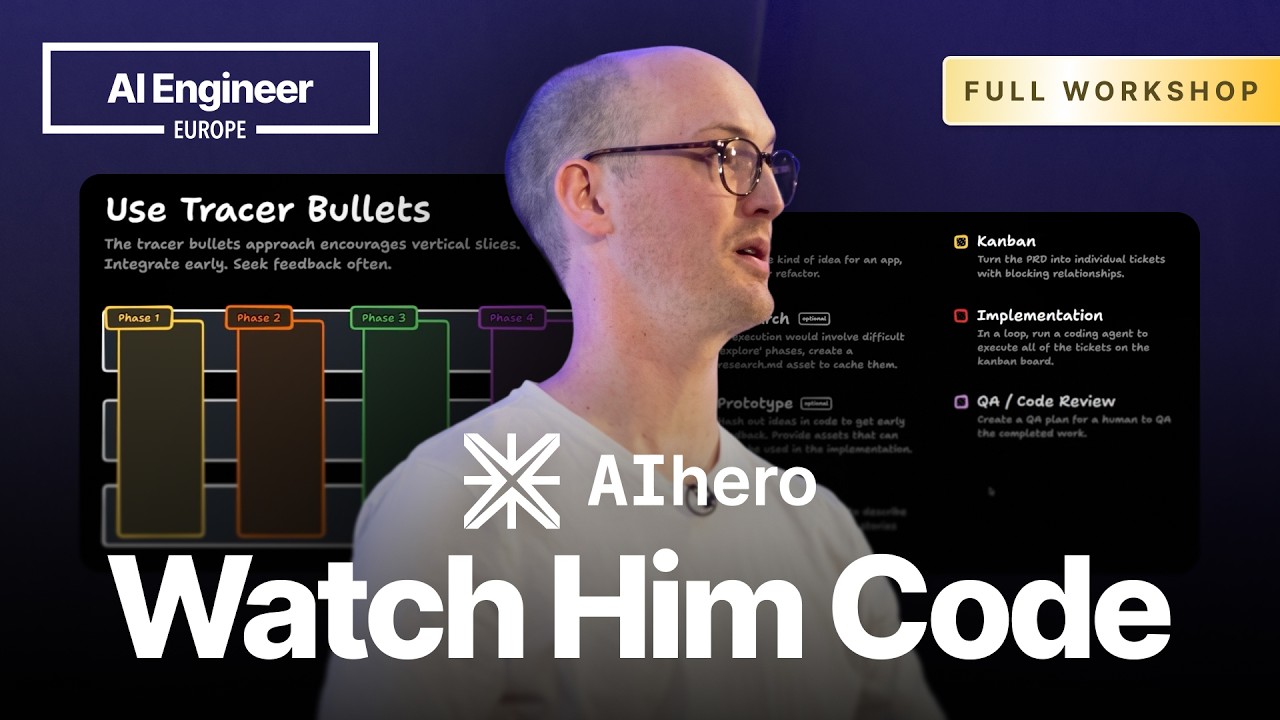
The 'Smart Zone' vs. 'Dumb Zone' of LLMs
Pocock introduced the concept of an LLM operating within a "smart zone" and a "dumb zone." The "smart zone" is where the LLM performs best, accurately understanding and executing tasks based on clear, concise prompts. However, as the complexity or length of the prompt increases, the model can drift into the "dumb zone," leading to errors and suboptimal outputs. Pocock illustrated this with the analogy of adding too many tokens to a football team, making it less effective. He suggested that developers should aim to keep their prompts within the "smart zone" by breaking down complex requests into smaller, more manageable steps.
Multi-Phase Planning: A Key to Success
To achieve this, Pocock advocated for a "multi-phase plan" approach. This involves dividing a large task into a series of smaller, sequential steps. Each step, or "phase," should be designed to be manageable for the AI, allowing it to maintain context and accuracy. He illustrated this with a diagram showing how a large task can be broken down into four "smart" phases, each with its own defined input and output. This systematic approach, he argued, prevents the AI from becoming overwhelmed and ensures a higher quality of output.
Leveraging the 'Grill-Me' Skill
Pocock then demonstrated the practical application of these principles using his "grill-me" skill. This skill is designed to help developers "grill" the AI, essentially stress-testing its understanding of a plan or design by asking it a series of targeted questions. By feeding the AI specific requirements and observing its ability to generate accurate and relevant code, developers can identify potential misalignments or gaps in understanding. He stressed that the effectiveness of this skill lies in its ability to elicit detailed, specific responses from the AI, ensuring that the generated code aligns perfectly with the intended outcome.
The Importance of Iteration and Feedback
Pocock highlighted that this process is iterative. After the AI generates code or a plan, developers should review it, provide feedback, and refine the prompts or the plan itself. This feedback loop is crucial for improving the AI's performance and ensuring that the final output meets the project's requirements. He emphasized that the goal is not just to get a result, but to achieve a shared understanding between the human and the AI, leading to more robust and reliable outcomes.