

Local AI Models: The Desktop Frontier is Here

Ahmad Osman of Osmantic explores the rapid advancement of local AI, predicting powerful models on consumer hardware and advocating for sovereign AI.

3 min read
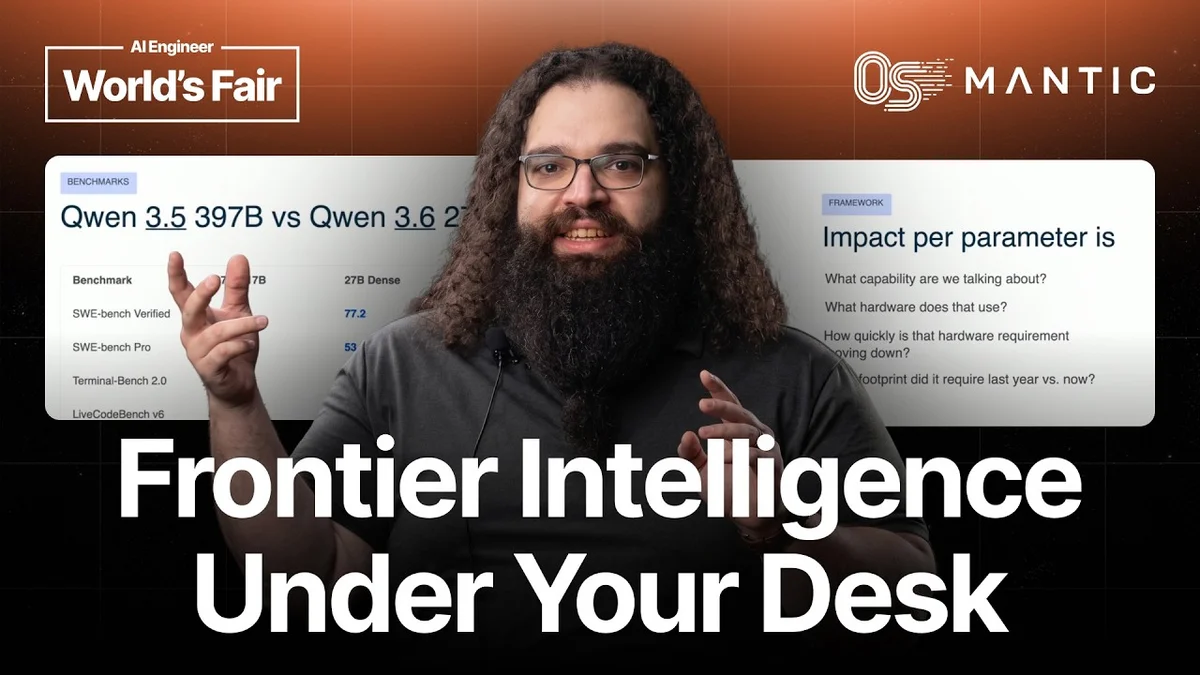
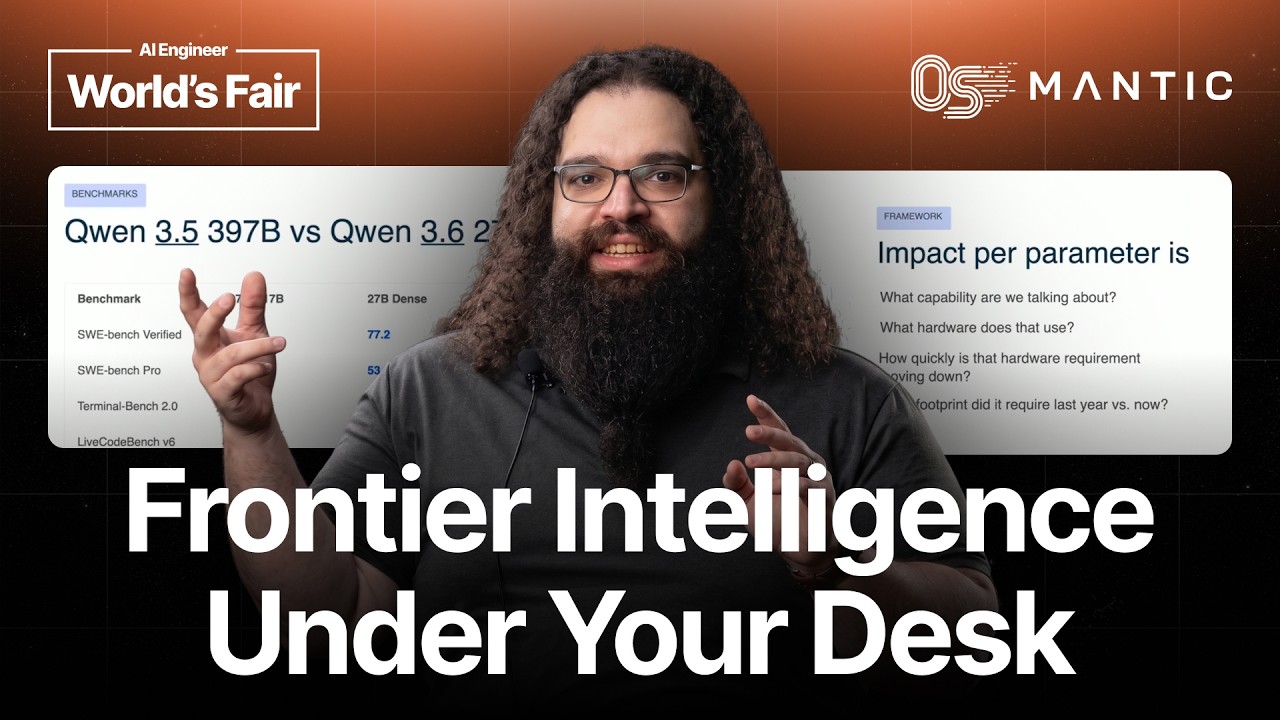
Ahmad Osman presenting on stage at AI Engineer World's Fair
AI Engineer

The AI revolution is no longer confined to massive data centers. Ahmad Osman, Founder & CEO of Osmantic, presented "The Desktop Frontier" at the AI Engineer World's Fair, detailing the significant strides made in local and open-source AI models. Osman predicts that within 18 months, AI intelligence equivalent to GLM 5.2 will be runnable on a single RTX 5090 with 32GB of VRAM, a development he considers conservative.
Local AI Models: The Desktop Frontier is Here - AI Engineer
Local AI Models: The Desktop Frontier is Here — from AI Engineer

The Compression Curve of AI

For years, the narrative in AI has been about scaling up: bigger models, more parameters, and larger clusters. However, Osman highlighted a crucial shift: "A second curve has become impossible to ignore over the last three years. Similar capability bands are appearing in smaller active footprints and more ownable systems." He introduced the concept of "impact per parameter," emphasizing the efficiency gains that allow models to achieve comparable or better results with significantly fewer parameters and a smaller hardware footprint.

Osman illustrated this with a personal anecdote: "A year ago, I used to run Llama 2 on an RTX 3090. It's now running Qwen 3.5, 3.6, 27 billion parameter. That's better than Llama's 405, a 400 billion plus parameter model that you beat with a 27 billion parameter model a year and a half after." This trend, he noted, is not random but driven by ongoing research, architectural innovations, and efficiency gains.

"Densing Law" in Action

Citing research from Nature Machine Intelligence, Osman referred to this phenomenon as the "densing law" of LLMs, where capability density is rising. He explained that every 3.5 months, there's a roughly 50% increase in parameters, whether dense or activated, leading to more intelligence from the models we use.

As examples of this progress, Osman pointed to GLM 5.2, a 744 billion parameter model with only 40 billion activated, supporting up to 1 million tokens context. He also mentioned NVIDIA's Nemotron 3 Ultra, which demonstrated that more efficient training can be done on hardware, making fine-tuning and specialized model development more accessible.

From Llama 2 to Smartphone AI

Looking back at the evolution, Osman recalled Llama 2 as a baseline 70 billion parameter model that required substantial hardware. He contrasted this with current capabilities, stating, "You can now run GPT-40 quality on your iPhone. That thing required data centers to serve." This democratization of AI capabilities raises a critical question for consumers and businesses: "Why wouldn't you invest in sovereign AI?"

Osman urged the audience to consider the benefits of owning their AI infrastructure: control over models, optimization for specific use cases, cost savings, and the assurance that their AI won't be restricted or have requests refused. He stressed the importance of enterprises migrating from cloud-based solutions to owning their hardware stack to foster the continued growth of open-source AI.

The Future of Local AI

Tracing the lineage of efficient models, Osman highlighted Mistral 7B as an early indicator of smaller models outperforming larger ones. He then moved through Llama 3, Gemma, and Qwen, emphasizing the shrinking gap between open-source and frontier models.

The presentation culminated in a forward-looking question: "What will a DGX Station be able to run in 3, 6, 12, and 18 months from now?" Osman revealed that he holds onto his NVIDIA RTX 3090s, believing their value will increase as models become more efficient. He concluded by posing the fundamental question to the audience: "If an RTX 5090 with 32GB of VRAM runs the equivalent of GLM 5.2 in 18 months... Should you buy a GPU?"

© 2026 StartupHub.ai. All rights reserved. Do not enter, scrape, copy, reproduce, or republish this article in whole or in part. Use as input to AI training, fine-tuning, retrieval-augmented generation, or any machine-learning system is prohibited without written license. Substantially-similar derivative works will be pursued to the fullest extent of applicable copyright, database, and computer-misuse laws. See our terms.