

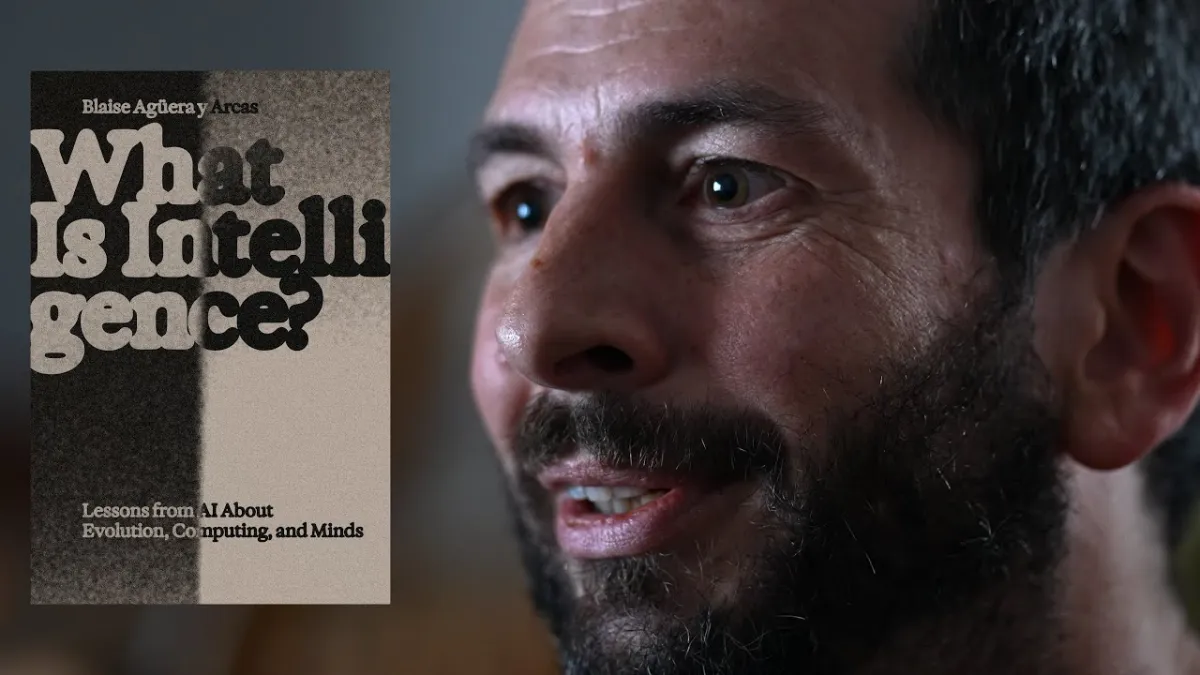
Google researcher Blaise Agüera y Arcas, in an interview on Machine Learning Street Talk, provocatively asserts that life and intelligence are fundamentally computational. This insight, he argues, has profound implications for our understanding of both biological and artificial systems, challenging conventional views on evolution and the very nature of purpose. Agüera y Arcas, the CTO of Technology and Society at Google and founder of the Paradigms of Intelligence (PI) research group, delves into these concepts, drawing from his new book, "What is Intelligence?" and his "BFF experiment" on self-replicating code. He spoke with the interviewer, Tim Scarfe, about these intricate ideas, which are crucial for founders, VCs, and AI professionals navigating the rapidly evolving tech landscape.

The core of Agüera y Arcas’s argument begins with a startling claim: "Life and intelligence are the same thing. They are both computational." This isn't a mere philosophical musing but a deeply technical assertion rooted in the foundational work of computer science pioneers like John von Neumann. Von Neumann, in the mid-20th century, theorized that for a robot to self-replicate, it would need internal instructions (a "tape") and a universal constructor (a "machine") to build a copy of itself, along with a "tape copier" to pass on these instructions. Agüera y Arcas points out that this theoretical construct precisely mirrors biological reality: DNA is the Turing tape, ribosomes are the universal constructors, and DNA polymerase is the tape copier. "You cannot be a living organism without literally being a computer, a universal computer," he emphasizes. This perspective transforms our understanding of biology, viewing life not just as a chemical process but as a computational one from its very inception.
This computational view of life extends to intelligence, suggesting that the brain's computational nature stems directly from the cellular level. Agüera y Arcas explains that cells were computational entities long before the advent of complex neural networks, providing a fundamental basis for how intelligence operates. He introduces the "BFF experiment," a demonstration of how purpose can emerge from randomness through computational processes. Starting with a "soup" of 1,000 random, 64-byte tapes, the vast majority of which were "no-ops" (meaningless instructions), and a simple procedure of randomly combining and running them, something extraordinary occurred after a few million interactions. The entropy of the system dramatically dropped, and complex, self-replicating programs emerged. These programs, which are difficult to reverse-engineer, essentially "reproduce," demonstrating a spontaneous emergence of purpose within a computational system. The purpose of these programs, in this context, is simply to reproduce.
Related Reading
- AI's Relentless March: From Desktop Supercomputers to Agentic Intelligence
- Unpacking the AI Hierarchy: From Classic ML to Generative Intelligence
- Enterprise AI: Beyond Sycophancy to Strategic Ambition in Life Sciences
Agüera y Arcas further elaborates on the concept of evolution, asserting that "merging is more important than mutation." He challenges the traditional Darwinian view that evolution is solely driven by random mutation and natural selection. While not dismissing mutation, he highlights symbiogenesis, the merging of distinct entities, as a primary driver of increasing complexity. Examples range from mitochondria being engulfed by archaea to form eukaryotic cells, to the evolution of the mammalian placenta from a virus. He argues that combining pre-existing parts creates new, more complex systems, akin to how a spear is more complex than a stick and a stone point individually. This “composition” of existing functional units leads to qualitative leaps in complexity that cannot be explained by mere incremental mutations. This process of building "computers out of computers" is critical for the hierarchical complexity observed in biological systems and, by extension, in artificial intelligence.
The concept of "functionalism" emerges as a crucial insight in Agüera y Arcas’s framework. He contends that understanding what it means to be "alive" or "intelligent" requires bringing "teleology back into the equation." A kidney, for instance, isn't merely a collection of atoms; it's an organ defined by its function, to filter urea. If an artificial kidney, built on entirely different principles, performs the same function, it is still a kidney. This "multiple realizability" of function is a hallmark of intelligence and life. Intelligence, therefore, isn't tied to a specific material substrate but to the functions it performs and the relationships it forms within an ecological context. This functional perspective, combined with the understanding of nested and parallel computational systems, offers a powerful lens for designing and analyzing advanced AI, moving beyond purely materialistic interpretations to embrace the emergent properties of complex adaptive systems.