

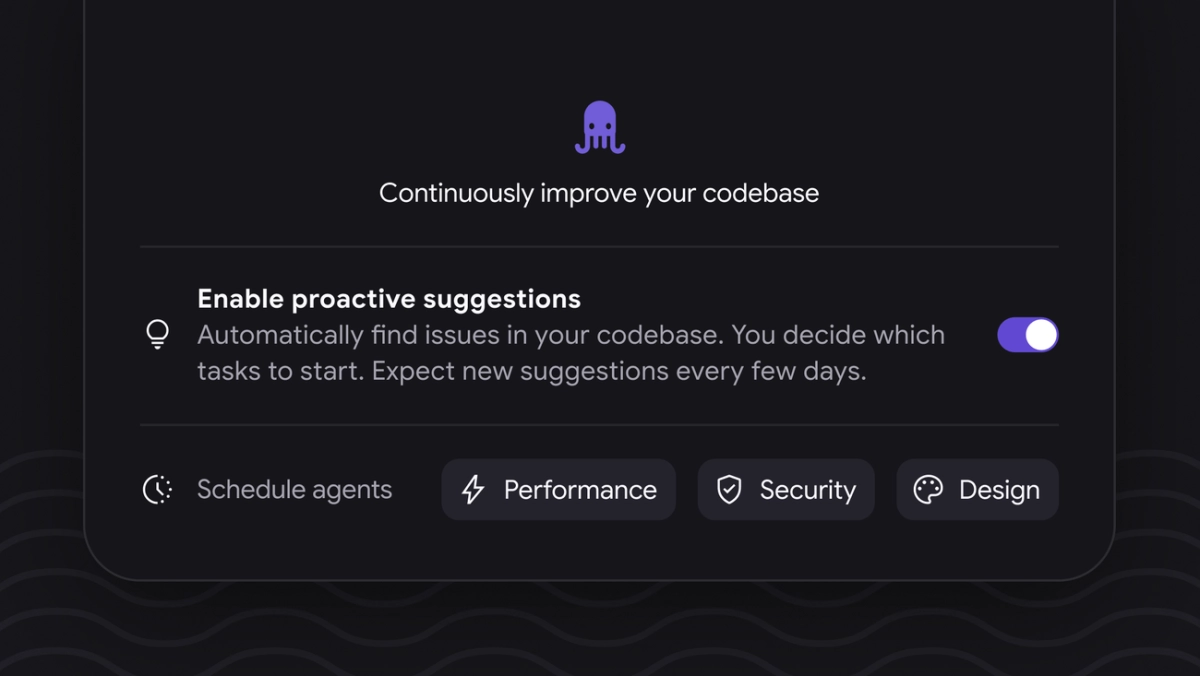
Google's Jules AI is evolving beyond a reactive coding assistant, now offering proactive capabilities designed to anticipate developer needs and automate routine tasks. This significant shift positions Jules as an intelligent partner, capable of surfacing critical work, suggesting improvements, and even self-healing deployments. The update signals a broader industry move towards more autonomous and anticipatory AI in software development.
The core of this proactive evolution lies in new features like Suggested Tasks and Scheduled Tasks. Suggested Tasks, available to Google AI Pro and Ultra subscribers, continuously scans codebases for improvements, initially targeting #todos comments. This offloads the mental burden of tracking minor technical debt. Scheduled Tasks further automates predictable maintenance, such as dependency checks, allowing developers to define cadences for routine housekeeping and reducing the cognitive load of staying current. According to the announcement, this background work has already made Jules a major contributor to Google's internal Stitch repository, freeing human teams for complex feature development.
A particularly impactful addition is the new Render integration, which directly addresses the friction of failed deployments. When a Jules pull request deployment fails, the AI now automatically analyzes logs, identifies the issue, writes a fix, and opens a new pull request for review. This capability drastically shortens the loop between failure and resolution, maintaining developer momentum and ensuring a quicker path back to a stable state. It represents a tangible step towards truly self-healing infrastructure, moving beyond mere error reporting to active problem-solving.
The Shift to Autonomous Development
This expansion of Jules proactive AI capabilities underscores a fundamental redefinition of the developer-AI relationship. No longer just a tool for prompt-based queries, Jules is becoming an embedded agent that actively contributes to codebase health and operational stability. This trend extends beyond Google, hinting at a future where AI agents are not just assistants but integral, autonomous team members, handling the "small tasks, drift, and maintenance work" that often bog down human engineers. The emphasis remains on human oversight, but the scope of AI's independent action is clearly widening.
The implications for developer productivity and operational efficiency are substantial. By automating mundane yet critical tasks, Jules allows human talent to focus on innovation, complex problem-solving, and strategic initiatives. This proactive approach minimizes context switching and reduces the accumulation of technical debt, ultimately accelerating development cycles and improving software quality. It sets a new benchmark for what developers can expect from their AI partners, pushing the industry towards more intelligent, contextual, and seamless development workflows across distributed environments.