

IBM Experts on AI Training: Efficiency vs. Scale

IBM's Marina Danilevsky and Gabe Goodhart discuss the company's new 'Bob' and 'Granite' AI models, highlighting the shift towards specialized, efficient training and the challenges of distributed AI infrastructure.

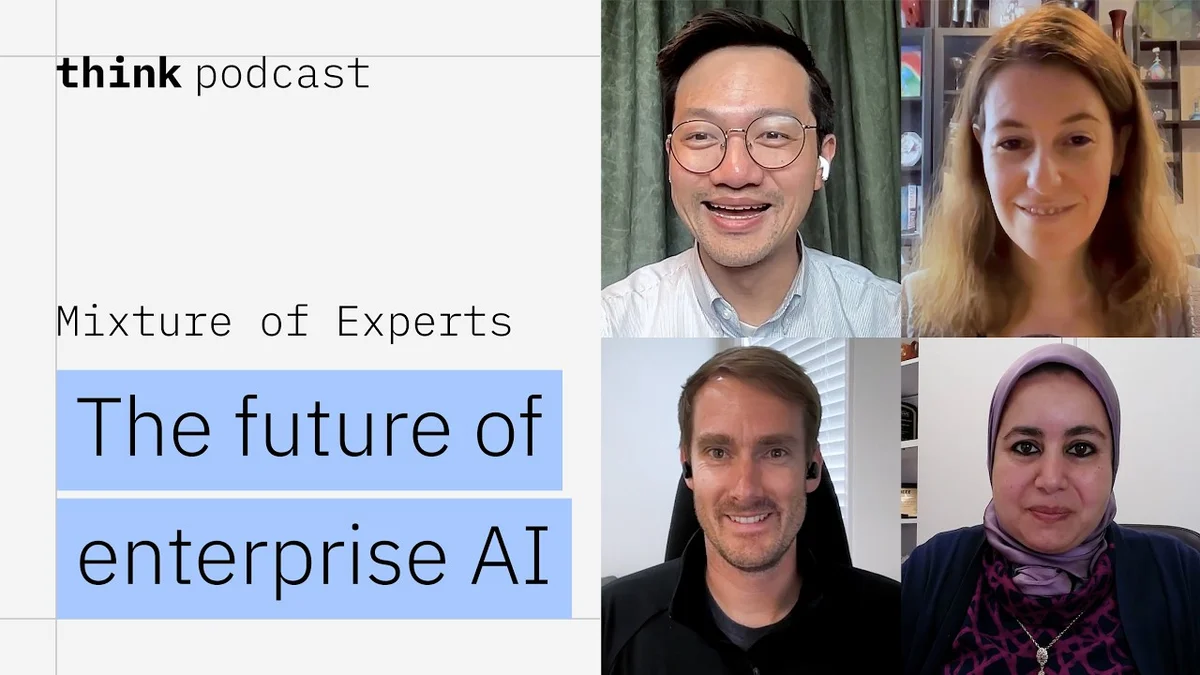
Four people on a video call discussing AI models.
Image credit: Mixture of Experts / IBM· IBM

In a recent discussion on the 'Mixture of Experts' podcast, IBM's Marina Danilevsky, Senior Research Scientist, and Gabe Goodhart, Chief Architect for AI Open Innovation, shed light on the evolving landscape of AI model training and deployment within enterprises. Their conversation focused on IBM's latest advancements, particularly the 'Bob' and 'Granite' model families, and the strategic considerations driving these developments.

Introducing IBM's AI Expertise

Marina Danilevsky, a Senior Research Scientist at IBM, brings a deep understanding of AI research and its practical applications. Her work at IBM focuses on pushing the boundaries of AI capabilities, particularly in areas relevant to enterprise solutions. Gabe Goodhart, as Chief Architect for AI Open Innovation at IBM, is at the forefront of translating cutting-edge AI research into tangible products and strategies for businesses. His role involves bridging the gap between academic discovery and real-world implementation.

The Shift Towards Specialized AI Models

The discussion began by highlighting a significant trend in AI development: the move from monolithic, general-purpose models to more specialized, efficient, and adaptable ones. Tim Hwang, the podcast host, noted the increasing focus on models that can be fine-tuned for specific tasks rather than relying on a single, massive model that attempts to do everything. This shift is driven by the need for greater efficiency, cost-effectiveness, and performance tailored to particular enterprise use cases.

The full discussion can be found on IBM's YouTube channel.
Related startups

Granite 4.1, IBM Bob & building a quantum ecosystem - IBM
Granite 4.1, IBM Bob & building a quantum ecosystem — from IBM

IBM's 'Bob' and 'Granite' Models

Goodhart introduced IBM's latest contributions to this trend with the 'Bob' and 'Granite' models. 'Bob' is positioned as a foundational model, likely serving as a base upon which more specialized capabilities can be built. 'Granite,' on the other hand, is presented as a family of models designed with enterprise needs in mind. These models offer a range of sizes and capabilities, including multimodal features, meaning they can process and understand different types of data, such as text and images.

Goodhart elaborated on the strategic advantage of this approach: "We're seeing a lot of models now that are going out targeting a general agential use case, whereas the Granite team has really focused on specializing... providing models that complement general agential frameworks really well." This specialization allows businesses to select models that precisely fit their needs, rather than trying to force a general model to perform a specific task.

Decoupled Training and Infrastructure Challenges

Danilevsky emphasized the concept of 'decoupled' AI training, where different components of an AI system are trained independently and then brought together. This approach contrasts with the more traditional method of training a single, massive model end-to-end. She explained, "You can train those models for specific tasks, and then you can use them in ways that are much more efficient and cost-effective for the enterprise."

However, this shift introduces new challenges, particularly around infrastructure. Training these large, specialized models requires significant computational resources, and distributing this training across multiple data centers efficiently is a complex undertaking. The discussion touched upon the need to optimize hardware utilization and manage the logistical challenges of distributed training, especially when dealing with massive datasets and complex model architectures.

The Future of AI Model Development

The conversation also explored the idea of AI models becoming more modular and composable. Instead of relying on a single, all-encompassing model, future AI systems might be built by assembling various specialized components, much like Lego bricks. This modularity allows for greater flexibility and customization, enabling organizations to adapt their AI solutions as their needs evolve.

Danilevsky noted the importance of this trend: "The modularity here is really interesting because it allows us to, you know, really fine-tune the kind of capabilities that we're going to need for specific tasks." This approach not only makes AI more accessible but also more manageable and cost-effective for businesses that may not have the resources to train massive models from scratch.

The Role of Data and Benchmarking

A key takeaway from the discussion was the critical role of data quality and the need for robust benchmarking. To effectively train specialized models, access to high-quality, domain-specific data is essential. Furthermore, rigorous benchmarking is necessary to evaluate the performance of these models and ensure they meet the required standards for accuracy, efficiency, and reliability.

Goodhart highlighted the ongoing efforts in this area: "We're seeing a lot of companies that are not just releasing models, but also releasing benchmarks that allow you to see how these models perform on specific tasks." This transparency and focus on measurable performance are crucial for the adoption and trust in AI technologies within enterprises.

Addressing Enterprise Needs

The experts agreed that the future of enterprise AI lies in providing solutions that are not only powerful but also practical and cost-effective. By focusing on specialized, modular, and efficiently trained models, companies like IBM are aiming to democratize access to advanced AI capabilities, enabling a wider range of businesses to benefit from its transformative potential.

© 2026 StartupHub.ai. All rights reserved. Do not enter, scrape, copy, reproduce, or republish this article in whole or in part. Use as input to AI training, fine-tuning, retrieval-augmented generation, or any machine-learning system is prohibited without written license. Substantially-similar derivative works will be pursued to the fullest extent of applicable copyright, database, and computer-misuse laws. See our terms.