


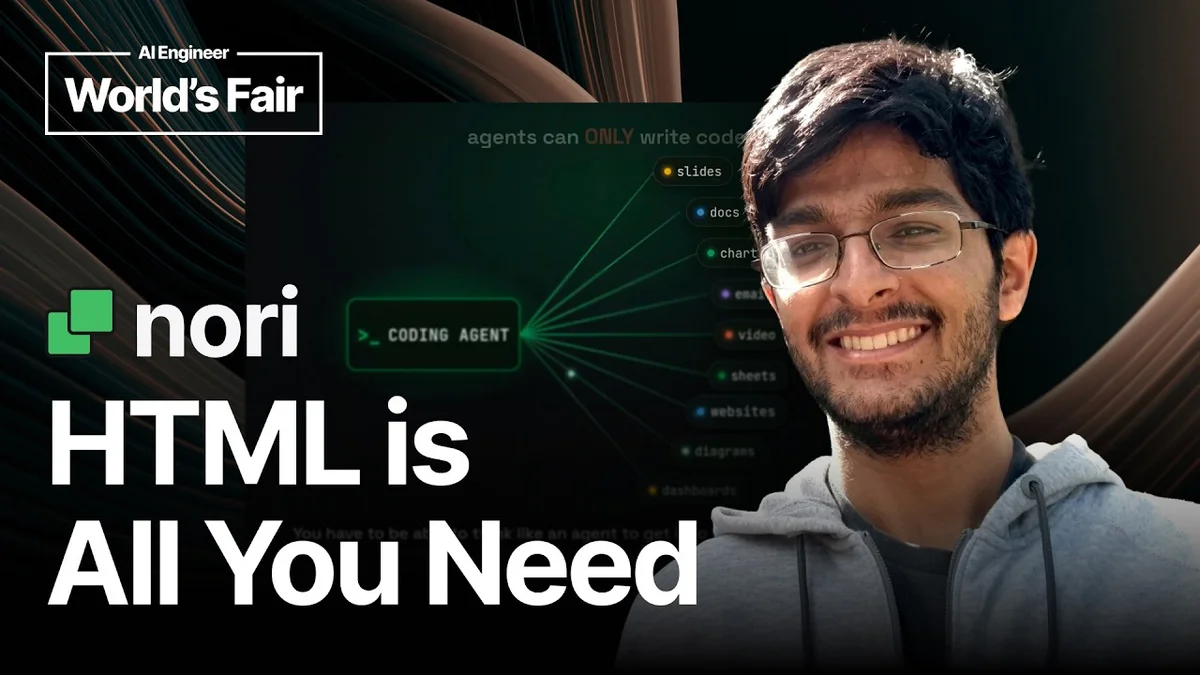
HTML: The Key for AI Agents to Create Graphics

Amol Kapoor of Nori Agentic argues that HTML is the ideal language for AI agents to create graphics, moving beyond pixel-based limitations to leverage AI's natural strengths.

5 min read
Amol Kapoor of Nori Agentic discusses how HTML is essential for AI agents to create graphics.
Amol Kapoor, CEO of Nori Agentic, presents on using HTML for AI-generated graphics.· AI Engineer
Visual TL;DR
Pixel-based tools inefficient for AIDriver
human-centric tools like PowerPoint rely on direct manipulation
AI excels at language/structureDriver
AI models process information inherently language and structure-based
HTML is AI's languageCore
From the article 9+ mentionsAmol Kapoor, CEO of Nori Agentic, presents a compelling case for HTML as the universal language for AI agents tasked with creating visual content.
AI creates diverse visualsEffect
slides, documents, and even entire videos
Future of AI visualsContext
leveraging AI's natural strengths for graphics
From the article 8 mentionsHe argues that these agents can produce a wide array of visual artifacts, from slides and documents to entire videos, by leveraging the right tools and formats.
Reclaim timeOutcome
automating visual creation tasks
From the article 2 mentionsBy offloading this "grunt work" to AI agents using HTML, humans can reclaim this time and focus on higher-level aspects like vision and storytelling.
Enhance creativityOutcome
focus on higher-level design concepts
Contents(4)

Amol Kapoor, CEO of Nori Agentic, presents a compelling case for HTML as the universal language for AI agents tasked with creating visual content. In his talk, "HTML is All You Need (for Agents to Make Graphics)," Kapoor challenges the perception that AI agents are solely code-writing entities. He argues that these agents can produce a wide array of visual artifacts, from slides and documents to entire videos, by leveraging the right tools and formats.

HTML: The Key for AI Agents to Create Graphics - AI Engineer
HTML: The Key for AI Agents to Create Graphics — from AI Engineer

The Limitations of Pixel-Based Creation for AI

Kapoor begins by highlighting the inefficiencies and limitations of current visual creation tools when used by AI. He points out that software like PowerPoint, Google Slides, Figma, and Canva are built with human interaction in mind, relying on direct manipulation through clicks, drags, and resizes. This graphical, pixel-based approach is fundamentally at odds with how AI models process information, which is inherently language- and structure-based.

He illustrates the point by referencing Simon Willison's test, which asks AI models to generate an SVG of a pelican riding a bicycle. While models can often produce the SVG code, the visual output is frequently flawed, demonstrating a lack of spatial reasoning. Kapoor asserts that this isn't a failure of the AI models themselves, but rather a mismatch in the medium. Asking an AI to create graphics using pixel manipulation is akin to asking a human to draw complex vector graphics purely by hand, it's inefficient and prone to error.

HTML: The Language AI Understands

The core of Kapoor's argument is that HTML provides the structural and semantic language that AI agents can effectively process and generate. Unlike pixel-based interfaces, HTML uses tags and attributes that define elements, their relationships, and their meaning (e.g., a heading, a paragraph, a chart). This structure allows AI models to understand and manipulate content in a way that aligns with their computational strengths.

Kapoor demonstrates this by showing how an AI can generate HTML code for a presentation slide, complete with charts and layouts. The browser then interprets this HTML and renders it into the visual output. He emphasizes that the AI doesn't need to 'think' about coordinates or pixel placement; it simply needs to output the correct HTML structure. This approach is significantly more efficient and scalable for AI-driven content creation.

Reclaiming Time and Enhancing Creativity

The talk also addresses the significant human time spent on the "fiddling" aspects of visual creation, aligning boxes, nudging text, and recoloring charts. Kapoor estimates that 34,000 human years are spent daily on these tasks, much of which is not the core creative thinking. By offloading this "grunt work" to AI agents using HTML, humans can reclaim this time and focus on higher-level aspects like vision and storytelling.

Kapoor highlights that Nori Agentic uses this HTML-centric approach to build various assets, including board decks, sales decks, and even the video presentation itself. He shows how a simple prompt can instruct an AI to generate a complete board deck, pulling data from various sources like call transcripts, emails, and Slack messages. This demonstrates the power of using AI agents with the right tools to automate complex content creation workflows.

The Future of AI-Generated Visuals

Kapoor concludes by urging a shift in perspective: stop thinking like a user of graphical interfaces and start thinking like the AI model. By providing AI agents with a language they understand, like HTML, and the necessary tools, we can unlock their full potential for creating a wide range of visual content. This reframe suggests that HTML is not just for web pages but is a fundamental building block for the next generation of AI-powered creative tools, enabling efficient, scalable, and high-quality visual output.

© 2026 StartupHub.ai. All rights reserved. Do not enter, scrape, copy, reproduce, or republish this article in whole or in part. Use as input to AI training, fine-tuning, retrieval-augmented generation, or any machine-learning system is prohibited without written license. Substantially-similar derivative works will be pursued to the fullest extent of applicable copyright, database, and computer-misuse laws. See our terms.