

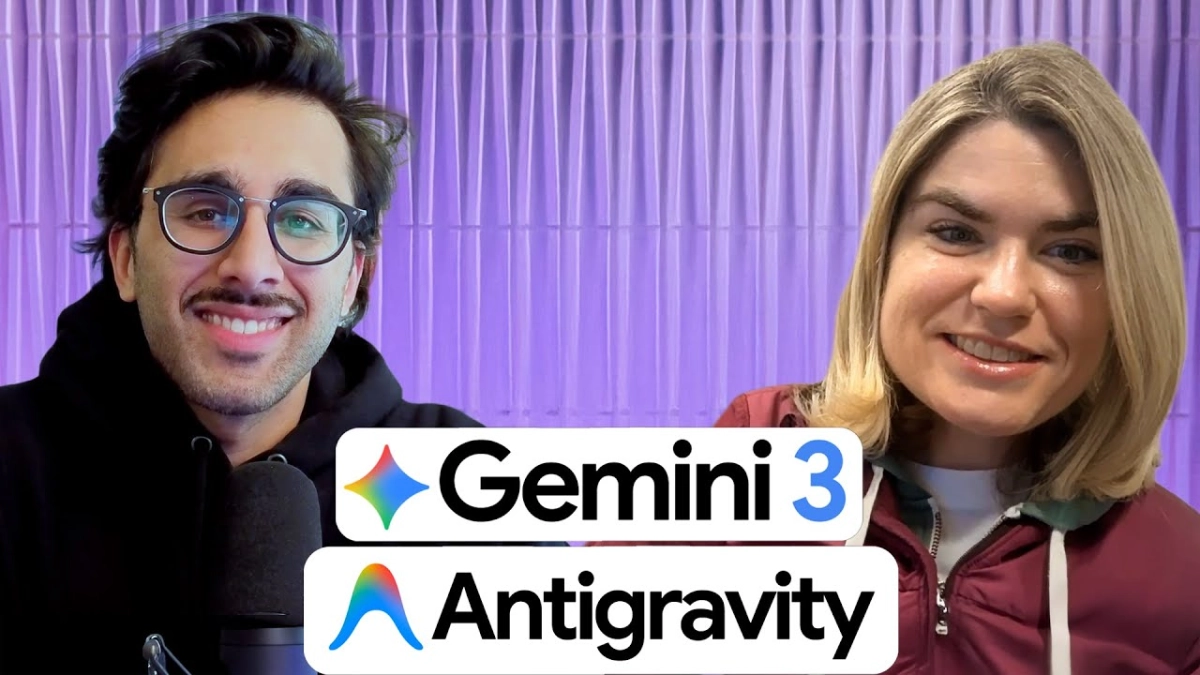
Google's DeepMind team, spearheaded by UTL Paige Bailey, recently unveiled a rapid succession of AI advancements, including Gemini 3 Pro, Nano Banana Pro, and the AI-native Antigravity IDE. On The Agent Factory Podcast, host Amit Maraj engaged Bailey in a detailed discussion about these releases, painting a picture of an AI landscape evolving at an unprecedented clip. Maraj aptly captured the excitement, noting that the flurry of announcements felt "almost like Christmas Day."
The sheer velocity of Google's AI development is a core insight from the interview. Bailey revealed that Google has been shipping a new model or feature "about every single day" over the past year, a relentless pace that underscores the intensity of competition and innovation in the AI space. This continuous deployment strategy ensures that Google's AI offerings remain at the cutting edge, constantly expanding their capabilities and reach across various platforms and use cases.
Central to these releases is the evolution of Gemini, Google's flagship AI model. Bailey articulated its progression through three distinct stages: Gemini 1 focused on multimodal understanding, enabling the model to comprehend diverse content types like video, images, audio, text, and code simultaneously. Gemini 2 advanced to "thinking," introducing sophisticated reasoning and planning abilities, allowing for detailed, step-by-step thought processes. Now, Gemini 3 marks a significant "shift to an era of action." This latest iteration excels at coding, tool use, and long-range planning, effectively translating complex reasoning into tangible outputs and interactions. Amit Maraj likened this progression to Gemini attending "school to learn the basics" (pre-training) and then gaining "on-the-job experience" (post-training), a process that involves feeding the model vast datasets, including synthetic data and real-world examples of tool usage and multi-turn conversations.
The practical implications of Gemini 3's enhanced agency are immediately apparent in its performance on agentic benchmarks. Bailey highlighted "Vending-Bench 2," a unique benchmark designed to measure an AI model's ability to autonomously run a simulated business over long durations. Gemini 3 Pro significantly outperformed competitors, generating over $5400 per vending machine in a simulated year. This demonstrates the model's capacity for strategic long-term decision-making and coherent execution, moving beyond simple task completion to managing complex, ongoing operations.
Google's new suite of AI-native developer tools further amplifies the power of Gemini 3, empowering founders and AI professionals to rapidly prototype and iterate on their ideas. The Google AI Studio, for instance, now features a "Build" mode where users can describe their app ideas in natural language. Bailey demonstrated building "Nordic Shield," an intelligent insurance cataloging app that seamlessly integrates webcam and microphone input for real-time object identification, wear assessment, and Google Search grounding to estimate item values. The system even intelligently named the app "Nordic Shield" and provided a Nordic/IKEA-inspired design. The AI Studio’s "auto-fix" feature is particularly noteworthy; as Bailey noted, the models are becoming so proficient that "it's triggering much less frequently now because the models are getting so good." This capability allows the AI to not only identify but also reason through and resolve coding errors, offering developers an unprecedented level of support and accelerating the development cycle. The "annotate" feature also enables collaborative UI design, allowing users to circle elements and add comments for the AI to implement design changes, much like a human designer would.