

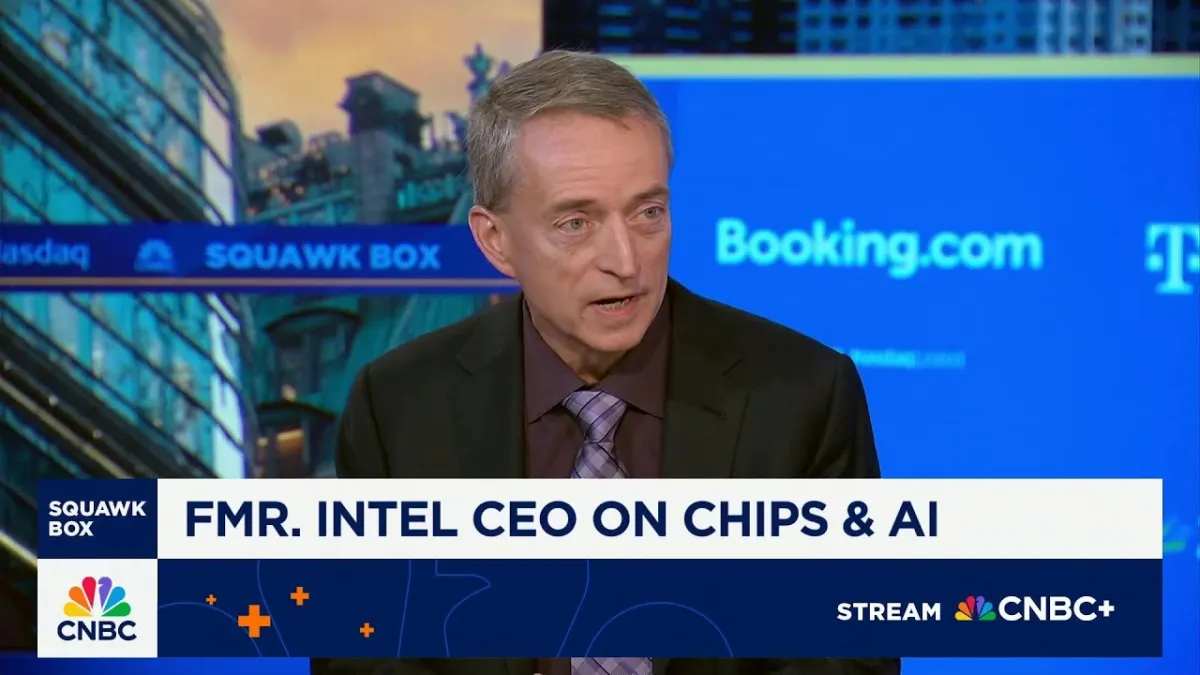
"Of course, we're in an AI bubble," declared Pat Gelsinger, former Intel CEO and current General Partner at Playground Global, offering a candid assessment of the current technological landscape during a recent appearance on CNBC's 'Squawk Box'. His commentary, delivered alongside discussions on the CHIPS Act and Intel's competitive standing, provided a grounded perspective for founders, investors, and industry professionals navigating the complexities of the chip and artificial intelligence sectors.
Gelsinger spoke with Andrew Ross Sorkin and the 'Squawk Box' team about the U.S. government's strategic investments in Intel, the efficacy of the CHIPS Act, the broader state of chip competition, and the profound impact of AI. His insights cut through the pervasive hype, grounding the conversation in tangible metrics and historical context.
The AI bubble, Gelsinger explained, is characterized by "hype, we're accelerating, we're putting enormous leverage into the system." However, he doesn't foresee this period of intense investment and rapid development concluding for "several years." This isn't merely speculative enthusiasm; it’s driven by a fundamental industry shift, a paradigm analogous to previous technological revolutions. Businesses, he notes, are "yet to really start materially benefiting from it," indicating that the foundational changes are still being laid, and the true economic returns are still on the horizon. This suggests a sustained period of innovation and infrastructure build-out, rather than an imminent collapse.
Central to the discussion was the CHIPS Act and its implications for domestic semiconductor manufacturing. Gelsinger, having been at the helm of Intel during the Act's initial phases, articulated a clear, results-oriented measure of success. "To me, the only metric that matters is: does it cause the building and filling of Intel fabs?" he stated. If the Act successfully stimulates the construction and operation of new fabrication facilities in the U.S., fulfilling its intent to re-shore supply chains and bolster national security, then it is a beneficial policy. If not, its purpose is effectively unmet.
His critique extended to the execution of the CHIPS Act. Gelsinger expressed "super disappointment" at the bureaucratic delays, noting "the length that it took to get that money deployed. Two and a half years, critical years, nothing happened." This bureaucratic inertia, in his view, undermined the urgency and effectiveness of the policy, potentially squandering valuable time in a fiercely competitive global industry. The administration's current approach, he observed, seems to acknowledge these shortcomings, indicating a willingness to "blow them up and reconceive them" to achieve better outcomes.