

Fed's Daly: Next Year is Litmus Test for AI's Economic Impact

San Francisco Fed President Mary Daly believes next year will be a crucial test for AI's economic impact, noting that while investment is high, widespread productivity gains are yet to materialize.

8 min read
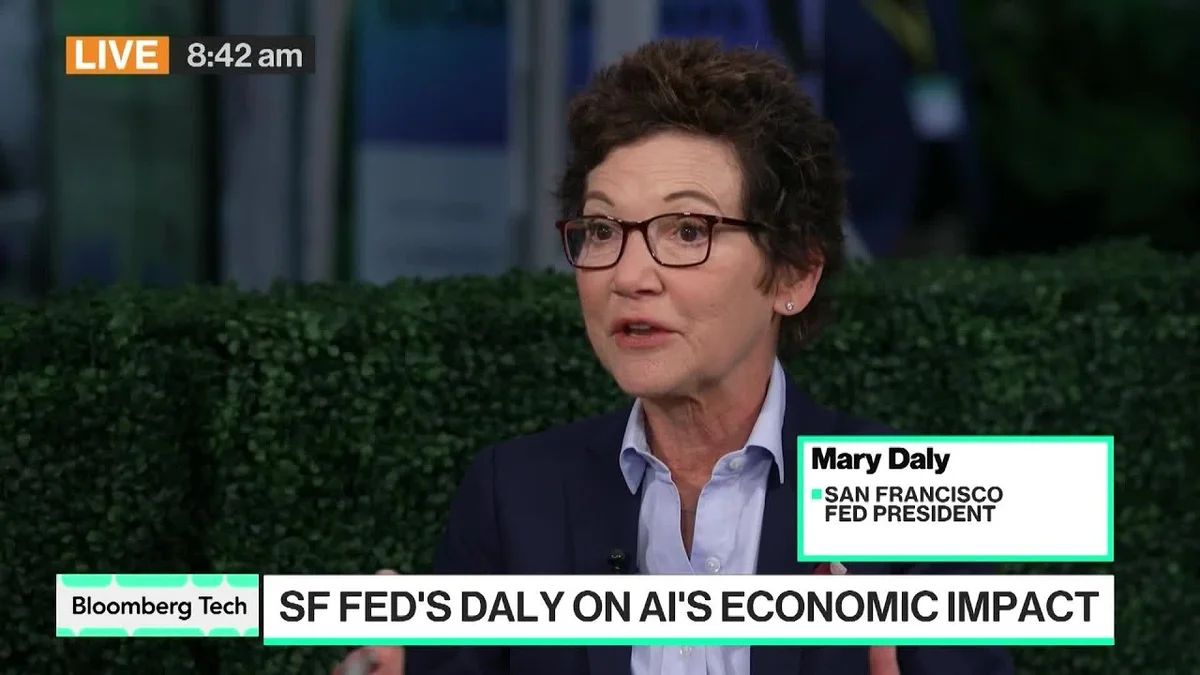
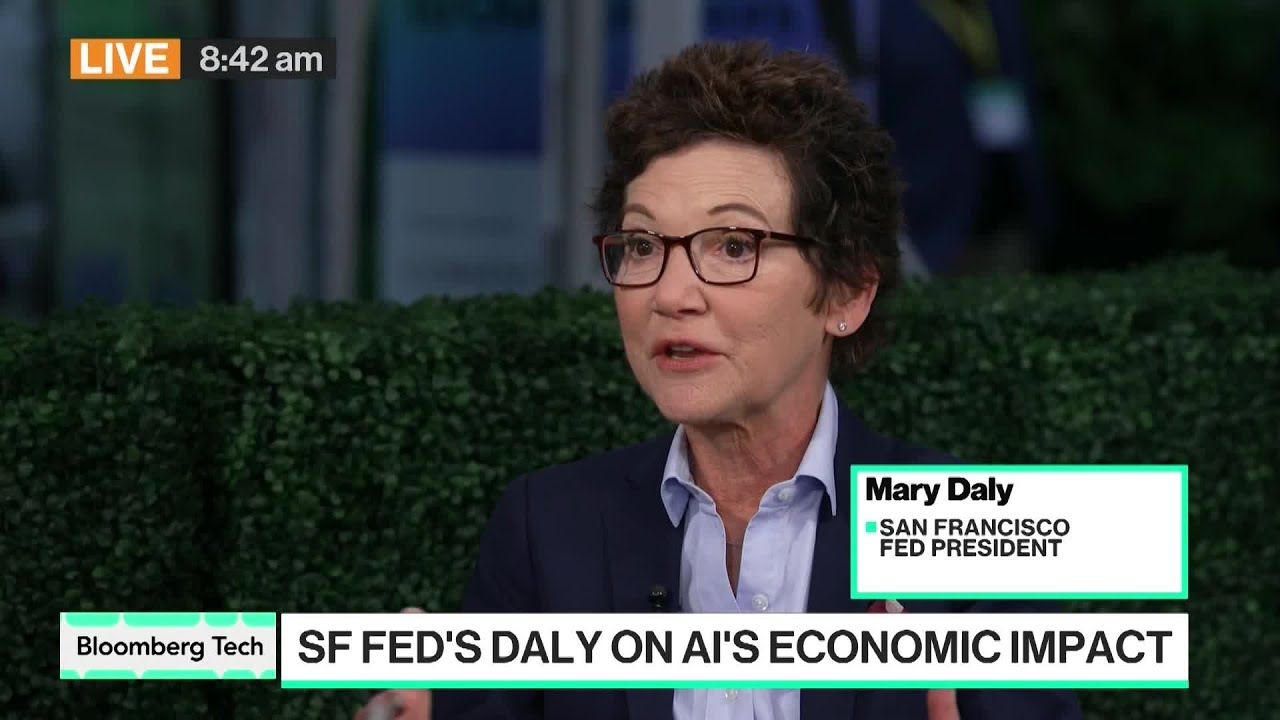
Mary Daly, San Francisco Fed President, speaking at a Bloomberg Tech event.
San Francisco Fed President Mary Daly discusses the economic implications of artificial intelligence.· Bloomberg Podcast

San Francisco Fed President Mary Daly believes that the coming year will serve as a critical period for assessing the real-world economic impact of artificial intelligence. Speaking at a Bloomberg Tech event, Daly highlighted the current disconnect between the immense enthusiasm and investment surrounding AI and the observable productivity gains across various industries.

Visual TL;DR. AI Investment High but Productivity Gains Missing. Productivity Gains Missing according to Fed's Daly. Fed's Daly states Next Year Litmus Test. Next Year Litmus Test depends on Transform Business Processes. Transform Business Processes determines AI Economic Impact.

  1. AI Investment High: significant enthusiasm and investment surrounding AI technologies
  2. Productivity Gains Missing: tangible benefits in productivity not yet consistently reflected
  3. Fed's Daly: San Francisco Fed President Mary Daly's assessment
  4. Next Year Litmus Test: crucial period for assessing real-world economic impact
  5. Transform Business Processes: how businesses are transforming fundamental operational processes
  6. AI Economic Impact: the true measure of AI's success
Visual TL;DR
Visual TL;DR — startuphub.ai AI Investment High but Productivity Gains Missing. Productivity Gains Missing according to Fed's Daly. Fed's Daly states Next Year Litmus Test but according to states AI Investment High Productivity Gains Missing Fed's Daly Next Year Litmus Test From startuphub.ai · The publishers behind this format
Visual TL;DR — startuphub.ai AI Investment High but Productivity Gains Missing. Productivity Gains Missing according to Fed's Daly. Fed's Daly states Next Year Litmus Test but according to states AI InvestmentHigh ProductivityGains Missing Fed's Daly Next Year LitmusTest From startuphub.ai · The publishers behind this format
Visual TL;DR — startuphub.ai AI Investment High but Productivity Gains Missing. Productivity Gains Missing according to Fed's Daly. Fed's Daly states Next Year Litmus Test but according to states AI Investment High significant enthusiasm and investmentsurrounding AI technologies Productivity Gains Missing tangible benefits in productivity not yetconsistently reflected Fed's Daly San Francisco Fed President Mary Daly'sassessment Next Year Litmus Test crucial period for assessing real-worldeconomic impact From startuphub.ai · The publishers behind this format
Visual TL;DR — startuphub.ai AI Investment High but Productivity Gains Missing. Productivity Gains Missing according to Fed's Daly. Fed's Daly states Next Year Litmus Test but according to states AI InvestmentHigh significantenthusiasm andinvestment… ProductivityGains Missing tangible benefitsin productivity notyet consistently… Fed's Daly San Francisco FedPresident MaryDaly's assessment Next Year LitmusTest crucial period forassessingreal-world economic… From startuphub.ai · The publishers behind this format
Visual TL;DR — startuphub.ai AI Investment High but Productivity Gains Missing. Productivity Gains Missing according to Fed's Daly. Fed's Daly states Next Year Litmus Test. Next Year Litmus Test depends on Transform Business Processes. Transform Business Processes determines AI Economic Impact but according to states depends on determines AI Investment High significant enthusiasm and investmentsurrounding AI technologies Productivity Gains Missing tangible benefits in productivity not yetconsistently reflected Fed's Daly San Francisco Fed President Mary Daly'sassessment Next Year Litmus Test crucial period for assessing real-worldeconomic impact Transform Business Processes how businesses are transformingfundamental operational processes AI Economic Impact the true measure of AI's success From startuphub.ai · The publishers behind this format
Visual TL;DR — startuphub.ai AI Investment High but Productivity Gains Missing. Productivity Gains Missing according to Fed's Daly. Fed's Daly states Next Year Litmus Test. Next Year Litmus Test depends on Transform Business Processes. Transform Business Processes determines AI Economic Impact but according to states depends on determines AI InvestmentHigh significantenthusiasm andinvestment… ProductivityGains Missing tangible benefitsin productivity notyet consistently… Fed's Daly San Francisco FedPresident MaryDaly's assessment Next Year LitmusTest crucial period forassessingreal-world economic… TransformBusiness… how businesses aretransformingfundamental… AI EconomicImpact the true measure ofAI's success From startuphub.ai · The publishers behind this format

Daly articulated that while companies are actively exploring and implementing AI technologies, the tangible benefits in terms of productivity are not yet consistently reflected in economic data. She suggested that the true measure of AI's success will lie not just in the adoption of new models or tools, but in how effectively businesses are transforming their fundamental operational processes.

Related startups

She elaborated on this by stating, "It's about transforming your business processes. It's about how you train your workforce, how you think about what AI can do not just in the back office but in the front office of operations." Daly observed that this transformation is occurring across a wide spectrum of businesses, from small startups to large multinational corporations, and spans diverse sectors such as agriculture and manufacturing.

The full discussion can be found on Bloomberg Podcast's YouTube channel.

Fed's Daly Says Next Year to Be Litmus Test for AI - Bloomberg Podcast
Fed's Daly Says Next Year to Be Litmus Test for AI — from Bloomberg Podcast

AI's Broad Application and the Search for ROI

The San Francisco Fed President noted that businesses are integrating AI into various facets of their operations, from automating routine tasks to enhancing complex decision-making. She highlighted examples such as AI assisting in machinery and building processes, as well as in service industries. However, she stressed that the key challenge remains in quantifying the return on investment (ROI) for these AI implementations.

Daly expressed a cautiously optimistic outlook, stating, "I'm definitely bullish on the possibilities of AI, and I see the enthusiasm picked up tremendously over the last year." She acknowledged that while some businesses are beginning to see early rewards, the broader economic impact is still in its nascent stages. "We haven't seen widespread productivity gains yet," she admitted, "but I am seeing tremendous investment and thinking about how to train their workforces to be AI ready."
The "Litmus Test" Year Ahead

Looking ahead, Daly positioned the next year as a significant "litmus test" for AI's economic potential. She explained that the focus will be on discerning which AI applications are truly driving value and which are merely hype. "What we know is that it's not just about getting a model and using it as an agent," Daly stated, "it's about transforming your business processes."

The Federal Reserve, she indicated, is closely monitoring the integration of AI and its potential effects on inflation and the broader economy. While Daly stated she is not currently seeing financial stability concerns related to AI investment itself, she acknowledged the need for careful observation of how these investments translate into real economic outcomes. "We have to wait and see," she commented, "and we will be looking at the data for the next year to see if we start to see those productivity gains."

Comparing AI Boom to Dot-Com Bubble

When asked to compare the current AI boom to the dot-com bubble of the late 1990s, Daly drew a distinction, noting that the AI revolution is built on a more solid foundation of tangible utility. "The dot-com bubble was very different from the AI boom," Daly remarked. "We have seen productivity growth that has been outside the historical norm and is a positive for the U.S. economy."

She elaborated that unlike the dot-com era, where many companies lacked clear business models or revenue streams, current AI applications are demonstrating more immediate and practical value. This difference, she suggested, means that while there may be speculative elements, the underlying technology has a stronger potential for sustained economic contribution.

Daly concluded by emphasizing the importance of careful analysis and prudent policy-making in navigating the AI revolution. "We are fiduciary stewards of public trust," she stated, "and we have to do our best work to ensure that we are spending taxpayer dollars wisely and that our policies are driving toward the outcomes that we want." The Federal Reserve's approach, she indicated, will be to remain data-driven and adaptable, ensuring that the benefits of AI are realized broadly across the economy.

© 2026 StartupHub.ai. All rights reserved. Do not enter, scrape, copy, reproduce, or republish this article in whole or in part. Use as input to AI training, fine-tuning, retrieval-augmented generation, or any machine-learning system is prohibited without written license. Substantially-similar derivative works will be pursued to the fullest extent of applicable copyright, database, and computer-misuse laws. See our terms.