


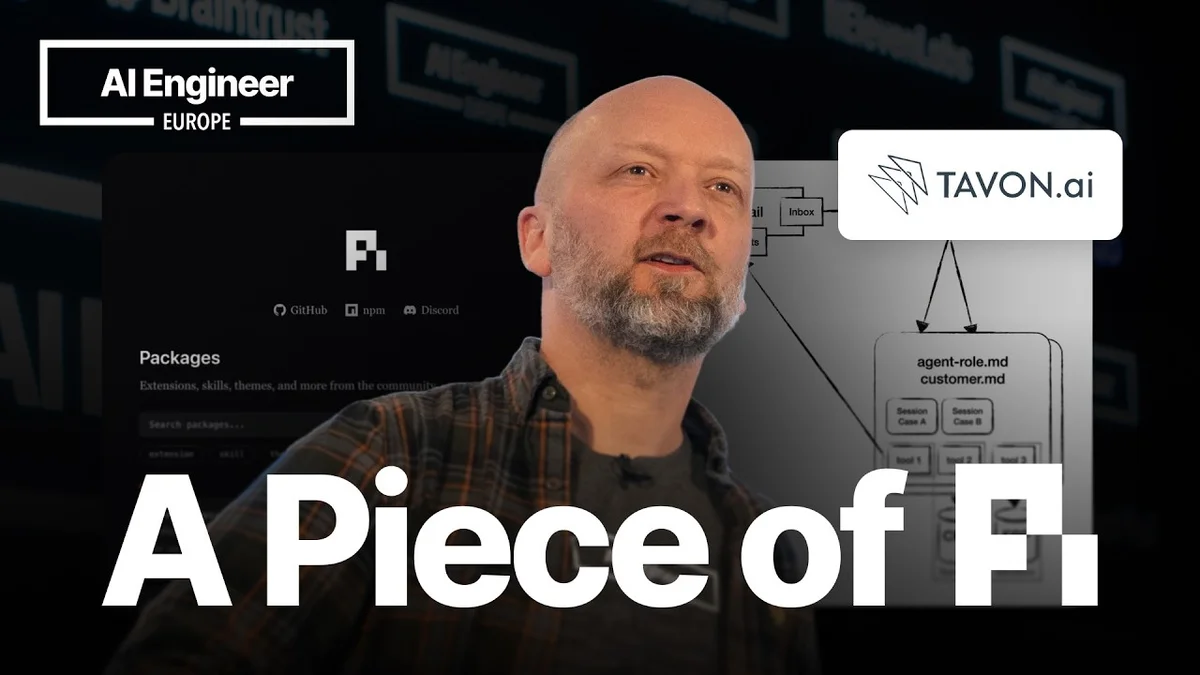
Matthias Luebken, from Tavon.ai, presented at AI Engineer Europe on the topic of embedding the OpenClaw coding agent into products. The session, titled "A Piece of Pi: Embedding The OpenClaw Coding Agent In Your Product," explored how developers can integrate this powerful AI tool into their own applications.
Understanding the "Pi" Coding Agent
Luebken introduced "Pi" as a minimal terminal coding agent that streamlines the process of interacting with AI for coding tasks. Unlike more complex agents that might include sub-agents or plan modes, Pi focuses on direct interaction, allowing users to "ask Pi to build what you want." He highlighted that Pi is open-source, built by Mario Zechner, and has recently become part of earendil.com.
Agents as Core Building Blocks
A central theme of the presentation was the growing importance of coding agents as fundamental components of future software systems. Luebken referenced the current phase as "the fuck around and find out phase of (coding) agents," emphasizing that while the field is rapidly evolving, understanding the core mechanics is crucial. He advocated for a design philosophy that makes it easy for coding agents to function effectively.
The OpenClaw Plugin Hook System
Luebken detailed OpenClaw's plugin hook system, designed for a multi-channel, multi-agent platform. This system provides hooks for various aspects of agent operation, including multi-channel routing, model provider orchestration, sub-agent management, gateway lifecycle, session lifecycle, message persistence, observability, and production agent wrapping. This modular approach allows for flexibility and extensibility when building agent-powered applications.
Practical Application: CRM Lead Qualifier
To illustrate the practical application of these concepts, Luebken showcased a "CRM Lead Qualifier" agent. This agent helps sales teams score and prioritize leads by interacting with CRM data. The example demonstrated how the agent could search contacts, score leads based on various criteria, update contact information, and log interactions. The underlying mechanism involved multiple tools, including the ability to interact with data via command-line interfaces and potentially web UIs.