

ElevenLabs Gives Chat Agents a Voice

Luke Harries from ElevenLabs discusses the increasing importance of voice for AI chat agents, highlighting the benefits of speed, accessibility, and user experience.

5 min read
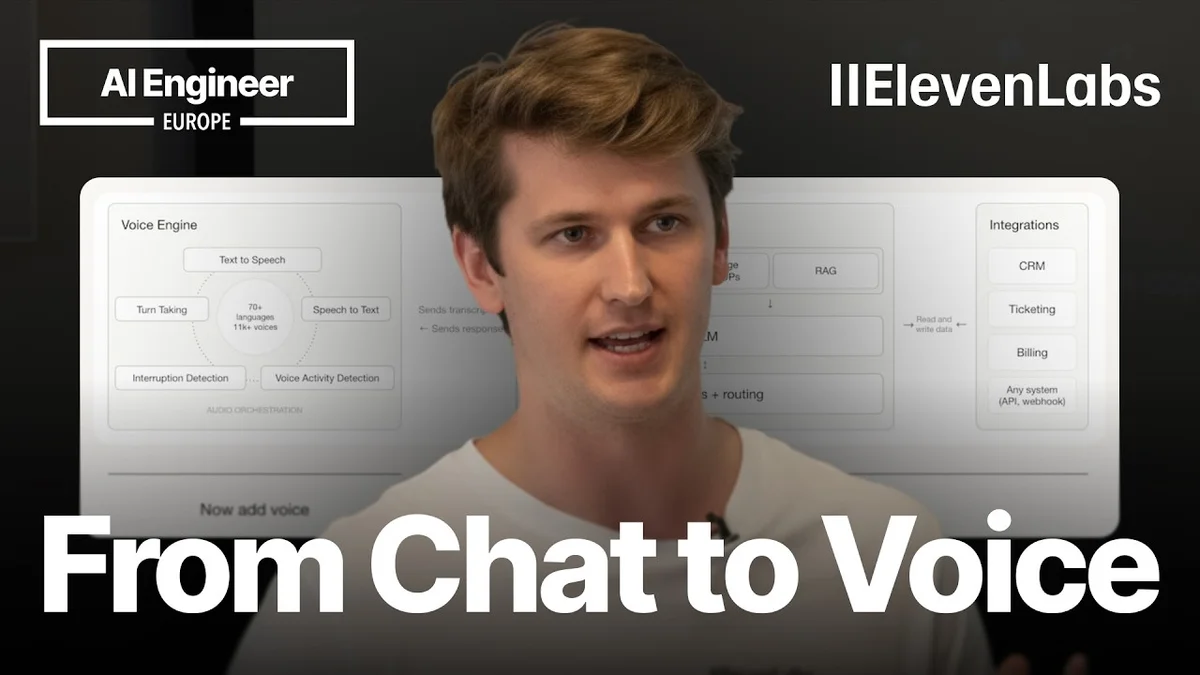
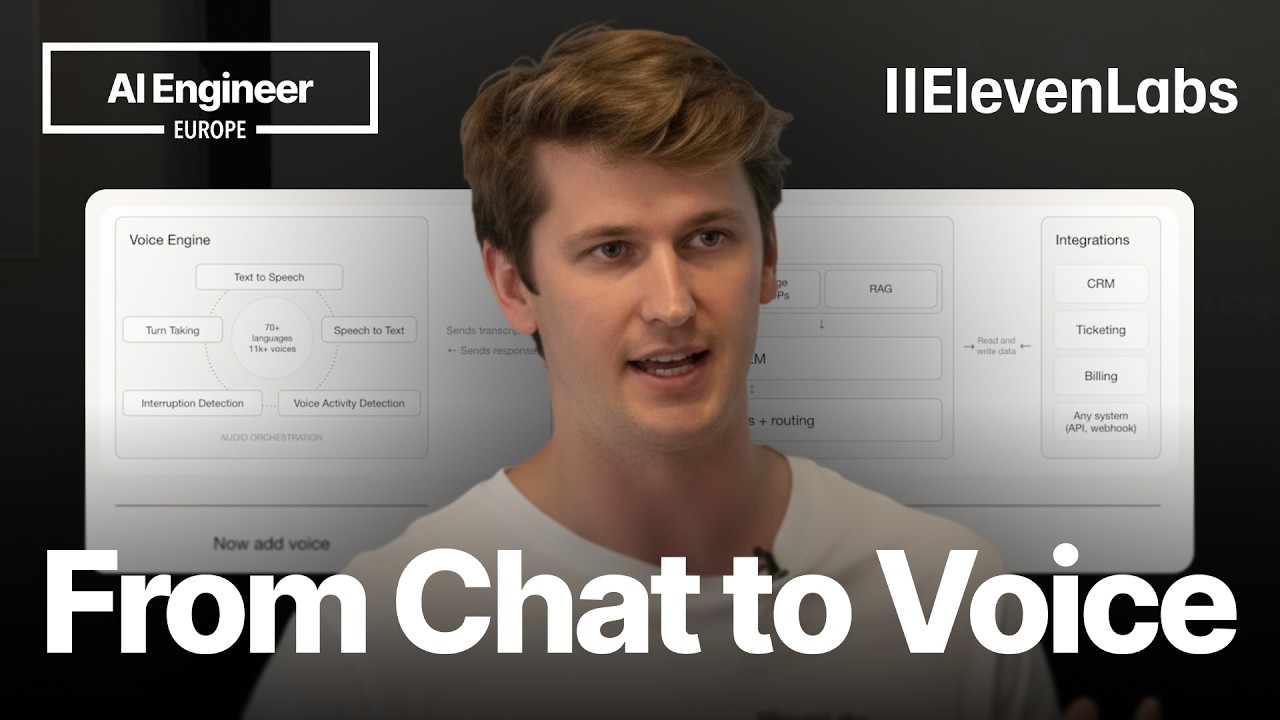
Luke Harries of ElevenLabs presenting on giving chat agents a voice.
Image credit: AI Engineer· AI Engineer

Luke Harries from ElevenLabs presented on the future of AI interaction, focusing on how to equip chat agents with a voice. He posited that by 2025, businesses will either have integrated chat agents into their software-as-a-service (SaaS) offerings or will have adopted an AI-first approach where chat agents are the primary user interface.
ElevenLabs Gives Chat Agents a Voice - AI Engineer
ElevenLabs Gives Chat Agents a Voice — from AI Engineer

The Evolution of Chat Agents

Harries highlighted a prevalent trend driven by a viral tweet: by 2025, businesses will either have died as a SaaS or added a chat agent. This sentiment suggests the increasing importance of conversational AI in user experience. He noted that while chat agents are becoming standard, voice remains the more natural and efficient medium for human-computer interaction. Voice is presented as being three times faster and more accessible, enabling omnichannel experiences.

The Power of Voice in AI Interaction

The presentation emphasized that voice interaction unlocks new possibilities for AI agents. Harries stated, "Voice is the natural medium... it's way quicker, it's way more interactive, it's also much more accessible." This accessibility is crucial for users who may struggle with traditional keyboard interfaces due to conditions like dyslexia. The ability to integrate voice allows AI agents to participate in voice calls, offer real-time feedback, and provide a more engaging user experience.

Building and Integrating Voice Agents

ElevenLabs is providing developers with the tools to seamlessly integrate voice capabilities into their existing chat agents. Harries showcased the architecture of a voice agent, which typically comprises a 'Voice Engine' for audio processing and 'Agent Orchestration' for managing the LLM, knowledge base, and integrations. The Voice Engine handles tasks like turn-taking, speech-to-text, and text-to-speech, ensuring natural and context-aware interactions. The Agent Orchestration layer integrates with LLMs, knowledge bases, and Retrieval-Augmented Generation (RAG) systems to provide intelligent responses.

Harries demonstrated the simplicity of integrating ElevenLabs' technology. He explained that developers can leverage their existing chat agent infrastructure and add a voice wrapper. The process involves obtaining a conversation token, starting a session, and then using the server SDK to attach the voice engine. This allows the agent to process voice input, generate responses, and output them as speech. The client SDK simplifies this further, enabling developers to add a voice widget to their site with just a few lines of code.

ElevenLabs' Offerings: Voice Engine vs. Agents Platform

ElevenLabs offers two distinct paths for developers: the 'Voice Engine' and the 'Agents Platform'. The Voice Engine provides maximum flexibility, allowing users to implement their own LLM and orchestration logic, custom RAG and business logic, and text-only servers. It supports the same Conversation SDK. The Agents Platform, conversely, focuses on maximum performance with fully managed LLMs, built-in tools, a knowledge base, a dashboard for non-developers, and out-of-the-box telephony, offering the lowest possible latency.

Harries concluded by offering a glimpse into the future, predicting that by 2026, the choice will be stark: either a company's chat agent will die, or it will evolve into a voice agent. He expressed enthusiasm for collaborating with early adopters and design partners who are looking to lead this transition, emphasizing the ease with which existing chat agents can be enhanced with voice capabilities.

ElevenLabs in 2026: From Demo to Enterprise Standard

In the months since this presentation, ElevenLabs has moved from conference demo to enterprise infrastructure. In February 2026, the company raised $500 million in a Series D round led by Sequoia Capital at an $11 billion valuation, per TechCrunch, more than triple its January 2025 mark. By April 2026, annualized revenue had surpassed $500 million, up from $350 million at end of 2025, with enterprise revenue growing 200% year-over-year. The company's voice platform is now deployed by 41% of Fortune 500 companies, including two landmark rollouts that validate exactly the use cases Harries outlined in the presentation above.

Revolut deployed ElevenLabs Agents for customer support across the UK and Europe, covering more than 4 million customers, and reported an 8x reduction in time-to-resolution across 30-plus languages. Klarna launched an ElevenLabs voice AI agent as first-line phone support for 35 million U.S. customers, reporting up to 10x faster resolutions. Both deployments reflect the voice-over-text thesis Harries argued: three times faster, more accessible, and available across channels.

StartupHub.ai, which tracks ElevenLabs at a score of 79 out of 100, notes the company is among the highest-rated AI voice infrastructure providers in the tools we index, alongside competitors building in speech-to-text, text-to-speech, and real-time translation. The gap between ElevenLabs and the next tier of voice providers has widened as enterprise contract sizes have grown.

Frequently Asked Questions

What does ElevenLabs do for chat agents?

ElevenLabs provides voice infrastructure that wraps existing chat agents with speech-to-text, turn-taking, and text-to-speech capabilities. Developers can add a voice widget to their site with a few lines of code, transforming a text-only chatbot into a full voice agent without rebuilding the underlying LLM or knowledge base.

How much does ElevenLabs cost?

ElevenLabs offers business plans starting at $0.50 per hour of generated audio, with custom enterprise pricing for large-scale deployments. A free tier is available for developers and small projects.

What is the difference between ElevenLabs Voice Engine and Agents Platform?

The Voice Engine gives developers maximum flexibility to plug in their own LLM, orchestration, and RAG logic using the Conversation SDK. The Agents Platform is fully managed, offering built-in LLMs, a knowledge base, dashboard for non-technical users, and out-of-the-box telephony with the lowest possible latency.

Who are ElevenLabs' biggest enterprise customers?

Publicly confirmed deployments include Revolut (customer support for 4 million-plus UK and European customers across 30 languages, 8x faster resolution) and Klarna (first-line voice support for 35 million U.S. customers, up to 10x faster resolution). The platform is used by 41% of Fortune 500 companies as of 2026.

Last updated: August 2026

© 2026 StartupHub.ai. All rights reserved. Do not enter, scrape, copy, reproduce, or republish this article in whole or in part. Use as input to AI training, fine-tuning, retrieval-augmented generation, or any machine-learning system is prohibited without written license. Substantially-similar derivative works will be pursued to the fullest extent of applicable copyright, database, and computer-misuse laws. See our terms.