Diane Lin on AI Agent Inconsistency

Diane Lin from Datadog explains how AI agents' inconsistent outputs often stem from ambiguous data and how to improve them using memory augmentation techniques.

8 min read
Diane Lin speaking on a video call about AI agent consistency
AI Engineer

Visual TL;DR. AI Agent Inconsistency addressed by Diane Lin. AI Agent Inconsistency caused by Ambiguous Data. Ambiguous Data illustrated by Gray Zone Data. Diane Lin proposes Memory Augmentation. Memory Augmentation includes Active Learning. Memory Augmentation leads to Improved Consistency. Diane Lin offers Practical Solutions. Ambiguous Data mitigated by Memory Augmentation.

  1. AI Agent Inconsistency: outputs vary for same input, a common yet overlooked challenge for developers
  2. Diane Lin: Datadog Tech Lead for Self-Evolving AI Agents, presented solutions to this issue
  3. Ambiguous Data: root cause often lies in data points near decision boundaries, not the model
  4. Gray Zone Data: examples from sentiment analysis and cybersecurity where human experts might disagree
  5. Memory Augmentation: techniques to improve consistency by providing agents with past interactions
  6. Active Learning: leveraging human feedback to clarify ambiguous data points and refine decisions
  7. Improved Consistency: agents produce more reliable and predictable outputs for similar inputs
  8. Practical Solutions: offering actionable methods for developers to address agent output variability
Visual TL;DR
Visual TL;DR, startuphub.ai AI Agent Inconsistency addressed by Diane Lin. AI Agent Inconsistency caused by Ambiguous Data. Diane Lin proposes Memory Augmentation. Memory Augmentation leads to Improved Consistency. Ambiguous Data mitigated by Memory Augmentation addressed by caused by proposes leads to mitigated by AI Agent Inconsistency Diane Lin Ambiguous Data Memory Augmentation Improved Consistency From startuphub.ai · The publishers behind this format
Visual TL;DR, startuphub.ai AI Agent Inconsistency addressed by Diane Lin. AI Agent Inconsistency caused by Ambiguous Data. Diane Lin proposes Memory Augmentation. Memory Augmentation leads to Improved Consistency. Ambiguous Data mitigated by Memory Augmentation addressed by caused by proposes leads to mitigated by AI AgentInconsistency Diane Lin Ambiguous Data MemoryAugmentation ImprovedConsistency From startuphub.ai · The publishers behind this format
Visual TL;DR, startuphub.ai AI Agent Inconsistency addressed by Diane Lin. AI Agent Inconsistency caused by Ambiguous Data. Diane Lin proposes Memory Augmentation. Memory Augmentation leads to Improved Consistency. Ambiguous Data mitigated by Memory Augmentation addressed by caused by proposes leads to mitigated by AI Agent Inconsistency outputs vary for same input, a common yetoverlooked challenge for developers Diane Lin Datadog Tech Lead for Self-Evolving AIAgents, presented solutions to this issue Ambiguous Data root cause often lies in data points neardecision boundaries, not the model Memory Augmentation techniques to improve consistency byproviding agents with past interactions Improved Consistency agents produce more reliable andpredictable outputs for similar inputs From startuphub.ai · The publishers behind this format
Visual TL;DR, startuphub.ai AI Agent Inconsistency addressed by Diane Lin. AI Agent Inconsistency caused by Ambiguous Data. Diane Lin proposes Memory Augmentation. Memory Augmentation leads to Improved Consistency. Ambiguous Data mitigated by Memory Augmentation addressed by caused by proposes leads to mitigated by AI AgentInconsistency outputs vary forsame input, acommon yet… Diane Lin Datadog Tech Leadfor Self-EvolvingAI Agents,… Ambiguous Data root cause oftenlies in data pointsnear decision… MemoryAugmentation techniques toimprove consistencyby providing agents… ImprovedConsistency agents produce morereliable andpredictable outputs… From startuphub.ai · The publishers behind this format
Visual TL;DR, startuphub.ai AI Agent Inconsistency addressed by Diane Lin. AI Agent Inconsistency caused by Ambiguous Data. Ambiguous Data illustrated by Gray Zone Data. Diane Lin proposes Memory Augmentation. Memory Augmentation includes Active Learning. Memory Augmentation leads to Improved Consistency. Diane Lin offers Practical Solutions. Ambiguous Data mitigated by Memory Augmentation addressed by caused by illustrated by proposes includes leads to offers mitigated by AI Agent Inconsistency outputs vary for same input, a common yetoverlooked challenge for developers Diane Lin Datadog Tech Lead for Self-Evolving AIAgents, presented solutions to this issue Ambiguous Data root cause often lies in data points neardecision boundaries, not the model Gray Zone Data examples from sentiment analysis andcybersecurity where human experts mightdisagree Memory Augmentation techniques to improve consistency byproviding agents with past interactions Active Learning leveraging human feedback to clarifyambiguous data points and refine decisions Improved Consistency agents produce more reliable andpredictable outputs for similar inputs Practical Solutions offering actionable methods for developersto address agent output variability From startuphub.ai · The publishers behind this format
Visual TL;DR, startuphub.ai AI Agent Inconsistency addressed by Diane Lin. AI Agent Inconsistency caused by Ambiguous Data. Ambiguous Data illustrated by Gray Zone Data. Diane Lin proposes Memory Augmentation. Memory Augmentation includes Active Learning. Memory Augmentation leads to Improved Consistency. Diane Lin offers Practical Solutions. Ambiguous Data mitigated by Memory Augmentation addressed by caused by illustrated by proposes includes leads to offers mitigated by AI AgentInconsistency outputs vary forsame input, acommon yet… Diane Lin Datadog Tech Leadfor Self-EvolvingAI Agents,… Ambiguous Data root cause oftenlies in data pointsnear decision… Gray Zone Data examples fromsentiment analysisand cybersecurity… MemoryAugmentation techniques toimprove consistencyby providing agents… Active Learning leveraging humanfeedback to clarifyambiguous data… ImprovedConsistency agents produce morereliable andpredictable outputs… PracticalSolutions offering actionablemethods fordevelopers to… From startuphub.ai · The publishers behind this format

Inconsistency in AI agent outputs is a common, yet often overlooked, challenge for developers. Diane Lin, Tech Lead for Self-Evolving AI Agents at Datadog, addressed this pervasive issue in a recent presentation, explaining its root causes and offering practical solutions. Lin, whose background spans continuous learning, one-shot learning, and zero-shot transfer learning at institutions like Imperial College London and MIT, as well as industry giants like Alexa and Vicarious (now part of Google DeepMind), highlighted that the problem often lies not with the model itself, but with the data it's trained on.

Diane Lin on AI Agent Inconsistency - AI Engineer
Diane Lin on AI Agent Inconsistency — from AI Engineer

Understanding the Root of Inconsistency

Lin explained that when AI agents produce inconsistent outputs for the same input, it's frequently due to data points residing in the "gray zone", the area near a decision boundary where even human experts might disagree. She illustrated this with examples from sentiment analysis and cybersecurity. For instance, a hotel review that is subtly positive but contains minor negative elements might be classified differently across multiple runs, reflecting genuine ambiguity in the data.

Similarly, in cybersecurity, a "failed login attempt from a suspicious IP" could be classified as benign or malicious depending on contextual factors or company policy. The agent's inconsistency, Lin argued, is not a flaw in the AI but rather an indication that the AI is highlighting the inherent ambiguity present in the data. Traditional machine learning models often struggle with these edge cases, leading to the observed variability in outputs.

Leveraging Active Learning and Memory for Improvement

To address this, Lin proposed leveraging active learning techniques to identify these ambiguous data points. Instead of labeling all data, active learning focuses human attention on the most informative examples, particularly those near the decision boundary. This approach can significantly improve model performance with less labeling effort.

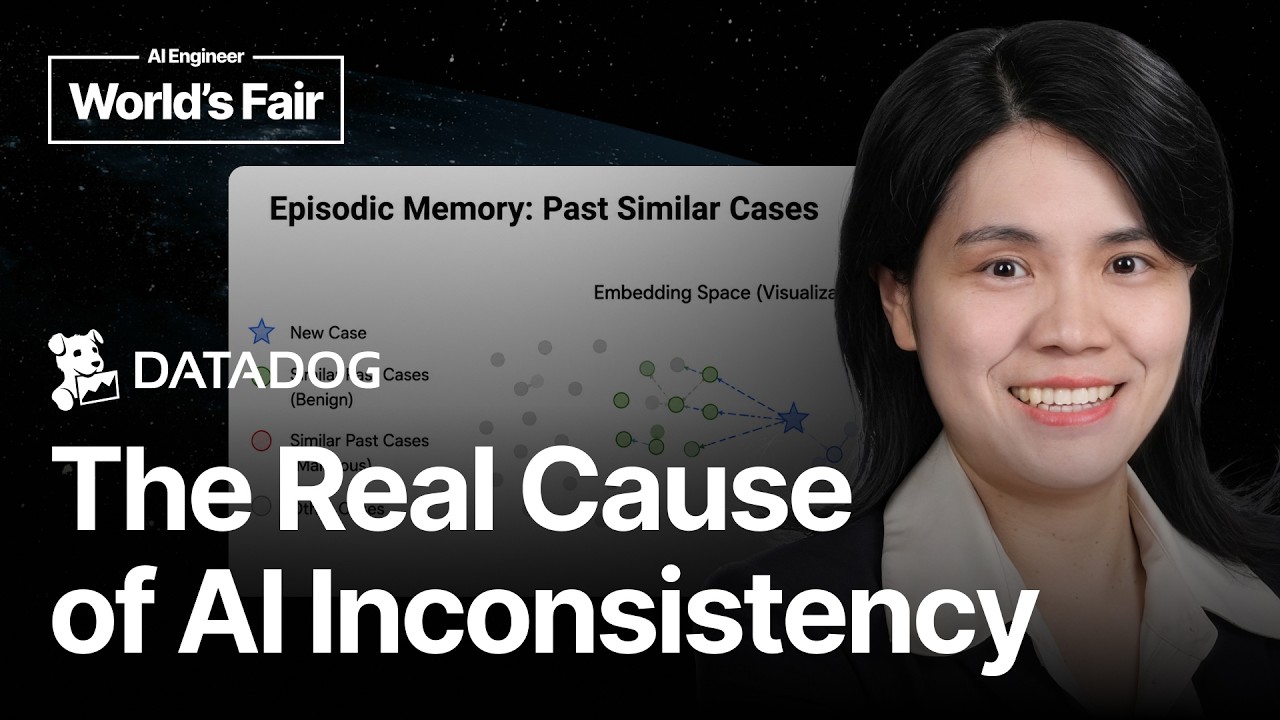
Furthermore, Lin introduced a novel approach that augments AI agents with semantic and episodic memory. Semantic memory involves incorporating explicit domain knowledge and rules, such as company-specific policies or preferences, directly into the agent's knowledge base. Episodic memory, on the other hand, leverages past similar cases to inform current decisions. By referencing previously labeled similar instances, the agent can make more consistent judgments without requiring explicit rule-based knowledge distillation.

The combination of these two memory systems, Lin explained, allows for a more robust and adaptable AI agent. Episodic memory handles recurring situations automatically, freeing up human reviewers to focus on truly ambiguous cases that require deeper analysis and the addition of new domain knowledge to the semantic memory.

Tangible Benefits and Experimental Results

Lin presented experimental results demonstrating the effectiveness of this approach. By applying their solution, which incorporates both semantic and episodic memory, they were able to significantly improve the consistency of AI agent verdicts. In an experiment with 93 cybersecurity alerts, a quarter of which initially showed inconsistent verdicts across three reruns, their method reduced the remaining inconsistency. This leads to more trustworthy AI agents, more efficient quality control, and better alignment with customer-specific needs and preferences.

Lin concluded with three key takeaways for AI developers:

  • Inconsistency is often a data problem, not a model problem. Focus on label ambiguity and insufficient information.
  • Model disagreement is a feature, not a bug, signaling areas for learning.
  • Fine-tuning is not the only path to improvement; augmenting agents with semantic and episodic memory offers a more efficient alternative.

By embracing these principles, developers can build more reliable and adaptable AI agents that better serve user needs.

© 2026 StartupHub.ai. All rights reserved. Do not enter, scrape, copy, reproduce, or republish this article in whole or in part. Use as input to AI training, fine-tuning, retrieval-augmented generation, or any machine-learning system is prohibited without written license. Substantially-similar derivative works will be pursued to the fullest extent of applicable copyright, database, and computer-misuse laws. See our terms.