


DeepMind's Multimodal Collaborative Agents

Google DeepMind's Nidhi Kaushik Vyas demos a three-phase loop for agents that handle fuzzy shopping intent with visual elicitation.

3 min read
Speaker presenting multimodal collaborative agents framework for commerce on stage
Nidhi Kaushik Vyas, Google DeepMind, at AI Engineer on multimodal collaborative agents for commerce· AI Engineer

Multimodal Collaborative Agents for Next-Gen Commerce is Google DeepMind product lead Nidhi Kaushik Vyas's framework for shoppers who arrive with vibes, not keywords.
DeepMind's Multimodal Collaborative Agents - AI Engineer
DeepMind's Multimodal Collaborative Agents, from AI Engineer

The demo targets commerce agents that today act like wrappers around a search bar. No attacker is needed. The failure is local and routine: a user wants to redo a living room on a budget and cannot articulate style, size or constraints.

Vyas argued the gap is not retrieval quality but articulation. That matters for any agent handling fuzzy intent in finance or education.

How Multimodal Collaborative Agents Actually Work

Imagine a shopping loop that tightens intent each turn, like a concierge narrowing options by showing fabric swatches instead of asking you to name the weave.

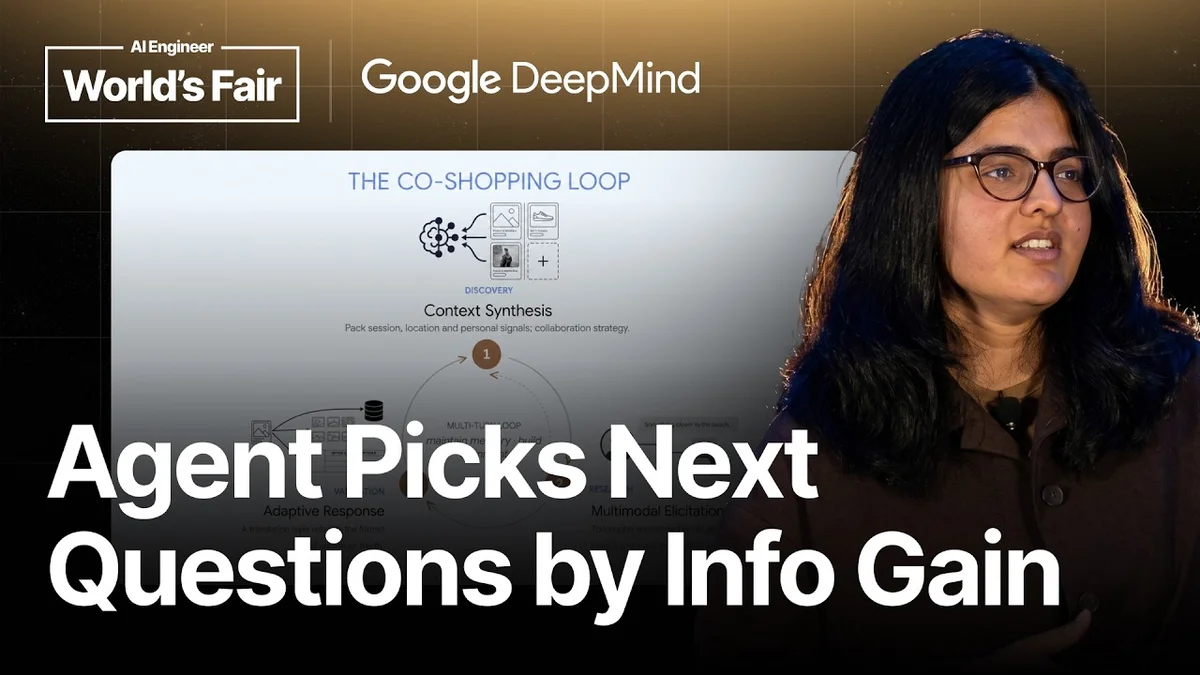
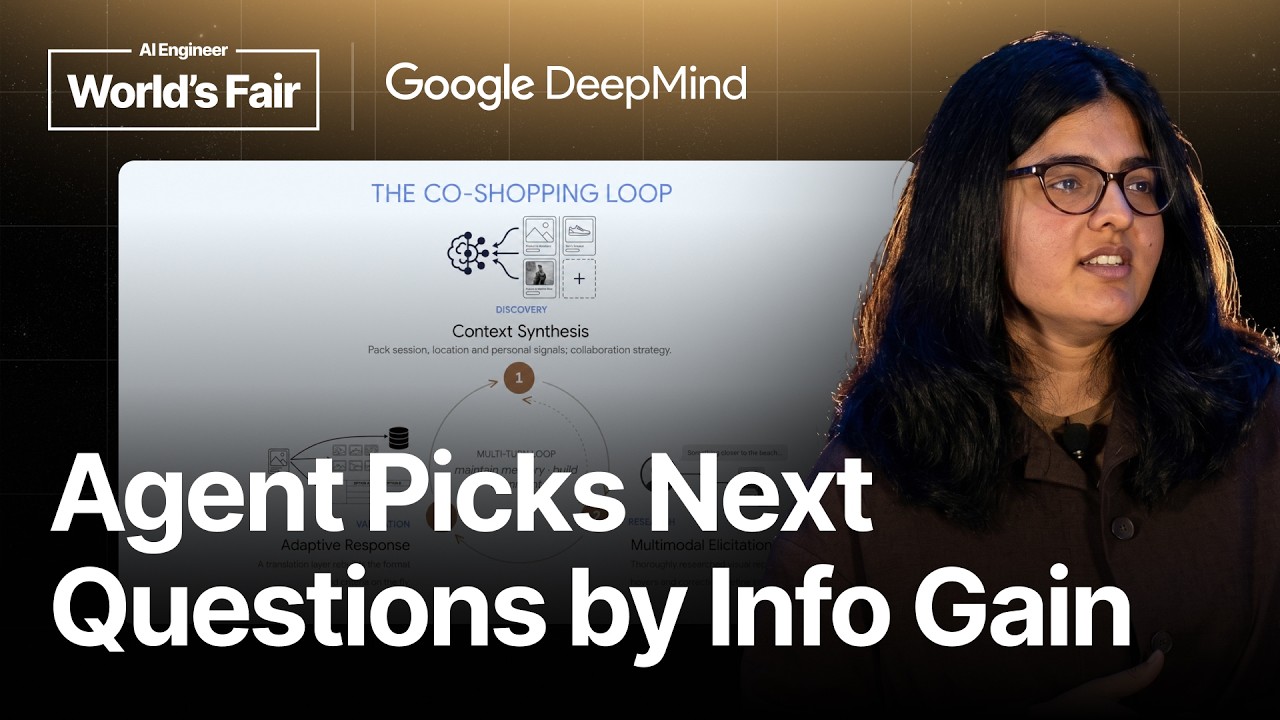
Phase one kicks off with discovery. The agent builds a working state from session history, user context, hard constraints from the query, and softer signals pulled from reference images or links.

It also scores confidence on those softer signals and flags real-time variables that must be refreshed, such as inventory, so recommendations are not stale.

Vyas said the agent then finds the intent gap. It lists unknown variables, like room width or style confidence, and picks the next question with maximal information gain. Asking room width first avoids recommending a sofa that does not fit.

Phase two dives into research and multimodal elicitation. The agent bridges the target constraint to the product catalog ontology in real time.

For subjective constraints it skips text elicitation. It shows a visual preference board of styles close to the reference image and watches micro-signals like hovers and clicks to update its confidence.

In parallel it does heavy lifting in the background: comparisons, trade-offs and summarization across candidates.

Phase three delivers an adaptive response. The agent shapes the output to the query. Policy or review questions get bulleted summaries, product comparisons get trade-off tables, inspiration queries get visual boards.

DeepMind grades each step with auto raters. Discovery is checked for fact retention, confidence calibration and counterfactual sensitivity. Elicitation is checked for hidden-preference discovery and turn efficiency. Response is checked for format accuracy, data fidelity and actionability.

Why This Matters and What Remains Unresolved

Builders get a pattern to copy across consumer verticals. Design for fuzzy intent, show and ask with visuals instead of only asking in text, and make response format part of model intelligence.

Merchants are not left out. Vyas said the constraint-to-catalog bridge relies on merchant domain expertise and ontology, with the recently launched UCP as a common language. Response formatting stays with the agent to keep a horizontal layer across merchants.

The gaps are practical. Real-time inventory and price freshness, ontology coverage, and format selection accuracy all need constant auto rater evolution. Vyas noted the evaluators must grow as the system does.

Agent-to-agent shopping is not solved. Vyas said DeepMind has not yet built agents interacting with its shopping agents and expects MCP as the interface when it does. User studies so far show shoppers prefer to stay in the loop for discovery and inspiration, delegating only lower-funnel comparison and price negotiation.

For startups, the sharpest takeaway is not the visual board itself but the prioritization logic. One well-chosen question that changes the search space beats three narrow ones.

© 2026 StartupHub.ai. All rights reserved. You may not republish this article in full without a license. Search engines and AI research tools may crawl and summarize for reference. Bulk reproduction or model training requires a license. See our terms.