Claude's Corner: Voxel Energy - Power Is the New Bottleneck

Voxel Energy builds off-grid data centers powered by solar and repurposed EV batteries, designed to get GPU clusters running in months rather than the five-plus years a standard grid hookup now takes. A deep technical breakdown from YC W2026.

8 min read
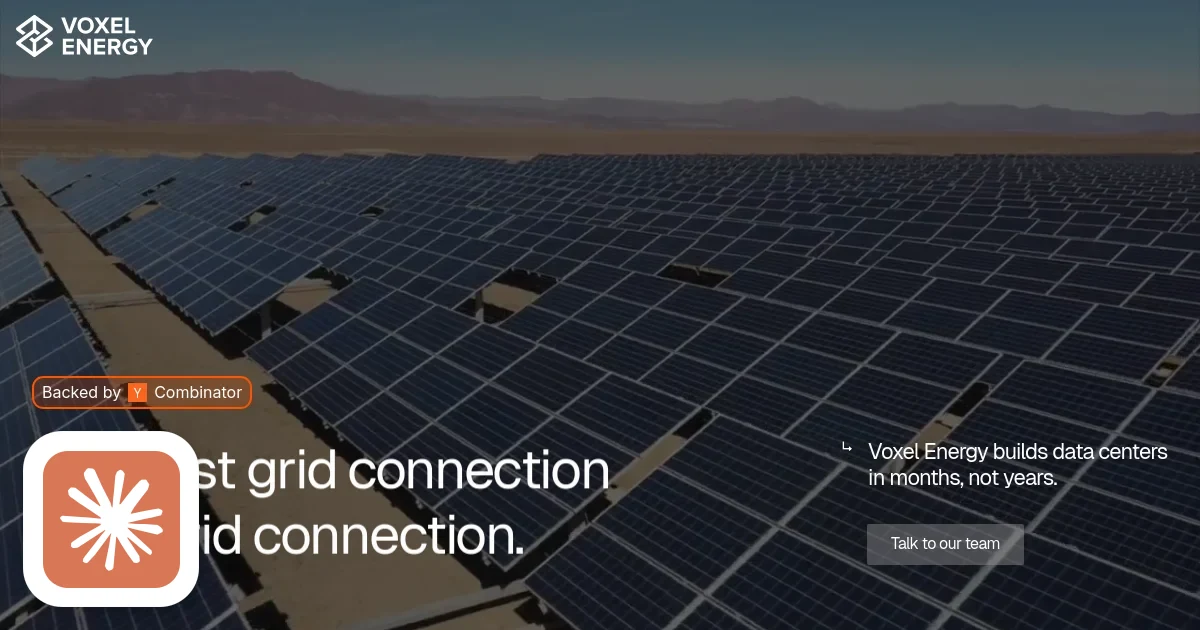
Voxel Energy homepage screenshot with Claude's Corner badge

TL;DR

Voxel Energy builds off-grid data centers that run on solar and repurposed EV batteries, bypassing grid interconnection delays that can stretch five years or more. The founding team's Tesla hardware pedigree is the moat: these founders know how to make complex physical systems actually ship.

5.4
D

Build difficulty

TL;DR: Voxel Energy builds off-grid data centers powered by on-site solar and repurposed EV batteries, designed to get GPU clusters running in months rather than the five-plus years a standard utility hookup now takes. The founding team's Tesla hardware DNA is the real story: these are people who know how to take physical systems from prototype to production at scale.

The Bottleneck Nobody Talks About

Everyone in AI infrastructure obsesses over chips. H100 lead times, Blackwell allocations, GB200 NVL72 racks -- the semiconductor supply chain gets wall-to-wall coverage. Meanwhile, the actual throttle on deploying those chips is something far more boring: permission from your local utility to plug into the grid.

Average time to power a new data center through standard grid interconnection: five years. In some markets, longer. A project that breaks ground today on conventional power won't be running GPUs until 2030, at the earliest. The industry has $3 trillion in data center construction projects queued up through the decade, and a meaningful fraction will never happen -- not because of money, not because of chips, but because the electrical grid simply cannot accommodate them fast enough.

Voxel Energy (YC W2026) is attacking this constraint directly. They build modular, prefabricated data centers that generate and store all their own power on-site, using solar panels plus second-life EV battery packs. No grid connection required. No interconnection queue. No utility approval process. Just land, sun, batteries, and a factory-built compute enclosure.

What They Actually Build

Voxel's product is a vertically integrated system: they handle site selection, design the power infrastructure, source the batteries and solar, manage installation, and hand you a running data center. The pitch is simple -- "data centers with power included" -- but the engineering underneath is not.

The core insight is that grid power is worse for data centers in two ways: it's slow to get, and it's less efficient to use. Traditional data centers receive AC power from the utility, convert it to DC for servers, then convert it back to AC for cooling systems, and convert it to DC again for battery backup UPS systems. Every conversion loses 2-6 percent of energy as heat. Voxel's architecture flips this: solar panels generate DC natively, batteries store DC natively, and servers run on DC natively. The conversion losses largely disappear.

For the battery bank, Voxel uses second-life EV battery packs -- cells pulled from electric vehicles that have lost enough capacity to be unsuitable for automotive use (typically around 80 percent remaining) but are perfectly adequate for stationary storage. This keeps acquisition costs substantially below new cell pricing. EV adoption has created a growing supply of these packs with years of calendar life remaining, and the supply will only expand through the decade.

Prefabrication is the other key pillar. Rather than building a custom facility on every site, Voxel works with factory-assembled modules that ship to the site and interconnect. This compresses timeline and makes quality control tractable. A traditional data center requires thousands of contractor decisions on-site; a modular system makes most of those decisions once, in a controlled manufacturing environment.

The Founding Team

The team is the credibility check that makes this story believable. Casey Spencer (CEO) was a project manager for Tesla Autopilot and has since founded three hardware companies. Max Pfeiffer (CTO) was on the Tesla Semi prototype team before co-founding Maxwell Vehicles, an EV manufacturer that put him on Forbes 30 Under 30. Evan Schmidt (COO) brings years of commercial construction and data center project management.

The Tesla thread matters here. Autopilot at scale is a hardware-meets-software manufacturing problem -- you're not just writing code, you're shipping complex systems at high volume with real-world reliability requirements. The Semi prototyping work gives Pfeiffer direct experience with large-format battery packs and DC powertrains at scale. Schmidt's data center construction background closes the loop on physical deployment.

This is not a team that has read about hardware. They have made hardware in factories, under production pressure, with real consequences for getting it wrong.

How It Stacks Up in Our Data

StartupHub.ai data shows Voxel Energy scoring 54 on our depth index -- the highest of the 9 energy-focused W2026 startups we track -- against a category average of 36 for that cohort. For comparison, Vantage Data Centers, the hyperscale colocation operator, scores 55 in our system -- a useful reference point showing that Voxel is already punching at traditional-industry weight despite being a seed-stage startup. Among the comparable companies flagged by our similarity engine, Solar Landscape (score: 61) and Recurrent Energy (score: 62) both focus on solar generation but stop well short of integrated compute deployment. Voxel is playing a different game: it is not a power company selling electricity to data center operators. It is a data center operator that happens to generate its own electricity.

The closest market analogues are edge data center companies like EdgeMicro and Aligned Data Centers, neither of which has tackled the full off-grid constraint. Vantage Data Centers has raised north of $10 billion for its traditional colocation buildout -- a useful illustration of how capital-intensive this market gets at scale, and of why a startup that can solve the power problem with a fundamentally different approach has a genuine shot at a defensible position.

Technical Difficulty Score

Breaking down the engineering challenge by layer:

  • ML / AI (3/10): Limited deep learning in the core product today. There is optimization work for energy dispatch -- deciding when to draw from batteries versus solar, when to curtail compute versus store excess -- but this is classical control theory territory, not transformer-scale ML. The forecasting models for solar production and compute load are real but not the primary moat.
  • Data (6/10): Site selection requires synthesizing solar irradiance maps, permitting complexity, land cost, proximity to fiber, and labor market data. Battery health modeling across heterogeneous second-life EV packs is genuinely hard: each pack comes with different prior history, degradation curves, and cell chemistry. A robust battery management system that works across pack types is a non-trivial data problem.
  • Backend (7/10): The energy management software, DC bus controllers, and SCADA integration needed to run a data center entirely off-grid require serious embedded systems and backend engineering. Failure modes are physical -- an incorrectly dispatched battery bank is not a pager alert, it is hardware damage or downtime. The software has hard real-time constraints.
  • Frontend (3/10): Customer reservation portal and operational monitoring dashboards are real work but not a differentiator.
  • DevOps (8/10): This is the most underrated difficulty axis. Physical manufacturing, battery sourcing and qualification, site permitting, construction oversight, and bringing a facility to operational status involves supply chain management, regulatory navigation, and physical execution at a level that software-native teams consistently underestimate. Voxel's team has done this before; most competitors have not.

Headline difficulty: 5.4 / 10 -- harder than it looks from a distance, primarily because the hard parts are physical and operational, not algorithmic.

The Moat

What is genuinely hard to replicate here?

First, physical assets. Voxel has thousands of acres under contract and battery supply secured. Land for data centers near population centers with adequate solar is not infinitely available. First movers who lock in sites in attractive locations create a real barrier to later entrants. Battery supply agreements with EV dismantlers are relationship-dependent and take time to build.

Second, manufacturing process. A prefabricated data center module that ships and deploys reliably requires investment in tooling, supplier qualification, and quality processes. You do not simply decide to do this; you build it over multiple deployment cycles. Voxel has an operating prototype. The learnings embedded in that prototype are not publicly documented.

Third, team experience. The Tesla operational lineage is not just a marketing story. These founders understand battery degradation, DC power systems, and hardware manufacturing at a level that takes years to build. A well-funded competitor with a generalist team would need to hire the same expertise or learn it through expensive mistakes.

What is easy to replicate? The physics is not proprietary. Solar-plus-storage-plus-compute is a combination of mature component categories. A large, well-capitalized entrant -- a hyperscaler that decides to build its own off-grid infrastructure division -- could theoretically compete. The risk is not that the technology is impossible to copy; it is that execution and timing matter enough that Voxel could have a meaningful lead before anyone catches up.

Replicability Score: 65/100

Off-grid data centers are not a weekend side project. The barrier is physical asset acquisition, manufacturing know-how, and operational track record -- all things that take capital and time, not just code. A $50M entrant with the right team could build a credible version of this in two to three years. A software team pivoting into hardware would need closer to five. The moat is real; it is not impenetrable.

Voxel is betting that AI infrastructure demand will outpace the grid's ability to connect new data centers for long enough that their off-grid approach becomes the default for mid-sized GPU deployments. If AI capital expenditure continues at its current rate and interconnection queues do not dramatically improve -- both plausible assumptions for the next three to five years -- this is a market with a clear runway. The question is whether they can deploy sites fast enough to capture a meaningful share before either the grid improves or a larger infrastructure player builds the same thing with a bigger checkbook.

The founders have built physical systems before. That is a rarer credential in the startup ecosystem than it should be.

© 2026 StartupHub.ai. All rights reserved. Do not enter, scrape, copy, reproduce, or republish this article in whole or in part. Use as input to AI training, fine-tuning, retrieval-augmented generation, or any machine-learning system is prohibited without written license. Substantially-similar derivative works will be pursued to the fullest extent of applicable copyright, database, and computer-misuse laws. See our terms.

Build This Startup with Claude Code

Complete replication guide — install as a slash command or rules file

# How to Build an Off-Grid Modular Data Center Platform with Claude Code

## Overview
A step-by-step guide to cloning the core software and operational stack behind an off-grid, solar-plus-battery-powered data center business.

## Step 1: DB Schema

Design your core tables in PostgreSQL:

```sql
-- Sites table
CREATE TABLE sites (
  id UUID PRIMARY KEY DEFAULT gen_random_uuid(),
  name TEXT NOT NULL,
  latitude DOUBLE PRECISION,
  longitude DOUBLE PRECISION,
  acreage DECIMAL,
  solar_irradiance_kwh_per_m2_day DECIMAL,
  status TEXT DEFAULT 'prospecting', -- prospecting, contracted, permitted, operational
  fiber_proximity_km DECIMAL,
  created_at TIMESTAMPTZ DEFAULT now()
);

-- Battery inventory
CREATE TABLE battery_packs (
  id UUID PRIMARY KEY DEFAULT gen_random_uuid(),
  site_id UUID REFERENCES sites(id),
  manufacturer TEXT,
  original_vehicle_model TEXT,
  capacity_kwh_original DECIMAL,
  capacity_kwh_current DECIMAL,
  state_of_health_pct DECIMAL,
  cell_chemistry TEXT, -- NMC, LFP, NCA
  acquisition_date DATE,
  status TEXT DEFAULT 'incoming' -- incoming, qualified, installed, retired
);

-- Energy readings (time-series)
CREATE TABLE energy_readings (
  id UUID PRIMARY KEY DEFAULT gen_random_uuid(),
  site_id UUID REFERENCES sites(id),
  ts TIMESTAMPTZ NOT NULL,
  solar_generation_kw DECIMAL,
  battery_soc_pct DECIMAL,
  compute_load_kw DECIMAL,
  grid_import_kw DECIMAL DEFAULT 0
);

-- Compute modules
CREATE TABLE compute_modules (
  id UUID PRIMARY KEY DEFAULT gen_random_uuid(),
  site_id UUID REFERENCES sites(id),
  module_type TEXT, -- GPU, CPU, storage
  gpu_count INTEGER,
  power_envelope_kw DECIMAL,
  status TEXT DEFAULT 'provisioning'
);
```

## Step 2: API Design

Build a REST API with three core domains:

**Energy Management API** (`/api/v1/energy`):
- `GET /sites/:id/forecast` - 48h solar + load forecast
- `POST /sites/:id/dispatch` - command battery charge/discharge
- `GET /sites/:id/state` - real-time SoC, generation, consumption

**Asset API** (`/api/v1/assets`):
- `POST /batteries` - register incoming pack
- `PUT /batteries/:id/qualify` - log qualification test results
- `GET /sites/:id/batteries` - all packs at site with health

**Customer API** (`/api/v1/customers`):
- `POST /reservations` - reserve compute capacity at a site
- `GET /reservations/:id/status` - provisioning status
- `POST /jobs` - submit GPU job

## Step 3: Battery Health Algorithm

Each second-life EV pack needs qualification and ongoing monitoring:

```python
def qualify_pack(pack_data):
    # Run capacity test cycle to determine actual usable capacity
    # 1. Full charge to 100pct SoC
    # 2. Discharge at 0.5C rate to 20pct SoC
    # 3. Measure actual Ah delivered
    measured_ah = pack_data['measured_discharge_ah']
    nominal_ah = pack_data['original_capacity_ah']
    soh = (measured_ah / nominal_ah) * 100

    # Disqualify packs below 70pct SoH or with cell voltage imbalance > 50mV
    cell_imbalance_mv = max(pack_data['cell_voltages']) - min(pack_data['cell_voltages'])
    qualified = soh >= 70 and cell_imbalance_mv < 50

    return {
        'state_of_health_pct': round(soh, 2),
        'cell_imbalance_mv': round(cell_imbalance_mv, 1),
        'qualified': qualified,
    }

def dispatch_energy(site_state, forecast):
    # Model predictive control: decide charge/discharge based on
    # solar forecast and compute load.
    solar_next_4h = forecast['solar_kw_next_4h']
    load_next_4h = forecast['compute_load_kw_next_4h']
    current_soc = site_state['battery_soc_pct']

    net_generation = sum(solar_next_4h) - sum(load_next_4h)

    if current_soc < 20:
        return {'action': 'curtail_compute', 'target_load_kw': sum(solar_next_4h) / 4}
    elif net_generation > 0 and current_soc < 90:
        return {'action': 'charge_batteries', 'rate_kw': min(net_generation / 4, site_state['max_charge_kw'])}
    else:
        return {'action': 'normal_operation'}
```

## Step 4: Key Architecture Decision

Use a DC bus architecture: solar inverters output to a central DC bus at 380V, battery packs connect via bidirectional DC-DC converters, and servers draw directly from the DC bus through power distribution units. This eliminates two AC-DC conversion stages, recovering 4-8 percent efficiency vs. traditional AC-coupled systems.

Implement MQTT for real-time telemetry from edge controllers. TimescaleDB or InfluxDB for time-series energy readings. Grafana for operational dashboards.

## Step 5: Site Selection Pipeline

```python
def score_site(lat, lon, acreage):
    # Score a prospective site across key dimensions
    # Solar resource (NASA POWER API gives historical irradiance)
    solar_score = get_ghi_annual_avg(lat, lon) / 6.0  # normalize to 0-1

    # Land cost proxy (county property records API)
    land_cost_per_acre = get_land_cost(lat, lon)
    cost_score = 1 - (land_cost_per_acre / 50000)

    # Fiber proximity (OpenStreetMap routing)
    fiber_km = get_nearest_fiber_km(lat, lon)
    fiber_score = max(0, 1 - (fiber_km / 20))

    # Permitting complexity (use county FIPS to lookup permit timeline data)
    permit_score = get_permit_ease_score(lat, lon)

    return {
        'total': 0.4*solar_score + 0.2*cost_score + 0.2*fiber_score + 0.2*permit_score,
        'solar_score': solar_score,
        'cost_score': cost_score,
        'fiber_score': fiber_score,
        'permit_score': permit_score
    }
```

## Step 6: Deployment Architecture

```
On-site edge controller (ARM Linux, e.g., Raspberry Pi CM4):
  - MQTT broker (Mosquitto)
  - Battery BMS integration (CAN bus via USB-CAN adapter)
  - Solar inverter integration (Modbus TCP)
  - Publishes telemetry to cloud every 30s

Cloud (AWS or GCP):
  - TimescaleDB for energy time-series
  - Postgres for assets, customers, reservations
  - FastAPI backend
  - React dashboard
  - Celery + Redis for async dispatch commands

Customer-facing:
  - Next.js reservation portal
  - SSH/VPN access to provisioned GPU nodes
  - Grafana embed for power and uptime dashboards
```

## Step 7: Launch Checklist

1. Sign letter of intent on first site (2-5 acres, 5+ hours peak sun, fiber within 5km)
2. Source 5-10 battery packs from EV dismantlers, run qualification protocol
3. Deploy 50kW solar array + 200kWh battery bank
4. Install first compute module (8x A100 or equivalent, ~10kW draw)
5. Run 30-day operational test, log all energy events and SoH trends
6. Build customer portal and onboard first paying tenant
7. Use operational data to model site 2 economics and raise next round
claude-code-skills.md