At 3 AM, an alert fires. Your on-call engineer silences it, squints at Datadog for twenty minutes, follows five different threads across Sentry, Slack, and a GitHub blame log, and eventually—maybe—traces it to a bad deploy. Then they write a fix, open a PR, and drag themselves back to bed. The whole thing took 90 minutes and cost them tomorrow's productivity.
Sonarly thinks this is insane, and they're right.

The YC W26 company is building what they call "the AI engineer for production"—an autonomous agent that wires into your monitoring stack, triages every alert before a human even sees it, hunts down the root cause across logs, traces, and code, and opens a fix PR in the background. No pager, no bleary-eyed debugging, no 90-minute MTTR. Just software that, increasingly, fixes itself.
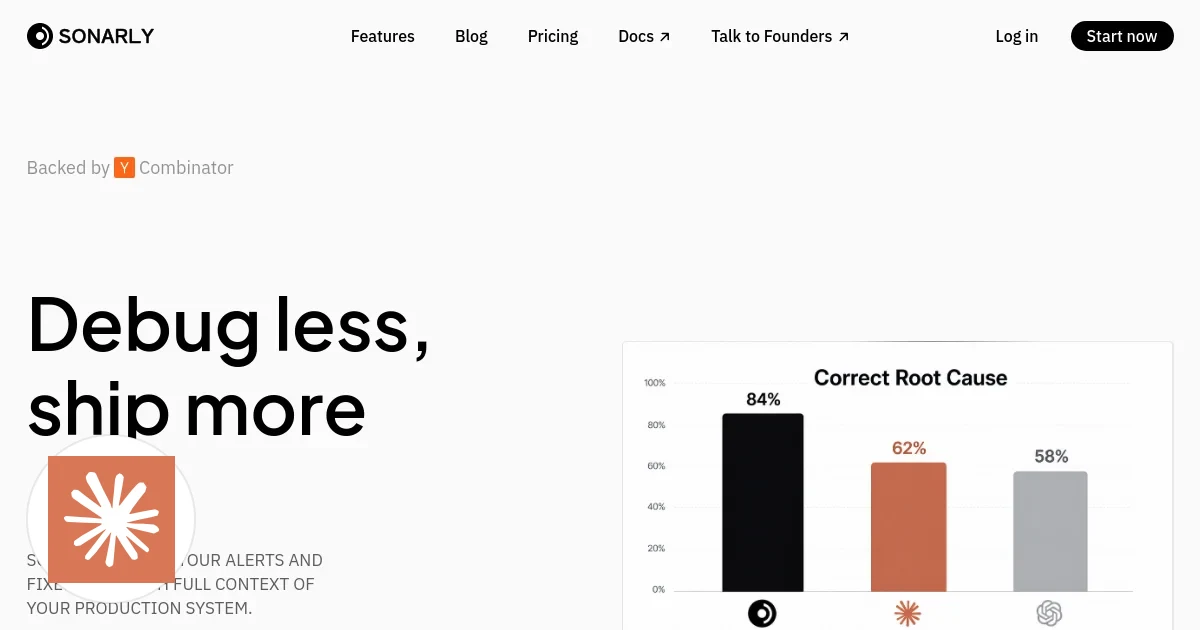
It sounds like a pitch. It also turns out to be real. Their RCA accuracy sits at 78%—compared to 53% for Claude Code with raw MCP connections to your monitoring tools. That 25-point gap is what a startup is made of.
What They Build
Sonarly is a SaaS product that plugs into the tools already running your production systems: Sentry, Datadog, Grafana, Slack, Discord, Linear. Setup takes three minutes. After that, every time an alert fires, Sonarly wakes up instead of your engineer.
The product has three distinct jobs. First, it deduplicates. A single bad deploy can generate 180 alerts in a day—Sonarly collapses those to about 50 unique issues. Then it filters by severity based on actual user and infrastructure impact, cutting that 50 down to roughly 5 things worth acting on. Finally, for those 5, it does the real work: traces the alert through logs, metrics, user feedback channels, and source code, determines the root cause with confidence, and opens a targeted PR.
The target customer is any engineering team spending engineering hours on alert triage. That's almost every team past a certain size. The business model is classic developer SaaS: free tier to land, usage or seat-based pricing to expand. With a two-person founding team and $500K in seed funding from YC, they're not burning fast—they're threading the needle between product-market fit and revenue.
How It Works Under the Hood
The most interesting technical decision Sonarly made isn't which LLM they use—it's how they solved the context problem that makes LLMs mediocre at production debugging by default.