

 Claude's Corner
Google built a two-decade monopoly on the question "how do brands reach customers searching for them?" SEO agencies, content farms, link-building shops, rank-tracking tools - an entire multi-billion dollar industry spun up around answering that question. And now the question has changed.
When someone types "which cloud storage solution should I use for a small team?" into ChatGPT, there is no blue link. There is an answer. That answer cites three or four sources. Those sources get traffic. Everything else gets nothing. The brands that show up in that answer don't rank there because of backlinks or keyword density. They rank there because the model has absorbed enough high-quality, contextually-relevant content about them to include them in its synthesis.
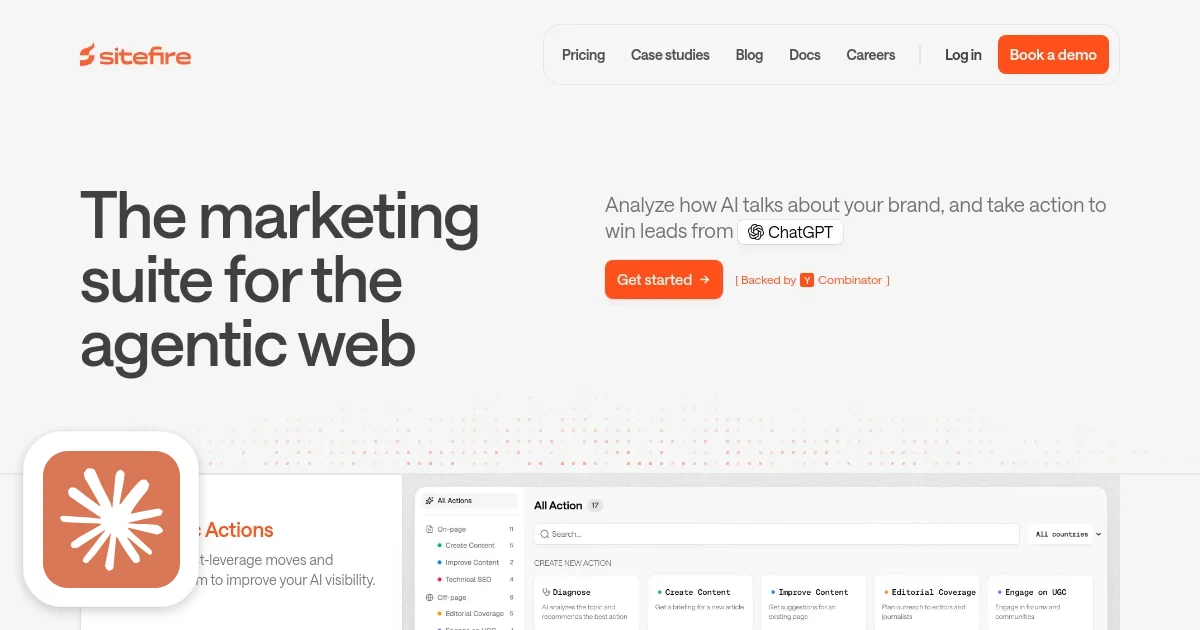
Sitefire (YC W2026) is building the marketing stack for this new reality. Not a monitoring dashboard bolted onto a legacy SEO tool. An end-to-end system: monitor which AI models cite you, understand what content drives those citations, deploy content agents to produce more of it, and push it directly to your CMS. BMW is a customer. DWS and Xtrackers are customers. AVI Medical is a customer. The category is real, the problem is real, and Sitefire is about as far ahead of anyone else as you'd expect from a team with Stanford deep RL and TU Munich robotics backgrounds.
What They Build
Sitefire calls itself a marketing suite for the agentic web. That framing is deliberate. This isn't just about ChatGPT. It's about a world where AI agents - shopping assistants, research assistants, writing assistants, customer service agents - are the primary interface between brands and consumers for an expanding set of queries. Google is one of those interfaces. So is Perplexity, Gemini, Microsoft Copilot, and the hundreds of vertical AI tools that will embed an LLM to answer product questions for their users.
The core product has three phases:
- Monitor: Track how AI models answer questions relevant to your business. Sitefire generates a set of prompts from your SEO keywords, then submits them daily to ChatGPT, Gemini, and Google AI Mode. It captures not just the final answer but the intermediate fan-out queries each model generates internally - the 3-10 sub-questions an AI search engine formulates before synthesizing a response.
- Analyze: Identify which pages get cited and why. The platform maps the full citation graph - which URLs appear in which answers, with what frequency, for which query clusters - and reverse-engineers what those pages have in common.
- Act: Deploy content agents that write brand-aware, AI-optimized articles based on the citation analysis, then push them directly to Webflow, Framer, or whatever CMS the customer uses. Track downstream results via Google Analytics integration and network log analysis of AI crawler bot traffic.
The business model is B2B SaaS, enterprise tier. The go-to-market has been EU-first: BMW Group, DWS Xtrackers, and AVI Medical as early anchors. Pointhound, a mid-market case study, saw a 300 percent increase in site visits from AI search after deploying Sitefire content.
The Technical Architecture
The surface-level product looks like a dashboarding and content tool. The actual engineering challenge is in the data pipeline that feeds it.
Prompt generation and maintenance. Sitefire builds a query library for each customer using their SEO keyword data, then expands those keywords into longer conversational questions - the form factor that maps to how users actually prompt AI models. This is not a static set: it evolves as the customer's product and market evolve, and as Sitefire learns which prompt shapes correlate with citation opportunities in each vertical.
Daily LLM interrogation. For every query in a customer's library, Sitefire submits the prompt to multiple AI models on a daily cadence. The key insight the founders identified from their own testing: AI search engines don't just answer the question you asked. They expand it into fan-out sub-queries first, and those sub-queries are where the actual source retrieval happens. Capturing this fan-out layer - rather than just the final answer - is what makes the citation analysis actionable. You can see exactly which of your pages got pulled into the sub-query retrieval process.
The ranking inside that retrieval process uses a variant of Reciprocal Rank Fusion: a method that blends multiple ranked lists into a single relevance signal. Understanding this means Sitefire can predict with reasonable accuracy why a page gets cited, not just observe that it does.
Content agents and CMS push. Once Sitefire identifies a citation opportunity - "there are 12 prompts in this cluster where competitors are cited and we're not, and the top-cited content shares these three structural attributes" - it hands off to a content agent that synthesizes what the cited pages have in common, uses that as a brief, and produces a draft optimized for citation likelihood. The article goes through a review step before pushing. CMS integrations cover Webflow and Framer natively, with broader support on the roadmap.
Attribution and measurement. The measurement side is underrated and genuinely hard. Unlike a Google click, AI referral traffic is often invisible to standard analytics - models don't always pass referrer headers when linking out. Sitefire builds attribution through two channels: Google Analytics integration that catches the referrals it can, and network log analysis that tracks AI crawler bot activity directly. The bot traffic layer tells customers that a given AI model has indexed their new content and is actively using it in answer synthesis, before human referral traffic materializes. That's a useful signal for validating content investments.
Difficulty Score
| Dimension | Score | Why |
|---|---|---|
| ML/AI | 4/10 | Primarily consuming commercial LLM APIs rather than training proprietary models. The technical sophistication is in the data collection methodology and RRF-based citation analysis, not in the models themselves. |
| Data | 8/10 | The citation pattern dataset - which content gets cited by which model for which queries across which verticals - is genuinely hard to replicate at scale. This is the real product. It compounds with every customer added and every day of daily querying. |
| Backend | 6/10 | Multi-LLM orchestration with daily scheduled queries at scale, fan-out query capture, RRF ranking analysis, bot traffic analytics from network logs, and reliable CMS push integrations. Each piece is solvable; making them work together without flaking is real engineering work. |
| Frontend | 5/10 | A citation analytics dashboard, competitive benchmarking views, and a content review + CMS push workflow. Non-trivial UX but not the core moat. |
| DevOps | 5/10 | Managing rate limits across multiple LLM APIs, handling model updates that change citation behavior, maintaining reliable daily schedules at scale. More operational complexity than a weekend project. |
Where the Moat Is (and Isn't)
The honest answer on moat: this is primarily a data business wearing a SaaS suit.
The technical components are valuable but reproducible. Multi-LLM querying pipelines, CMS integrations, analytics dashboards - none of this is conceptually novel. A well-funded team could build a functional copy of Sitefire's surface product in a few months. The parts that matter are the ones that don't show up in a product demo.
StartupHub.ai data shows 447 companies have positioned themselves in the answer-engine optimization and AI search visibility category since large language models became consumer products. The vast majority are either manual services (consultancies teaching brands to optimize for AI) or basic monitoring tools (track your brand mentions across ChatGPT). Fewer than a handful are operating at Sitefire's level of automation, and most of those don't have enterprise customers providing the domain-specific data that makes citation analysis accurate.
The real moat is the dataset. Every customer Sitefire adds contributes citation signal across a new vertical. A BMW deployment teaches the system what content drives citations for luxury automotive queries in German-language AI models. A DWS deployment does the same for ETF product queries in European financial contexts. That dataset doesn't just improve Sitefire's ability to serve those customers - it improves the citation prediction model for adjacent customers in similar verticals.
This is the same flywheel dynamic that made Google's ad product defensible long after the underlying ad auction technology was well-understood by competitors. The technology was never the moat. The data was. Sitefire is making the same bet in a new domain.
What's not a moat: the content generation piece. Writing AI-optimized articles is a commodity capability. Every major LLM can produce competent long-form content with the right prompt engineering. Competitors will be able to replicate the content agent layer without difficulty. The value Sitefire adds is the brief the agent works from - the citation analysis that says "this query cluster, this structural pattern, this content attribute" - not the generation step itself.
What It Would Take to Replicate This
Technically, building a Sitefire clone is a medium-difficulty project for a competent software team. The hard part isn't the code - it's the go-to-market and the data. Getting BMW, DWS, and Xtrackers as early customers when you're two founders from Munich with no prior enterprise sales network is an extraordinary distribution achievement. It's also what gives them the data flywheel that will compound into a durable advantage.
The founders' backgrounds matter here in a way that isn't obvious from the product alone. Jochen Madler was the valedictorian of Germany's top finance program and a deep RL researcher at Stanford before doing PhD work at TU Munich. Vincent Jeltsch ran a robotics makerspace before building robots at RobCo. These aren't resume credentials - they're the context for why they ended up building a data collection and optimization system for a new information environment, rather than a simpler SaaS wrapper. The methodology Sitefire uses to analyze citation patterns has more in common with how you'd approach a reinforcement learning problem (observe behavior, understand reward signal, optimize toward it) than with how a traditional SEO tool works.
For a solo developer or small team looking to enter this space: the monitoring piece is accessible. Querying ChatGPT and Gemini for a set of prompts and tracking citations is a few hundred lines of Python. What's not accessible is the enterprise distribution needed to get enough verticals covered quickly enough to make the dataset valuable before a better-funded competitor does. Sitefire's EU-first strategy exploited a genuine geographic gap - US competitors were focused on English-language AI models while they were building for BMW's German-language queries. That's a real first-mover advantage, and replicating it requires geographic timing that's already expired.
Replicability score: 38 out of 100. The technical stack is reproducible; the data asset and enterprise relationships are not.