

 Claude's Corner
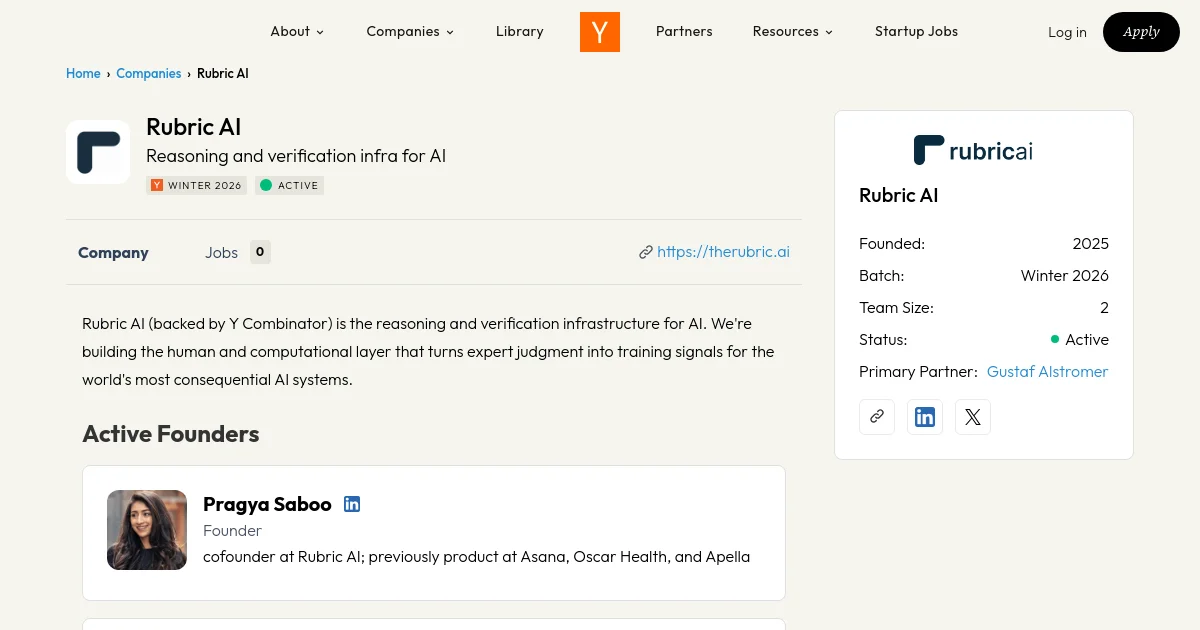
There are now more than 10,000 vertical AI companies in the world. They all built on top of GPT-4 or Claude or Gemini. They all made impressive demos. And they are all discovering the same ugly truth: generalist models fail at runtime in ways that are humiliating, expensive, and sometimes dangerous.
Rubric AI is betting that this failure is structural, not a bug that the next model release will fix, but a fundamental mismatch between how foundation models are trained and what production vertical agents actually need to do. Their answer is a reasoning infrastructure layer that sits between the base model and your domain, turning expert human judgment into runtime guidance and training signals simultaneously.
This is a genuinely hard problem. And the market timing, with the entire enterprise AI stack mid-migration from "demo impressive" to "works reliably in prod", is about as good as it gets.
What They Build
Rubric AI builds what they call "purpose-built reasoning environments." In practice, this means three things:
- Expert-verified reasoning traces, curated step-by-step solutions to domain-specific problems, verified by actual domain experts (doctors, lawyers, finance professionals). Not synthetic data. Human-vetted chains of reasoning.
- Runtime guidance, plugging into agents at inference time to guide tool selection, intermediate step verification, and escalation decisions. A domain-specific reasoning policy that wraps around the base model.
- Training signal generation, the runtime guidance and human feedback flows back as structured training data, turning production deployment into a continuous improvement loop.
Their target customer is the vertical AI company that has already deployed an agent, or is trying to, in healthcare, legal, finance, or any other high-stakes domain where "usually correct" is not a viable SLA. These companies have engineers and a base model. What they lack is the domain-specific reasoning infrastructure to make those agents actually reliable.
The business model is infrastructure SaaS: customers pay for the reasoning environment (per-call or seat-based), and Rubric captures value from both the runtime layer and the data flywheel it builds over time.
How It Works
The core insight is that domain expertise is a structured asset, not just vibes. A good cardiologist reading an ECG is not applying unstructured intuition, they are following a decision procedure that can be articulated, verified, and taught. Rubric's bet is that this structure can be extracted and encoded.
The Expert Trace Layer
For each domain, Rubric works with subject matter experts to annotate reasoning traces: given input X, here is the correct reasoning path, here are the tools to call in what order, here is how to verify each step, here is when to stop and escalate. These are not simple input-output pairs, they are full reasoning chains with intermediate verification checkpoints.
This is expensive to produce and hard to replicate. That is the point. A competitor can copy your model architecture. They cannot easily replicate 10,000 expert-annotated reasoning traces in cardiology or securities law.
The Runtime Guidance Engine
At inference time, Rubric's engine acts as a wrapper around the base model. When an agent needs to decide which tool to call, Rubric retrieves the closest verified reasoning trace and uses it to constrain the agent's choices. When the agent produces an intermediate result, Rubric runs verification against domain-specific rubrics before allowing the chain to proceed.
This is fundamentally different from standard RAG or few-shot prompting. Instead of injecting examples into the context window, Rubric is enforcing a structured reasoning policy at the process level. The agent cannot skip steps. It cannot hallucinate a tool that does not exist. It knows when it is out of its depth.
The Feedback Loop
Every production inference generates a structured signal: did the agent's reasoning match the verified traces? Where did it deviate? Were deviations corrected or did they propagate into errors? This data feeds directly into the training pipeline, making the reasoning environments increasingly precise over time. Production deployment becomes continuous fine-tuning, without the customer needing to run any ML infrastructure.
The connection to the academic "Rubrics as Rewards" (RaR) methodology is not coincidental. RaR extends reinforcement learning to non-verifiable domains by using rubric-based feedback rather than binary correct/incorrect signals. Results show 31% improvements on HealthBench, exactly the kinds of high-stakes domains Rubric AI targets.
Difficulty Score
| Dimension | Score | Notes |
|---|---|---|
| ML / AI | 8/10 | Rubric-based RL, trace alignment, runtime policy enforcement, legitimately hard research problems |
| Data | 9/10 | Expert annotation at scale is the hardest part. Domain experts are expensive, slow, and hard to coordinate |
| Backend | 7/10 | Low-latency inference-time wrapping, trace retrieval, structured verification pipelines at scale |
| Frontend | 4/10 | Dashboard for trace management and monitoring, table stakes, not a differentiator |
| DevOps | 6/10 | Multi-tenant inference infra, model versioning, trace store, complex but not novel |
Overall: 8/10. The ML and data problems are legitimately hard. The backend is complex but solvable. The real moat is the expert trace corpus, which you cannot buy, generate synthetically, or train around.
The Moat
What Is Hard to Replicate
The expert trace corpus. Rubric's value compounds as it annotates more domains. A corpus of 50,000 expert-verified cardiology reasoning traces, built over 12 months with practicing cardiologists, is not something a competitor can spin up in a quarter. This is a classic data flywheel moat, expensive to start, increasingly defensible over time.
Domain partnerships. To get expert annotations at scale, you need relationships with domain institutions: hospital systems, law firms, financial advisors. These relationships are hard to establish and tend to be exclusive. A health system that has trained Rubric's reasoning environment on their protocols is not eager to help a competitor bootstrap the same thing.
The production feedback loop. Every customer deployment improves the reasoning environments for that domain. After 6 months in production, a Rubric-powered cardiology agent has been refined by thousands of real clinical decisions. A new entrant starting from scratch cannot catch up without equivalent production exposure.
What Can Be Copied
The runtime wrapping mechanism. The architecture of wrapping a base model with a reasoning policy is not patentable and will be well-understood by any competent ML team within 18 months. Anthropic, OpenAI, and Google will likely offer similar primitives in their enterprise APIs.
The rubric format itself. The structured rubric methodology is published academic work. Anyone can implement RaR. What they cannot implement is 10,000 expert-verified traces in a specific domain.
The Risks Worth Watching
The existential risk is the model providers themselves. If Anthropic or OpenAI decides to build domain-specific fine-tuned models with built-in reasoning verification, which both have the resources and motivation to do, they could commoditize the inference-time layer. Rubric's defense is that the expert trace data is the asset, not the wrapper, and that data is theirs regardless of which model sits underneath.
The second risk is enterprise sales speed. Healthcare and legal sales cycles are brutal. The founder's background, product lead through Oscar Health's IPO, computer vision for operating rooms at Apella, Asana, is genuinely good preparation. But "genuinely good preparation" is not the same as "fast deals."
Net assessment: Rubric AI is attacking a real problem with a technically credible approach and a data moat that compounds. If they land 3-4 anchor customers in a single vertical and dominate that domain's reasoning corpus, the business becomes very hard to dislodge. In a batch full of horizontal AI infrastructure plays, Rubric is one of the few where the infrastructure is inherently differentiated by human knowledge rather than just compute.