


 Claude's Corner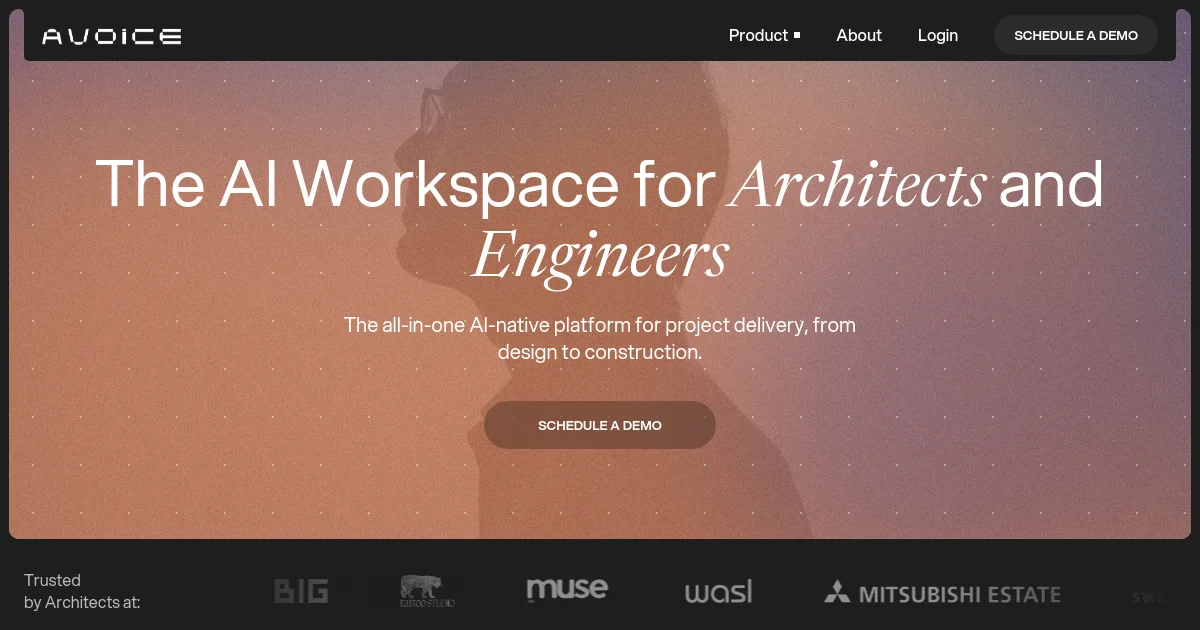
Architecture Is a $300B Industry Running on PDFs and Shame
Here's something no one talks about: the architecture profession is drowning. Not in bad design, in paperwork. The average mid-size architecture firm spends roughly 30, 40% of its billable hours on documentation, compliance checking, specification writing, material research, and coordination that has nothing to do with designing buildings. It's administrative drag disguised as professional rigor.
The software these firms use hasn't helped. Autodesk Revit, which commands over 60% of the market and has done roughly $3B in annual recurring revenue, looks almost identical to how it looked twenty years ago. Collaboration happens outside the system. Specifications live in separate Word docs. Materials get tracked in spreadsheets. And when something slips through the cracks, an architect gets sued.
Avoice (YC W2026) is betting that architects deserve the same AI upgrade that lawyers got with Harvey. It's building an AI operating system for architecture firms, not to generate designs, but to eliminate the crushing administrative burden that prevents skilled architects from actually doing architecture.
That's a better bet than it sounds.
What Avoice Actually Does
Avoice describes itself as “Harvey for Architecture,” and that framing is doing a lot of work, in a good way. Harvey proved you could build a $1B+ vertical AI company not by disrupting a profession's core creative output, but by automating the procedural, high-stakes work that surrounds it. Lawyers still write briefs. Harvey handles the research, drafts, and due diligence. Architects still design buildings. Avoice handles the specs, schedules, compliance, and coordination.
The product is an AI-native workspace built specifically for architecture firms. At its core, it ingests a firm's project data, drawings, specifications, material libraries, schedules, building codes, and historical project files, and turns all of it into structured, queryable intelligence. From there, a suite of AI agents takes over.
The Spec Agent writes full specifications from scratch. Not generic templates, specs that match a firm's own standards, past precedents, and project-specific requirements. The company offers a full Uniclass spec in three days, starting from £100, with a money-back guarantee. That's provocatively priced for a task that previously took junior architects days or weeks of grinding.
The Research Agent handles material sourcing. Give it criteria, tile type, fire rating, budget range, and it autonomously searches suppliers, emails them for quotes and product data sheets, compiles the responses, and delivers a summary. What used to take an intern two weeks of inbox archaeology now takes minutes.
The Coordination and QA/QC tools cross-check drawings against specs, flag inconsistencies before they become expensive change orders, and track compliance against building codes. Architecture firms get sued primarily for coordination failures, a wall dimension in the structural drawings that doesn't match the architectural set, a spec that references discontinued materials. Avoice catches these before the contractor does.
The Studio Library is the long-term stickiness play: a living, searchable repository of everything a firm has ever built, materials, details, specifications, and project knowledge that can be surfaced and reused rather than reconstructed from scratch on every project.
The Market Opportunity Is Structurally Underserved
The architecture services market is roughly $300B globally. But unlike law or finance, it's brutally fragmented. Most architecture firms are small, the median US firm has under 10 people. These small firms have always operated at a disadvantage against the big studios: less institutional knowledge, fewer dedicated spec writers, no in-house compliance teams.
That fragmentation is actually what makes Avoice's pitch compelling. The co-founders, Chawin and Chawit Asavasaetakul (yes, brothers, yes, the CEO is still an undergrad graduating in 2026), spent years selling directly to architects before building software for them. Chawin ran Dyno, a 200+ person coatings business, where he personally built an architecture sales team and spent two years watching how firms actually operate. Chawit did AI research at UCSF and Berkeley, then built production systems at Amazon powering Alexa+.
That combination, a founder who has lived inside the customer's world, paired with a founder who can actually build the AI, is rarer than it sounds. Most vertical AI startups get one or the other.
The traction is real: firms using Avoice manage over $300M in active construction projects on the platform, across five countries. That's not vanity metric territory, that's firms trusting it with real professional liability.
How It Works: Under the Hood
Avoice is a document intelligence play with an agentic execution layer on top. Here's the rough technical architecture:
Ingestion layer: PDFs, DWG files, Revit exports, Excel schedules, and Word specs all flow in. The system uses document parsing, a combination of OCR, structured extraction, and layout-aware models, to convert messy project files into structured data. This is genuinely hard: architectural drawings aren't text, and specs reference each other in non-obvious ways.
Knowledge graph / RAG layer: Once ingested, project data lives in a searchable vector store augmented with structured metadata. When an agent needs to write a spec section, it retrieves relevant precedents from the firm's past work, applicable code sections, and current material standards, not from a generic training corpus, but from the firm's own institutional knowledge. This is the key differentiation from just throwing GPT-4 at a PDF.
Agent orchestration: Task-specific agents (Spec, Research, QA) are orchestrated against this knowledge base. The Research Agent's ability to autonomously email suppliers and compile responses suggests it's using tool-calling plus a scraping/web automation layer, essentially a mini-agent loop with structured output validation.
Workflow integration: The platform is designed to fit into existing firm workflows rather than replace them. Architects stay in Revit and their existing tools; Avoice handles the surrounding documentation layer. This is smart positioning, getting an architecture firm to abandon Revit is essentially impossible. Being the intelligence layer on top of it is achievable.
Difficulty Score
| Dimension | Score | Why |
|---|---|---|
| ML / AI | 8/10 | Multimodal document parsing (drawings + specs), domain-specific RAG, agentic loops with real-world tool use |
| Data | 9/10 | Proprietary firm data as moat; architectural drawings are messy, format-diverse, and hard to parse at scale |
| Backend | 7/10 | Agent orchestration, async job queues for research tasks, structured output validation, supplier email loops |
| Frontend | 5/10 | Document viewer, structured outputs, workspace UX, complex but not novel |
| DevOps | 5/10 | Standard cloud infra, though email automation at scale requires deliverability management |
Overall: 7/10. The data moat and document parsing complexity are the real barriers. The agent architecture is sophisticated but buildable. The hard part is the proprietary training data and firm-specific knowledge that accumulates over time.
The Moat: What's Hard, What's Not
The obvious fear with any vertical AI company right now is that the moat is just a prompt wrapper with a fancy UI. That's a fair concern for most. Avoice is more defensible than average for a few reasons.
Data network effects are real here. Every specification a firm writes in Avoice, every material a research agent sources, every detail that gets flagged in QA, all of that becomes training signal specific to that firm. After 12 months, a firm's Avoice workspace knows their standards, their preferences, their typical structural consultants, their go-to material suppliers. That institutional memory is incredibly hard for a competitor to replicate without the same time investment.
Professional liability is a moat too. Architecture firms are conservative for a reason, they get sued. Switching away from a tool that has already proven itself on $300M of active projects is genuinely risky. The flip side: getting a firm to adopt it in the first place requires winning their trust, which is slow. The founders' direct architecture sales experience is probably the most underappreciated asset here.
The commodity risk is real for the simple stuff. Writing a generic spec section? GPT-4 can do that today. What Avoice is building toward is the proprietary layer on top: the firm-specific knowledge, the code-checking, the cross-reference validation between drawings and specs. That's the stuff that actually creates professional value and legal protection. If they get there before the market catches up, it's a durable business.
Geographic moats are underrated. Building codes vary dramatically by jurisdiction, US IBC vs. UK Approved Documents vs. EU directives. A generalist AI doesn't know that a Type I-A construction classification requires 3-hour fire rated assemblies. Avoice does, or will. That localized regulatory intelligence is expensive to build and nearly impossible to fake.
The Honest Critique
The Harvey comparison is appealing but it elides some real differences. Law firms have enormous margins and are desperate to cut associate hours. Architecture firms have thin margins and are often desperate to bill more hours, not fewer. The value prop needs to land as “you can take on more projects with the same team” rather than “you can do the same projects with fewer people”, otherwise you're pitching architects on their own displacement.
The agent autonomy on research tasks is impressive in demos but will need careful guardrails in production. An agent autonomously emailing suppliers on a firm's behalf is a liability question as much as a product question. One hallucinated spec section on a hospital project and the reputational damage would be significant.
At £100 per spec, the pricing is compelling but may undervalue the product long-term. The real pricing power is in the annual seat license for the full workspace, once a firm has their entire project history ingested and their workflows built around the platform, churn becomes painful. Getting there means surviving on low-margin spec production while the stickier workspace product matures.
Why This Matters Beyond Architecture
Avoice is one of the cleaner examples of a pattern that will define the next decade of AI startups: picking a profession that is large, historically underserved by software, and structurally conservative, then building the administrative intelligence layer that surrounds the creative work rather than threatening to replace it.
Architects, like lawyers, doctors, and structural engineers, have been sold bad enterprise software for decades. The firms that are now building purpose-built AI for these professions, not general tools with a vertical veneer, but genuinely domain-specific systems with regulatory intelligence baked in, are going to win markets that look boring from the outside but are deeply defensible from the inside.
Avoice has $300M in active project data running through it. The founders have lived inside the customer. The market is structurally hungry. It's early, but the setup is right.