


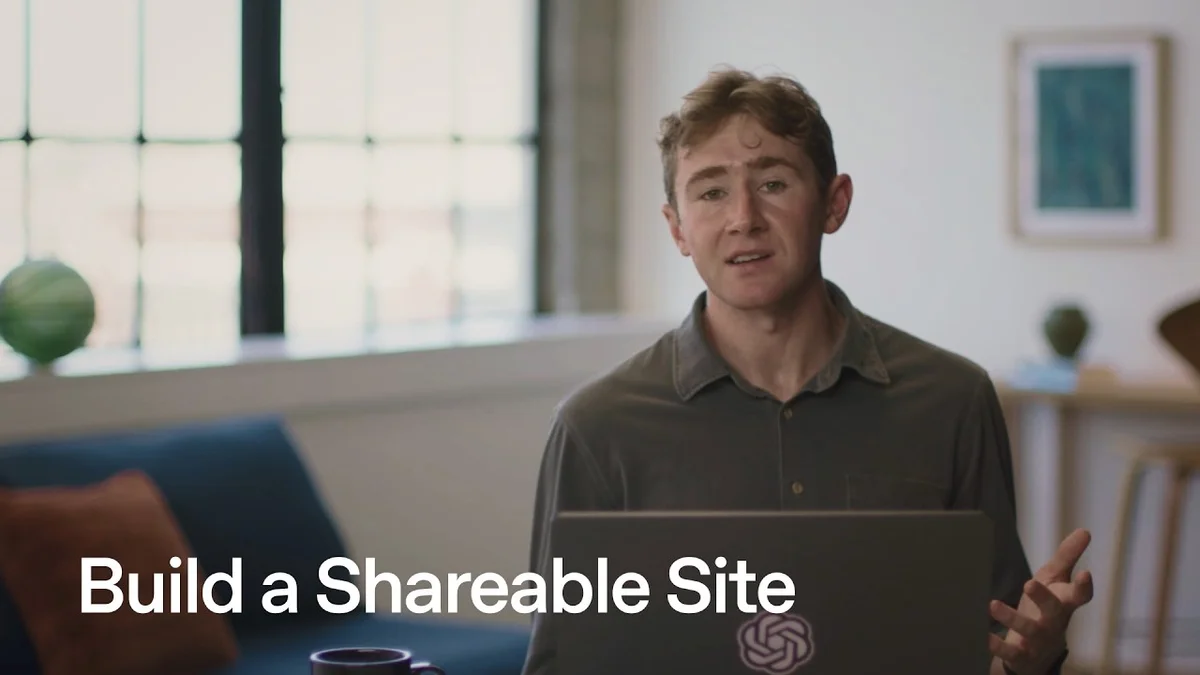
Build a Shareable Site Hands Hosting to ChatGPT Work

ChatGPT Work now builds and hosts live, shareable websites with database and access controls, moving ChatGPT from chat to app builder.

7 min read
ChatGPT Work Sites interface showing trip planner and launch dashboard on desktop and phone
OpenAI demo shows ChatGPT Work generating and hosting Sites for trip planning and launch dashboards.· OpenAI Youtube
Visual TL;DR
ChatGPT Work launches SitesDriver
new OpenAI feature that builds, hosts, and shares real websites with database support
From the article 5 mentionsChatGPT Work will now Build a Shareable Site for you and put it on the internet.
Frontend generatedCore
From the articleChatGPT Work creates the frontend, wires a database for votes and expenses, stores uploaded files like receipts, and controls access.
Hosted on internetEffect
no manual hosting setup required, site runs on ChatGPT infrastructure
From the article 2 mentionsYou can keep them private, grant access to specific people who sign in with ChatGPT, or make them public on the internet.
ChatGPT becomes app builderOutcome
shift from pure chatbot to building and hosting live, persistent applications
From the article 3 mentionsIf ChatGPT Work becomes the daily dashboard, those connectors become the system of record behind it.
ChatGPT Work launches SitesDriver
new OpenAI feature that builds, hosts, and shares real websites with database support
From the article 5 mentionsChatGPT Work will now Build a Shareable Site for you and put it on the internet.
Prompt to buildDriver
user describes desired site in natural language, dictation, or chat
From the article 5 mentionsYou prompt, preview, then ask for changes in natural language or dictation, and the site updates.
ChatGPT becomes app builderOutcome
shift from pure chatbot to building and hosting live, persistent applications
From the article 3 mentionsIf ChatGPT Work becomes the daily dashboard, those connectors become the system of record behind it.
Frontend generatedCore
From the articleChatGPT Work creates the frontend, wires a database for votes and expenses, stores uploaded files like receipts, and controls access.
Files and storageCore
uploaded receipts and assets persist on the live site
From the article 3 mentionsChatGPT Work tries to do both: context aware generation plus managed hosting and storage.
Hosted on internetEffect
no manual hosting setup required, site runs on ChatGPT infrastructure
From the article 2 mentionsYou can keep them private, grant access to specific people who sign in with ChatGPT, or make them public on the internet.
Iterate via chatEffect
user requests edits in plain language and preview updates instantly
From the article 3 mentionsIt pulls trip details and checks a group chat for missing info, then generates a private, mobile friendly site that includes arrival times, lodging, reservations, a day by day itinerary, votable activities and a shared expenses tracker.
Access controls built inCore
owner manages who can view or edit the generated website
From the articleChatGPT Work creates the frontend, wires a database for votes and expenses, stores uploaded files like receipts, and controls access.
Demo: trip plannerContext
pulls trip details from existing context and checks group chat for gaps
From the articleThe trip demo starts from context ChatGPT already has.
Contents(6)

ChatGPT Work will now Build a Shareable Site for you and put it on the internet. You describe what you want, it builds the site, hosts it, and lets you change it by asking.

The feature is called Sites, shown in a new video from OpenAI Youtube titled Build a Shareable Site. It works in the ChatGPT desktop app and on the web, even from a phone.

The full discussion can be found on OpenAI Youtube's YouTube channel.

Build a Shareable Site - OpenAI Youtube
Build a Shareable Site, from OpenAI Youtube

What Sites actually builds

Sites are real websites with persistence, not static canvases. ChatGPT Work creates the frontend, wires a database for votes and expenses, stores uploaded files like receipts, and controls access.

You do not write code or configure hosting. You prompt, preview, then ask for changes in natural language or dictation, and the site updates.

How the demos work

The trip demo starts from context ChatGPT already has. It pulls trip details and checks a group chat for missing info, then generates a private, mobile friendly site that includes arrival times, lodging, reservations, a day by day itinerary, votable activities and a shared expenses tracker.

The tracker splits shared costs automatically, shows what each person owes, and accepts receipt uploads. Voting, expense edits and uploads write to the database so the group sees the same state.

The work demo shows an operational dashboard for a product launch. The prompt is explicit: Every weekday morning, use Databricks to check this launch's latest metrics, Slack to find campaign updates, and @Chrome to look for new public feedback. Update the dashboard, explain significant changes, and flag anything falling behind target.

That pulls together three sources: numbers from Databricks, internal context from Slack, and public sentiment via Chrome. All Sites appear in a sites tab for quick open and link sharing.

Sharing and access model

Sites start private. You can keep them private, grant access to specific people who sign in with ChatGPT, or make them public on the internet.

Access is at the site level. The video does not detail row level permissions, SSO or SCIM, custom domains, or retention policies, which enterprises will need to evaluate.

Why this matters

This turns ChatGPT from an assistant into a builder and host. The value is not text generation, it is deployment.

For teams, it collapses the gap between a plan in chat and a tool the team can use. For Alphabet Inc. (NASDAQ:GOOGL) Sites, Notion Sites, Salesforce (NYSE:CRM) Slack canvases, Vercel v0, Lovable, Replit and Retool, it is direct pressure. Those products sell fast internal apps. OpenAI is now bundling that creation inside the chat where the data already lives.

For Databricks and Slack, being named as native morning check sources is distribution. If ChatGPT Work becomes the daily dashboard, those connectors become the system of record behind it.

How it stacks up

Competitors split into two camps. No code site builders host well but lack AI context. AI app generators have context but make you handle auth, DB and hosting yourself.

ChatGPT Work tries to do both: context aware generation plus managed hosting and storage. The tradeoff is control. You get speed and zero ops, but you inherit OpenAI's hosting, auth via ChatGPT, and undocumented limits on scale, versioning and export.

StartupHub.ai data shows how crowded this field is. StartupHub.ai data scores Perplexity AI at 72/100 and Google at 74/100, just ahead of You at 71/100, with Lucidworks at 52/100, matey at 50/100 and Dante at 47/100. You has VERIFIED financials of $80M raised in its Series A in 2023, which frames it as a well funded challenger against much larger platforms now racing to own the same workflow.

What OpenAI did not detail

The video shows no pricing, usage limits, storage quotas, or uptime guarantees for Sites. It does not say whether Sites support custom domains, edge functions, or external databases beyond the built in store.

It also does not address governance: audit logs, data residency, guest access without a ChatGPT account, or how long Chrome sourced feedback and Slack messages are retained to refresh the dashboard. Those answers will decide enterprise adoption, not the demo polish.

Sites that stay in sync without code change how small teams ship internal tools. If OpenAI adds export and granular permissions, the threat to lightweight internal tooling gets real fast.

© 2026 StartupHub.ai. All rights reserved. Do not enter, scrape, copy, reproduce, or republish this article in whole or in part. Use as input to AI training, fine-tuning, retrieval-augmented generation, or any machine-learning system is prohibited without written license. Substantially-similar derivative works will be pursued to the fullest extent of applicable copyright, database, and computer-misuse laws. See our terms.