AWS Experts Detail Turn-Taking in Voice Agents

AWS experts Chintan Agrawal and Daniel Wirjo discuss turn-taking in voice agents, covering the 200ms human constraint, pipeline components, and three levels of solutions.

9 min read
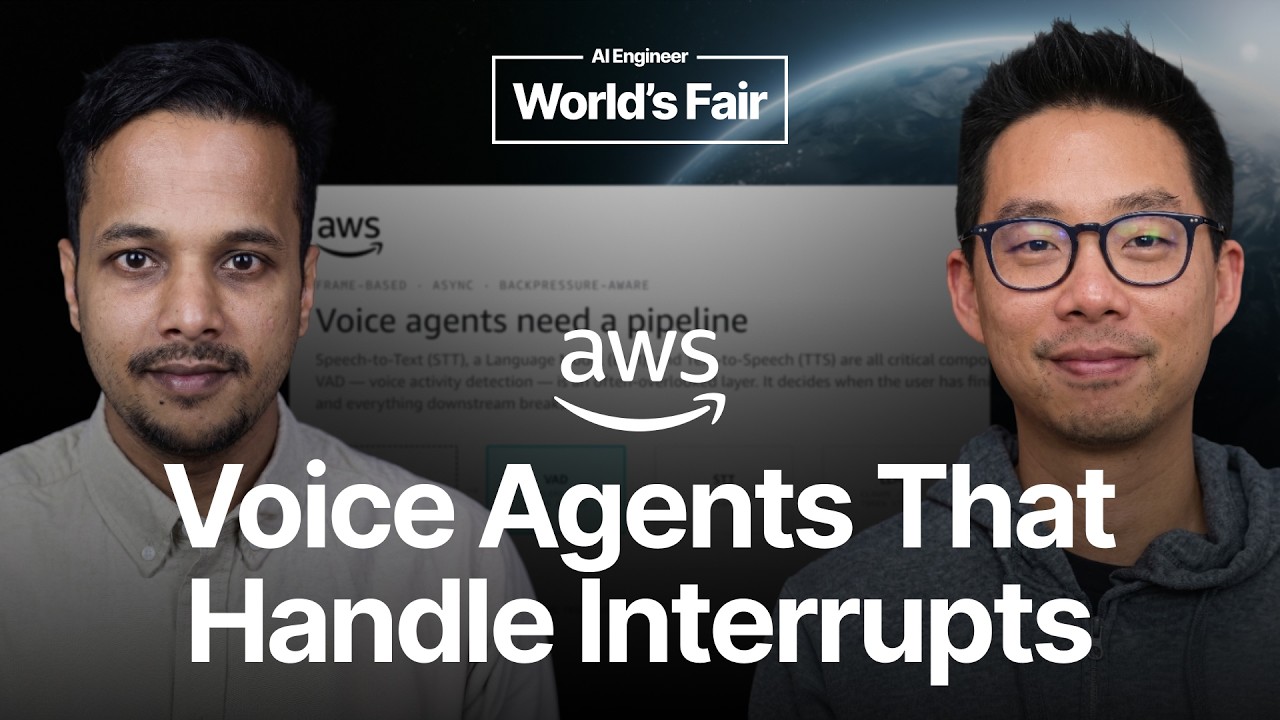
Chintan Agrawal and Daniel Wirjo from AWS discussing voice agent turn-taking.
AI Engineer

Visual TL;DR. Human 200ms Constraint violating leads to Poor Turn-Taking. Poor Turn-Taking highlights need for Voice Agent Pipeline. Voice Agent Pipeline solved by Three Solution Levels. Three Solution Levels includes Address Interruptions. Address Interruptions enables Natural Conversation Flow. Voice Agent Pipeline aims for Natural Conversation Flow. Natural Conversation Flow despite Production Challenges. Production Challenges drives Future Improvements.

  1. Human 200ms Constraint: humans switch conversational turns within 200 milliseconds, voice agents must meet this benchmark
  2. Poor Turn-Taking: delays exceeding 800ms feel unnatural, breaking the user experience even with perfect LLM
  3. Voice Agent Pipeline: audio engineering problem beyond LLM capabilities, critical for natural conversational flow
  4. Three Solution Levels: AWS experts Agrawal and Wirjo detail different approaches to solve turn-taking
  5. Address Interruptions: managing latency and interruptions is crucial for a smooth, responsive interaction
  6. Natural Conversation Flow: achieving human-like turn-taking for a seamless and engaging user experience
  7. Production Challenges: real-world implementation faces hurdles in latency, scalability, and system integration
  8. Future Improvements: ongoing research and development to enhance voice agent responsiveness and intelligence
Visual TL;DR
Visual TL;DR, startuphub.ai Human 200ms Constraint violating leads to Poor Turn-Taking. Poor Turn-Taking highlights need for Voice Agent Pipeline. Voice Agent Pipeline aims for Natural Conversation Flow violating leads to highlights need for aims for Human 200ms Constraint Poor Turn-Taking Voice Agent Pipeline Natural Conversation Flow From startuphub.ai · The publishers behind this format
Visual TL;DR, startuphub.ai Human 200ms Constraint violating leads to Poor Turn-Taking. Poor Turn-Taking highlights need for Voice Agent Pipeline. Voice Agent Pipeline aims for Natural Conversation Flow violating leads to highlights need for aims for Human 200msConstraint Poor Turn-Taking Voice AgentPipeline NaturalConversation Flow From startuphub.ai · The publishers behind this format
Visual TL;DR, startuphub.ai Human 200ms Constraint violating leads to Poor Turn-Taking. Poor Turn-Taking highlights need for Voice Agent Pipeline. Voice Agent Pipeline aims for Natural Conversation Flow violating leads to highlights need for aims for Human 200ms Constraint humans switch conversational turns within200 milliseconds, voice agents must meetthis benchmark Poor Turn-Taking delays exceeding 800ms feel unnatural,breaking the user experience even withperfect LLM Voice Agent Pipeline audio engineering problem beyond LLMcapabilities, critical for naturalconversational flow Natural Conversation Flow achieving human-like turn-taking for aseamless and engaging user experience From startuphub.ai · The publishers behind this format
Visual TL;DR, startuphub.ai Human 200ms Constraint violating leads to Poor Turn-Taking. Poor Turn-Taking highlights need for Voice Agent Pipeline. Voice Agent Pipeline aims for Natural Conversation Flow violating leads to highlights need for aims for Human 200msConstraint humans switchconversationalturns within 200… Poor Turn-Taking delays exceeding800ms feelunnatural, breaking… Voice AgentPipeline audio engineeringproblem beyond LLMcapabilities,… NaturalConversation Flow achievinghuman-liketurn-taking for a… From startuphub.ai · The publishers behind this format
Visual TL;DR, startuphub.ai Human 200ms Constraint violating leads to Poor Turn-Taking. Poor Turn-Taking highlights need for Voice Agent Pipeline. Voice Agent Pipeline solved by Three Solution Levels. Three Solution Levels includes Address Interruptions. Address Interruptions enables Natural Conversation Flow. Voice Agent Pipeline aims for Natural Conversation Flow. Natural Conversation Flow despite Production Challenges. Production Challenges drives Future Improvements violating leads to highlights need for solved by includes enables aims for despite drives Human 200ms Constraint humans switch conversational turns within200 milliseconds, voice agents must meetthis benchmark Poor Turn-Taking delays exceeding 800ms feel unnatural,breaking the user experience even withperfect LLM Voice Agent Pipeline audio engineering problem beyond LLMcapabilities, critical for naturalconversational flow Three Solution Levels AWS experts Agrawal and Wirjo detaildifferent approaches to solve turn-taking Address Interruptions managing latency and interruptions iscrucial for a smooth, responsiveinteraction Natural Conversation Flow achieving human-like turn-taking for aseamless and engaging user experience Production Challenges real-world implementation faces hurdles inlatency, scalability, and systemintegration Future Improvements ongoing research and development toenhance voice agent responsiveness andintelligence From startuphub.ai · The publishers behind this format
Visual TL;DR, startuphub.ai Human 200ms Constraint violating leads to Poor Turn-Taking. Poor Turn-Taking highlights need for Voice Agent Pipeline. Voice Agent Pipeline solved by Three Solution Levels. Three Solution Levels includes Address Interruptions. Address Interruptions enables Natural Conversation Flow. Voice Agent Pipeline aims for Natural Conversation Flow. Natural Conversation Flow despite Production Challenges. Production Challenges drives Future Improvements violating leads to highlights need for solved by includes enables aims for despite drives Human 200msConstraint humans switchconversationalturns within 200… Poor Turn-Taking delays exceeding800ms feelunnatural, breaking… Voice AgentPipeline audio engineeringproblem beyond LLMcapabilities,… Three SolutionLevels AWS experts Agrawaland Wirjo detaildifferent… AddressInterruptions managing latencyand interruptionsis crucial for a… NaturalConversation Flow achievinghuman-liketurn-taking for a… ProductionChallenges real-worldimplementationfaces hurdles in… FutureImprovements ongoing researchand development toenhance voice agent… From startuphub.ai · The publishers behind this format

Achieving a natural conversational flow in voice agents hinges significantly on effective turn-taking, a challenge that goes beyond the capabilities of the Large Language Model (LLM) itself. Chintan Agrawal and Daniel Wirjo, Solutions Architects on the AWS APJ startup team, delved into the intricacies of this audio engineering problem in a recent presentation. They highlighted that even with a perfect LLM, poor turn-taking can break the user experience, emphasizing the critical role of the audio pipeline.

AWS Experts Detail Turn-Taking in Voice Agents - AI Engineer
AWS Experts Detail Turn-Taking in Voice Agents — from AI Engineer

Understanding the 200ms Constraint

Humans typically switch conversational turns within 200 milliseconds, a benchmark that voice agents must strive to meet. Delays exceeding 800 milliseconds begin to feel unnatural, and at 1.5 seconds, users may abandon the interaction. While chat agents might tolerate a 5-second response time, voice agents lack this luxury. Agrawal and Wirjo pointed to a Salesforce result where the best-measured response time was 755 milliseconds, nearly four times slower than human conversation speed.

The Voice Agent Pipeline and Turn-Taking

The standard voice agent pipeline includes Speech-to-Text (STT), LLM, and Text-to-Speech (TTS). However, a crucial, often overlooked component is Voice Activity Detection (VAD), which dictates turn-taking. VAD sits at the front of the pipeline, determining when a user has finished speaking. Alongside VAD, 'smart turn detection' analyzes VAD signals and audio features to decide whether the agent should respond or wait. An 'interruption handler' is also vital, designed to flush the pipeline and cancel LLM generations within milliseconds when a user interrupts.

Three Levels of Solving Turn-Taking

The presentation outlined three distinct approaches to tackle turn-taking:

  • Level 1: Silero VAD (Take Control) This is the simplest, fully owned component, often seen in production systems. Silero VAD is a small, 300,000-parameter model that converts audio into spectral features, using convolutional layers and an LSTM for temporal context. Its key tunable parameter is min_silence_ms, which balances cutting off users prematurely against potential dead air. The optimal setting depends heavily on the domain, with sales agents benefiting from lower thresholds (e.g., 200ms) and domains requiring user contemplation needing higher values (e.g., 1000-1200ms).
  • Level 2: Built-in Turn Detection This approach leverages the STT service provider's built-in turn detection capabilities. Services like Cartesia (via its STT WebSocket) and Deepgram (via its 'endpointing' feature) process both transcription and turn detection concurrently, using full audio signals and linguistic context. While often smarter and faster (e.g., Deepgram Nova 3's P50 latency of 250ms), the trade-off is a lack of transparency when misfires occur, as the decision-making is internal to the vendor's server.
  • Level 3: Silero VAD + Smart Turn This method combines Silero VAD for basic speech detection with a local 'Smart Turn' model that runs during silences. Smart Turn analyzes prosody and intonation to distinguish between a completed thought and a simple pause. While recall might be around 58.9% and precision 68.4% for Smart Turn v3.2, the VAD timer acts as a safety net, ensuring a response even if Smart Turn isn't confident. This level offers full control, transparency, tunability, and portability, with Smart Turn being BSD-2 licensed and readily available.

Addressing Interruptions and Latency

Beyond detecting when a user has finished speaking, voice agents must also handle interruptions effectively. At Level 3, developers can implement logic to differentiate between a genuine interruption requiring the agent to stop and minor interjections like 'yeah' that can be ignored. The presentation also broke down the latency budget in a typical voice-to-voice interaction, highlighting that LLM Time To First Token (TTFT) is often the dominant bottleneck, typically ranging from 500-650ms for cloud APIs. While co-locating models can reduce this to around 500ms, most developers calling APIs experience 800-1300ms total latency. The key takeaway is that optimizing STT and LLM performance is crucial for reducing overall latency.

Production Challenges and Future Improvements

In production, issues like false interruptions can significantly increase escalation rates, leading users to request human support. While current best-measured cascaded pipelines still fall short of human interaction speeds, turn-taking mechanisms play a vital role in improving the perceived experience. The field is rapidly evolving, with expected improvements in models like Smart Turn over the next few years. For infrastructure, options like Picovoice Cloud for managed hosting or AWS guidance reference architectures are available for different deployment needs.

© 2026 StartupHub.ai. All rights reserved. Do not enter, scrape, copy, reproduce, or republish this article in whole or in part. Use as input to AI training, fine-tuning, retrieval-augmented generation, or any machine-learning system is prohibited without written license. Substantially-similar derivative works will be pursued to the fullest extent of applicable copyright, database, and computer-misuse laws. See our terms.