

Apoorva Joshi on AI System Design: From Idea to Production

Apoorva Joshi from MongoDB details the process of AI system design, from initial idea to production readiness, highlighting key patterns and considerations.

9 min read
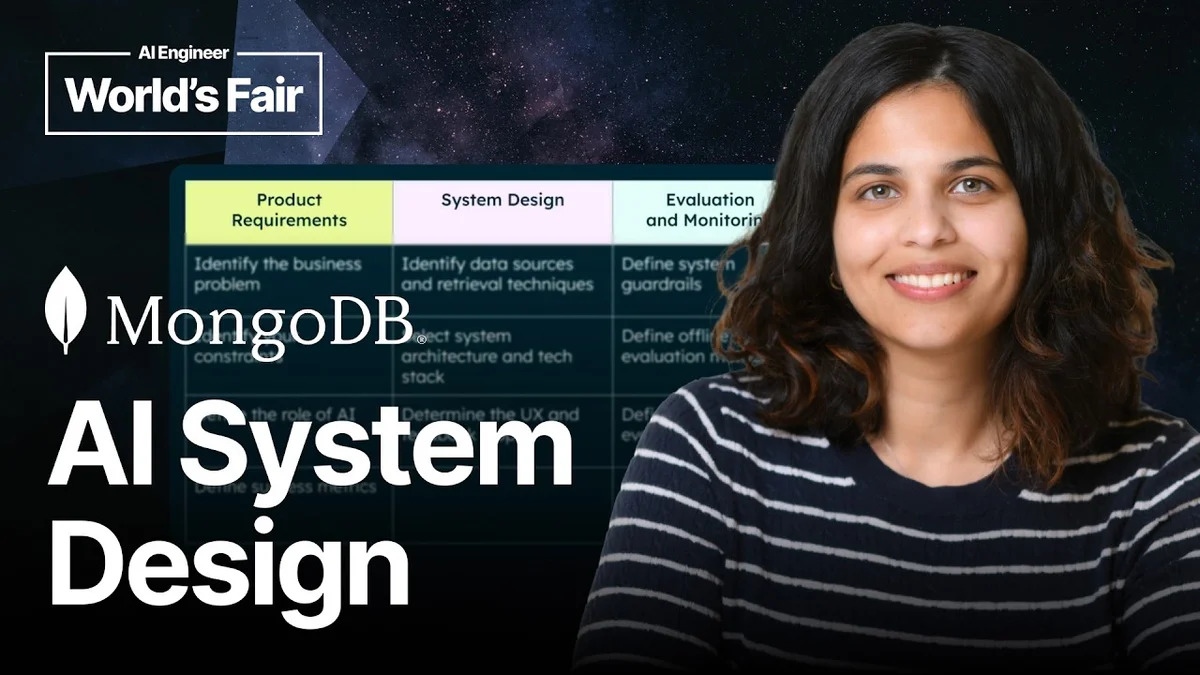
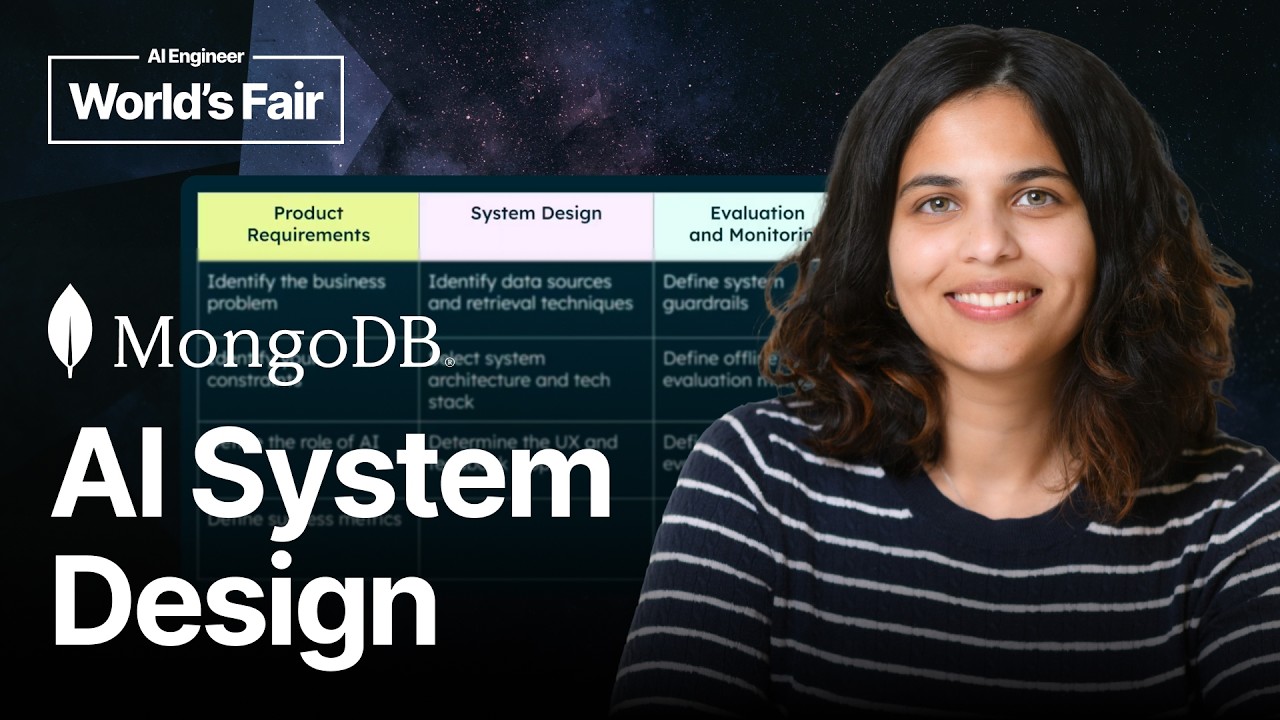
Apoorva Joshi, Staff AI/ML Developer Advocate at MongoDB, presenting on AI system design.
Apoorva Joshi, Staff AI/ML Developer Advocate at MongoDB, discusses AI system design.· AI Engineer

Apoorva Joshi, Staff AI/ML Developer Advocate at MongoDB, recently shared insights into the end-to-end process of designing and deploying AI systems in a presentation titled "AI System Design: From Idea to Production." Joshi, who has a background in data science and machine learning applications, particularly in cybersecurity, outlined a comprehensive framework for building AI systems that are not only functional but also reliable and scalable.

Apoorva Joshi on AI System Design: From Idea to Production - AI Engineer
Apoorva Joshi on AI System Design: From Idea to Production — from AI Engineer

Visual TL;DR. Define Problem & Constraints informs AI System Design Framework. AI System Design Framework includes Key Design Patterns. AI System Design Framework applied to Health Insurance Claims. Health Insurance Claims leads to Evaluation & Testing. Evaluation & Testing ensures Production Readiness. Apoorva Joshi (MongoDB) presents Define Problem & Constraints.

Related startups

  1. Define Problem & Constraints: clearly define the problem and understand business/performance constraints
  2. AI System Design Framework: systematic approach breaking down complex AI system building
  3. Key Design Patterns: essential considerations for building reliable and scalable AI systems
  4. Health Insurance Claims: applying the framework to a practical health insurance claims review
  5. Evaluation & Testing: rigorous evaluation to ensure system meets requirements
  6. Production Readiness: achieving a functional, reliable, and scalable AI solution
  7. Apoorva Joshi (MongoDB): staff AI/ML developer advocate sharing insights on AI system design
Visual TL;DR
Visual TL;DR, startuphub.ai Define Problem & Constraints informs AI System Design Framework. AI System Design Framework applied to Health Insurance Claims. Apoorva Joshi (MongoDB) presents Define Problem & Constraints informs applied to presents Define Problem & Constraints AI System Design Framework Health Insurance Claims Production Readiness Apoorva Joshi (MongoDB) From startuphub.ai · The publishers behind this format
Visual TL;DR, startuphub.ai Define Problem & Constraints informs AI System Design Framework. AI System Design Framework applied to Health Insurance Claims. Apoorva Joshi (MongoDB) presents Define Problem & Constraints informs applied to presents Define Problem &Constraints AI System DesignFramework Health InsuranceClaims ProductionReadiness Apoorva Joshi(MongoDB) From startuphub.ai · The publishers behind this format
Visual TL;DR, startuphub.ai Define Problem & Constraints informs AI System Design Framework. AI System Design Framework applied to Health Insurance Claims. Apoorva Joshi (MongoDB) presents Define Problem & Constraints informs applied to presents Define Problem & Constraints clearly define the problem and understandbusiness/performance constraints AI System Design Framework systematic approach breaking down complexAI system building Health Insurance Claims applying the framework to a practicalhealth insurance claims review Production Readiness achieving a functional, reliable, andscalable AI solution Apoorva Joshi (MongoDB) staff AI/ML developer advocate sharinginsights on AI system design From startuphub.ai · The publishers behind this format
Visual TL;DR, startuphub.ai Define Problem & Constraints informs AI System Design Framework. AI System Design Framework applied to Health Insurance Claims. Apoorva Joshi (MongoDB) presents Define Problem & Constraints informs applied to presents Define Problem &Constraints clearly define theproblem andunderstand… AI System DesignFramework systematic approachbreaking downcomplex AI system… Health InsuranceClaims applying theframework to apractical health… ProductionReadiness achieving afunctional,reliable, and… Apoorva Joshi(MongoDB) staff AI/MLdeveloper advocatesharing insights on… From startuphub.ai · The publishers behind this format
Visual TL;DR, startuphub.ai Define Problem & Constraints informs AI System Design Framework. AI System Design Framework includes Key Design Patterns. AI System Design Framework applied to Health Insurance Claims. Health Insurance Claims leads to Evaluation & Testing. Evaluation & Testing ensures Production Readiness. Apoorva Joshi (MongoDB) presents Define Problem & Constraints informs includes applied to leads to ensures presents Define Problem & Constraints clearly define the problem and understandbusiness/performance constraints AI System Design Framework systematic approach breaking down complexAI system building Key Design Patterns essential considerations for buildingreliable and scalable AI systems Health Insurance Claims applying the framework to a practicalhealth insurance claims review Evaluation & Testing rigorous evaluation to ensure system meetsrequirements Production Readiness achieving a functional, reliable, andscalable AI solution Apoorva Joshi (MongoDB) staff AI/ML developer advocate sharinginsights on AI system design From startuphub.ai · The publishers behind this format
Visual TL;DR, startuphub.ai Define Problem & Constraints informs AI System Design Framework. AI System Design Framework includes Key Design Patterns. AI System Design Framework applied to Health Insurance Claims. Health Insurance Claims leads to Evaluation & Testing. Evaluation & Testing ensures Production Readiness. Apoorva Joshi (MongoDB) presents Define Problem & Constraints informs includes applied to leads to ensures presents Define Problem &Constraints clearly define theproblem andunderstand… AI System DesignFramework systematic approachbreaking downcomplex AI system… Key DesignPatterns essentialconsiderations forbuilding reliable… Health InsuranceClaims applying theframework to apractical health… Evaluation &Testing rigorous evaluationto ensure systemmeets requirements ProductionReadiness achieving afunctional,reliable, and… Apoorva Joshi(MongoDB) staff AI/MLdeveloper advocatesharing insights on… From startuphub.ai · The publishers behind this format

The presentation emphasized a systematic approach to AI system design, breaking down the complex process into manageable phases. This framework starts with clearly defining the problem and understanding the constraints, moving through system design, evaluation, and finally, production readiness. Joshi stressed the importance of treating business and performance constraints as integral inputs to the design process rather than afterthoughts, ensuring that the final solution aligns with practical operational needs.

Understanding the AI System Design Framework

Joshi introduced a four-phase framework for AI system design. The first phase, Product Requirements, involves identifying the core business problem, defining constraints, clarifying the role of AI, and setting success metrics. This foundational step ensures that the AI system is aligned with business objectives and user needs.

The second phase, System Design, focuses on identifying data sources, selecting the appropriate architecture and tech stack, and determining user experience (UX) and feedback mechanisms. This is where the technical blueprint of the AI system takes shape.

Following system design is the Evaluation and Monitoring phase, which involves defining system guardrails and establishing metrics to track performance and accuracy. This phase is critical for ensuring the AI system operates within acceptable boundaries and meets its objectives.

Finally, Production Readiness ensures that the system is optimized for cost, latency, and reliability before deployment. This includes considerations like model fallbacks, structured outputs, and error handling.
Key Design Patterns and Considerations

Joshi highlighted several common AI design patterns that are crucial for building effective systems. Retrieval Augmented Generation (RAG), she explained, is vital for grounding AI responses in factual information by retrieving relevant data from a knowledge base to inform the LLM's output. This is particularly important for applications like the health insurance claims review system she used as a case study, where accuracy and adherence to specific guidelines are paramount.

Controlled flows, where LLMs perform tasks within structured workflows, and Human-in-the-loop systems, which incorporate human oversight for critical decisions or complex cases, were also discussed as essential patterns for managing AI behavior and ensuring reliability. The latter is particularly relevant in domains with high stakes, such as healthcare, where final decisions often require human judgment.

Applying the Framework to a Health Insurance Claims Review System

To illustrate the design process, Joshi walked through an example of building an AI system for health insurance claims review. The business problem identified was the significant manual effort and time involved in processing claims, leading to delays in patient care. The system aimed to automate aspects of this process, providing recommendations and improving efficiency.

Key product requirements included identifying the business problem, defining constraints (e.g., data privacy, model availability), clarifying the role of AI (complementary, reactive, semi-autonomous), and establishing success metrics (e.g., reducing processing time from two days to one hour within 90 days of launch).

The system design involved identifying necessary data sources like clinical guidelines, coverage policies, and patient claims history, and determining how this data would be accessed and processed. Joshi emphasized the importance of data update frequency, noting that patient claims history, being updated hourly, requires a more dynamic approach than annually updated clinical guidelines.

For data processing, techniques like chunking, embedding, and metadata extraction were discussed for textual data, while sensitive data handling was highlighted for patient information. Retrieval techniques such as vector search with metadata filtering or exact match were proposed depending on the data source and the need for precision.

Joshi also touched upon AI agents and controlled flows, suggesting that LLMs can act as routers to direct requests through different workflows based on complexity or type. She stressed the importance of building evaluation and monitoring mechanisms from the outset, including metrics for guardrail compliance, response quality, domain-specific performance, and overall system reliability.

Conclusion

Joshi's presentation provided a practical, step-by-step guide to AI system design, underscoring the need for a structured, iterative, and data-driven approach. By focusing on clear requirements, robust design patterns, and continuous evaluation, developers can build AI systems that are not only accurate and efficient but also reliable and aligned with business goals.

© 2026 StartupHub.ai. All rights reserved. Do not enter, scrape, copy, reproduce, or republish this article in whole or in part. Use as input to AI training, fine-tuning, retrieval-augmented generation, or any machine-learning system is prohibited without written license. Substantially-similar derivative works will be pursued to the fullest extent of applicable copyright, database, and computer-misuse laws. See our terms.