The quest to build an AI capable of advanced mathematical reasoning has hit a major milestone. Researchers behind the new AlphaProof system, detailed in a paper published in Nature, have demonstrated an AI capable of solving problems from the notoriously difficult International Mathematical Olympiad (IMO), achieving a silver medal performance in the 2024 contest.
The AlphaProof system, developed by Julian Schrittwieser and colleagues while at Google DeepMind, successfully generated formal proofs for three of the six IMO problems (P1, P2, and P6). Crucially, P6 was considered the hardest problem of the contest, solved by only five out of 609 human participants. This achievement isn't just about solving hard math; it’s about solving it with guaranteed, verifiable truth, bypassing the hallucination issues plaguing general-purpose large language models (LLMs).
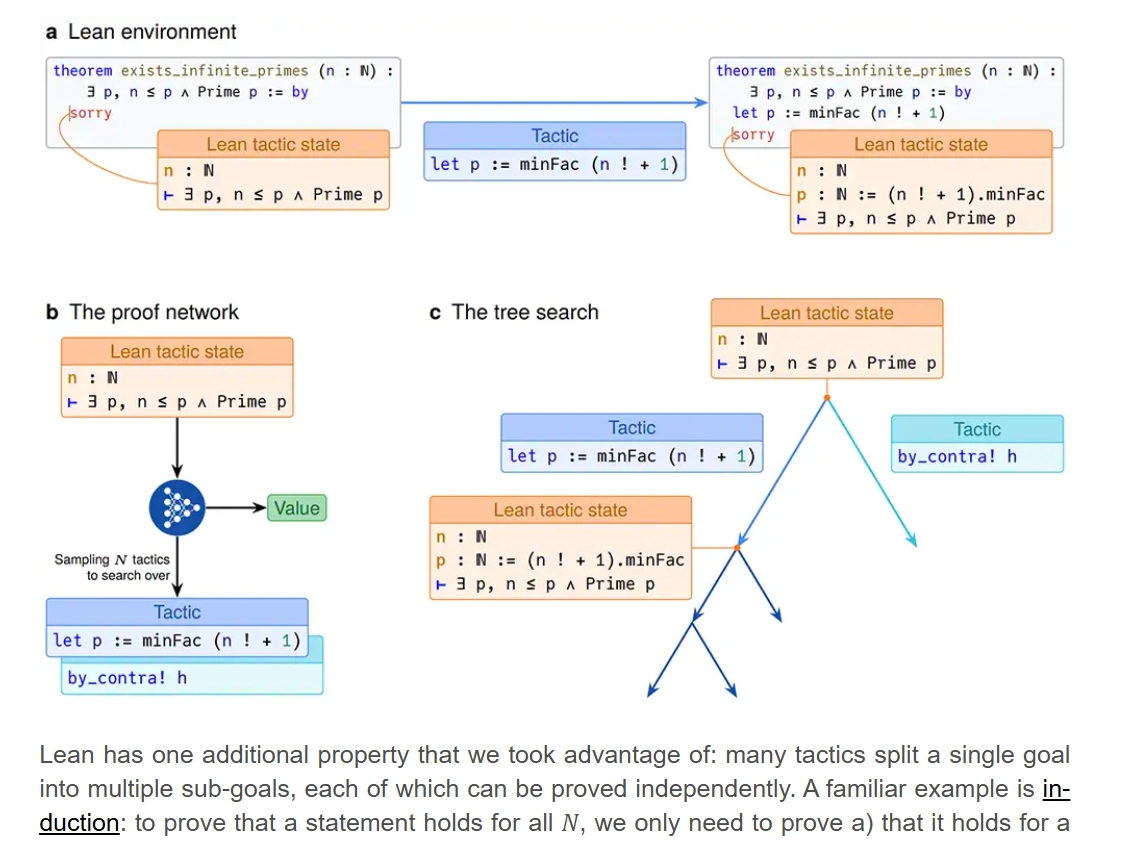
Unlike systems that output proofs in natural language, which still require human mathematicians to manually verify every step, AlphaProof operates entirely within Lean, a formal proof assistant language. Lean’s structure is ideal for programmatic discovery: proofs are composed of short, verifiable “tactics,” and the system can automatically check if the final result is logically sound, making it perfect for Reinforcement Learning (RL) reward computation.
The system’s foundation is a massive encoder-decoder transformer, pretrained for an unprecedented 50 epochs on a mix of code and mathematical data, seeing 12 trillion tokens on the encoder side. This specialized training ensures the model can generate plausible Lean tactics from the start.
Why Formal Verification Changes Everything
The real innovation lies in how AlphaProof leverages AlphaZero-style tree search and RL to navigate the vast space of possible proofs. Because Lean proofs often involve splitting a single goal into multiple independent sub-goals (like induction), the team introduced a new concept into the search algorithm: the "product node." This node requires all its children to be proven, allowing the search to efficiently track which sub-goals are complete and focus compute on the hardest remaining branches.