

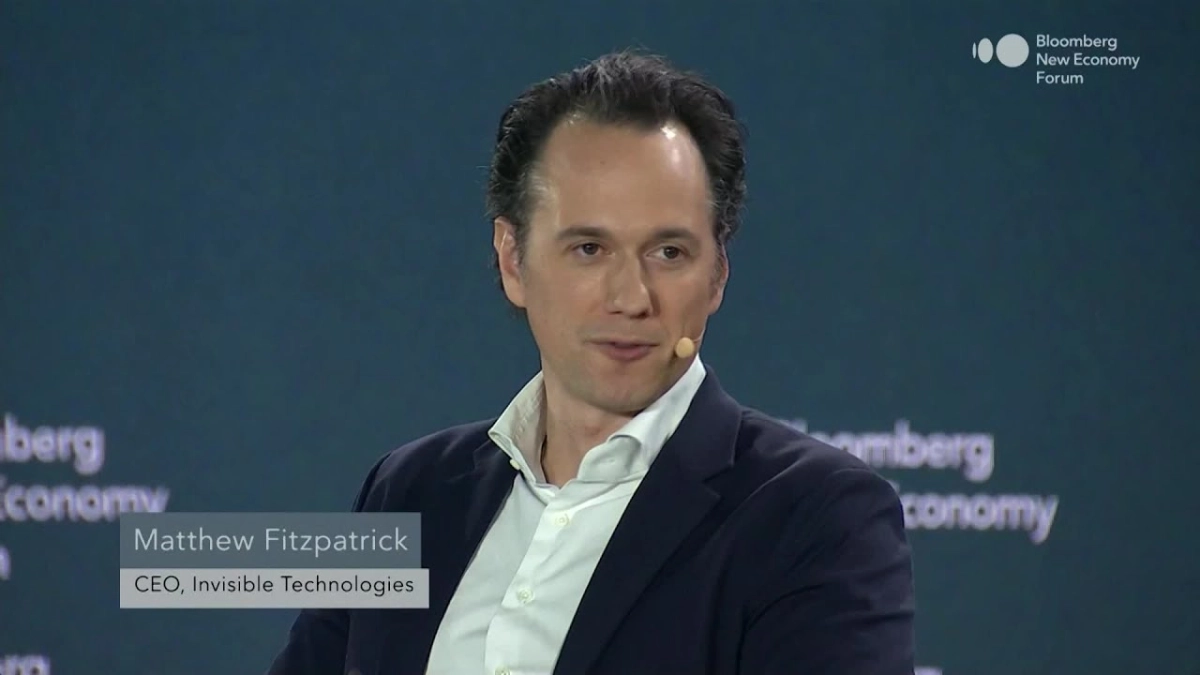
The prevailing sentiment among leading minds at the 2025 Bloomberg New Economy Forum in Singapore, as articulated by Bloomberg's Technology Columnist Parmy Olson and a distinguished panel of AI innovators, is a nuanced blend of immense potential and the sobering realities of adoption. Matthew Fitzpatrick, CEO of Invisible Technologies, Anna Fang, Founding Partner & CEO of ZhenFund, David Ha, Co-Founder & CEO of Sakana AI, and Nathan Xu, Co-Founder & CEO of Plaud, converged to dissect the transformative power of artificial intelligence, particularly highlighting the chasm between consumer enthusiasm and enterprise integration.
Matthew Fitzpatrick swiftly cut to the core issue of AI adoption, noting, "If you look at adoption today, it's really a split between consumer and enterprise adoption. So consumer adoption has been the fastest growing technology evolution in history probably." He cited a recent study showing 65% of consumers across 50 countries use generative AI monthly. However, the narrative shifts dramatically for businesses. Enterprise adoption, Fitzpatrick observed, "is going to take longer than people had expected." This delay stems from deeply entrenched legacy systems, fragmented data infrastructure, and the necessity to fundamentally redesign workflows and achieve leadership alignment. An MIT study revealing that only 5% of enterprise AI models make it to production underscores the formidable challenges of integrating AI into complex, often outdated, corporate environments.
This slower-than-anticipated enterprise uptake fuels discussions around an "AI bubble," a concern Anna Fang addressed directly. She invoked Amara's Law, explaining that "humans tend to um have this type of expectation about technology. And in reality, it'll we'll kind of go through periods of overestimating and underestimating the market." Fang emphasized a shift in focus from mere growth to the "quality of revenue," scrutinizing retention rates and gross margins. This reflects a healthy market correction, moving beyond the initial frenzy of investment to a more discerning evaluation of tangible value and sustainable business models.
Amidst the debate on scale versus sustainability, David Ha introduced an alternative paradigm for innovation. While the dominant AI model relies on "scaling, building larger and larger models requiring larger infrastructure," Ha argued for "innovation, based on constraints." He highlighted that countries with fewer resources are often compelled to develop more novel and efficient AI algorithms. His company, Sakana AI, actively pursues such innovation, even utilizing AI itself, through "AI scientists", to discover more efficient algorithms.
Nathan Xu's venture, Plaud, embodies this push for innovation rooted in real-world data capture, extending beyond the internet's scraped text. Plaud's wearable AI devices record in-person conversations, creating entirely new datasets that capture the nuances of human interaction. "We have a philosophy where conversation is a form of intelligence, and that means, you know, it's best that if we are able to capture all those meaningful conversations. But guess what? For in-person meetings and conversations, people are not doing that. ... All this data set has never been captured before." This represents a profound opportunity to train more capable language models by feeding them the rich, contextual data of our physical world.