

AI Writing: Authorship's New Frontier

Philosophical debates on authorship from the 1960s illuminate our modern reactions to AI-generated text, revealing a social need for 'author-function' in content.

8 min read
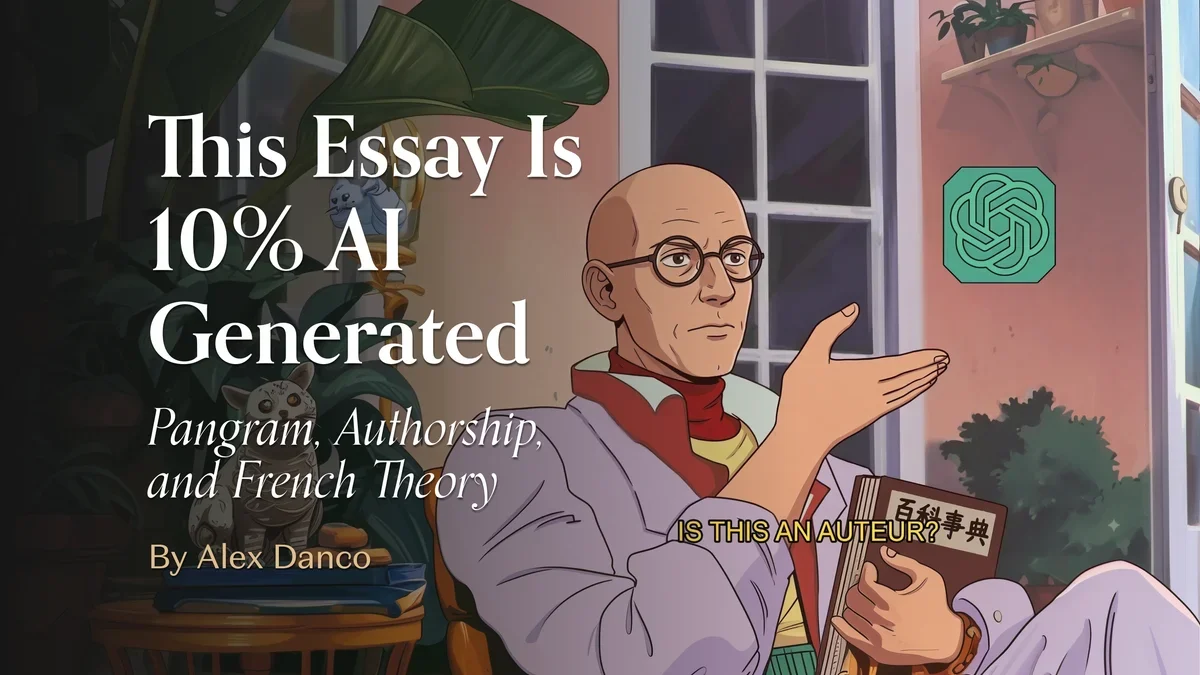
Abstract graphic representing text and digital connections, with subtle AI motifs.
a16z Blog

Visual TL;DR. AI Writing Emerges prompts review of Authorship Debates (1960s). Authorship Debates (1960s) informs Author-Function Needed. AI Writing Emerges creates The 'Alien' Voice. The 'Alien' Voice highlights Authorship Still Matters. Author-Function Needed reinforces Authorship Still Matters. Authorship Still Matters shapes Marketplace Decides. Authorship Debates (1960s) includes Death of the Author.

  1. AI Writing Emerges: AI-generated texts lead to new social signals like '100% AI' disclaimers
  2. Authorship Debates (1960s): Barthes and Foucault questioned author's intent vs. text's inherent meaning
  3. Author-Function Needed: modern reactions to AI reveal a social need for 'author-function' in content
  4. The 'Alien' Voice: dislike for AI prose despite its rapid adoption suggests a preference disconnect
  5. Authorship Still Matters: philosophical questions about authorship, meaning, and language persist with AI
  6. Marketplace Decides: marketplace of ideas will bend toward what readers truly engage with
  7. Death of the Author: Barthes argued text meaning resides in language, not author's intent
Visual TL;DR
Visual TL;DR, startuphub.ai Author-Function Needed reinforces Authorship Still Matters. Authorship Still Matters shapes Marketplace Decides reinforces shapes AI Writing Emerges Author-Function Needed Authorship Still Matters Marketplace Decides From startuphub.ai · The publishers behind this format
Visual TL;DR, startuphub.ai Author-Function Needed reinforces Authorship Still Matters. Authorship Still Matters shapes Marketplace Decides reinforces shapes AI WritingEmerges Author-FunctionNeeded Authorship StillMatters MarketplaceDecides From startuphub.ai · The publishers behind this format
Visual TL;DR, startuphub.ai Author-Function Needed reinforces Authorship Still Matters. Authorship Still Matters shapes Marketplace Decides reinforces shapes AI Writing Emerges AI-generated texts lead to new socialsignals like '100% AI' disclaimers Author-Function Needed modern reactions to AI reveal a socialneed for 'author-function' in content Authorship Still Matters philosophical questions about authorship,meaning, and language persist with AI Marketplace Decides marketplace of ideas will bend toward whatreaders truly engage with From startuphub.ai · The publishers behind this format
Visual TL;DR, startuphub.ai Author-Function Needed reinforces Authorship Still Matters. Authorship Still Matters shapes Marketplace Decides reinforces shapes AI WritingEmerges AI-generated textslead to new socialsignals like '100%… Author-FunctionNeeded modern reactions toAI reveal a socialneed for… Authorship StillMatters philosophicalquestions aboutauthorship,… MarketplaceDecides marketplace ofideas will bendtoward what readers… From startuphub.ai · The publishers behind this format
Visual TL;DR, startuphub.ai AI Writing Emerges prompts review of Authorship Debates (1960s). Authorship Debates (1960s) informs Author-Function Needed. AI Writing Emerges creates The 'Alien' Voice. The 'Alien' Voice highlights Authorship Still Matters. Author-Function Needed reinforces Authorship Still Matters. Authorship Still Matters shapes Marketplace Decides. Authorship Debates (1960s) includes Death of the Author prompts review of informs creates highlights reinforces shapes includes AI Writing Emerges AI-generated texts lead to new socialsignals like '100% AI' disclaimers Authorship Debates (1960s) Barthes and Foucault questioned author'sintent vs. text's inherent meaning Author-Function Needed modern reactions to AI reveal a socialneed for 'author-function' in content The 'Alien' Voice dislike for AI prose despite its rapidadoption suggests a preference disconnect Authorship Still Matters philosophical questions about authorship,meaning, and language persist with AI Marketplace Decides marketplace of ideas will bend toward whatreaders truly engage with Death of the Author Barthes argued text meaning resides inlanguage, not author's intent From startuphub.ai · The publishers behind this format
Visual TL;DR, startuphub.ai AI Writing Emerges prompts review of Authorship Debates (1960s). Authorship Debates (1960s) informs Author-Function Needed. AI Writing Emerges creates The 'Alien' Voice. The 'Alien' Voice highlights Authorship Still Matters. Author-Function Needed reinforces Authorship Still Matters. Authorship Still Matters shapes Marketplace Decides. Authorship Debates (1960s) includes Death of the Author prompts review of informs creates highlights reinforces shapes includes AI WritingEmerges AI-generated textslead to new socialsignals like '100%… AuthorshipDebates (1960s) Barthes andFoucault questionedauthor's intent vs.… Author-FunctionNeeded modern reactions toAI reveal a socialneed for… The 'Alien' Voice dislike for AIprose despite itsrapid adoption… Authorship StillMatters philosophicalquestions aboutauthorship,… MarketplaceDecides marketplace ofideas will bendtoward what readers… Death of theAuthor Barthes argued textmeaning resides inlanguage, not… From startuphub.ai · The publishers behind this format

The digital ink is barely dry on many AI-generated texts, yet a new social signal has emerged: the "100% AI" disclaimer. For Alex Danco, writing for the a16z Blog, this isn't just a way to dismiss content. It's a modern manifestation of deep philosophical questions about authorship, meaning, and the very nature of language.

Danco posits that the prevalence of AI writing, and our immediate reactions to it, can be better understood through the lens of 1960s French theorists like Roland Barthes and Michel Foucault. While we might dislike AI prose, its rapid adoption suggests a disconnect between stated preferences and actual behavior. The marketplace of ideas, Danco argues, will ultimately bend toward what readers truly engage with.

The Death and Rebirth of the Author

Barthes, in his seminal 1967 essay "The Death of the Author," argued that a text's meaning resides in the language itself and its interconnections, not in the author's intent or biography. He suggested that words are already imbued with prior meanings, and the writer is merely recombining them. This idea feels remarkably prescient when observing how Large Language Models (LLMs) operate, predicting token by token based on vast datasets.

However, Foucault, in his 1969 essay "What is an Author?", countered that authorship, while perhaps not essential to a text's intrinsic meaning, serves a vital social function. We create "authorship" as a way to categorize, contextualize, and regulate discourse. It’s a meaning-compressor, allowing us to quickly understand the provenance and potential significance of a piece of writing.

Danco connects this intellectual history to the current AI debate. When tech communities flag content as "100% AI-generated," they're not just saying "AI is bad." They are, in Foucault's terms, performing the author-function. They are creating a new category of authorship, "AI-generated," to help process and manage the influx of digital text. It’s a social mechanism for making sense of a world where traditional authorship is increasingly blurred.

The 'Alien' Voice of AI

Beyond the social signaling, Danco points to the subtle linguistic tells that can betray AI authorship. He highlights phrases like "Give the pruning logic real attention," contrasting it with a more natural human phrasing like "Pay attention to the pruning logic." This "alien" construction, he suggests, stems from the LLM's token-prediction process. The model optimizes for a coherent output, but its word-by-word, statistically driven approach can lead to sentence structures that feel slightly off, echoing Barthes' idea that language itself does much of the writing.

Another common AI trait identified is an overly confident assertion of connections between disparate ideas, often resolving into pronouncements like "that's the quiet brilliance of it." Danco speculates that LLMs, having absorbed a vast amount of human text, might be "backfilling" the author-function into their training data. They are, in essence, optimizing not just for factual accuracy or coherence, but for the appearance of authorship, a social requirement they've learned to fulfill.

Why Authorship Still Matters

The drive to detect AI content, and the very existence of the "author-function" debate, suggests that authorship holds a value beyond mere attribution. It’s tied to meaning, to how we organize and relate ideas. Even as AI makes the Barthesian notion of "inherent authorship" more literal, where meaning is derived from the text's internal logic and its relationship to all other text, we continue to recreate Foucault's "emergent authorship," a socially constructed layer of significance.

Danco's own exploration of his older blog posts, which scored surprisingly high on AI detection, highlights this ambiguity. Are these texts merely echoing patterns learned from a vast corpus that includes his own writing, or is the AI sophisticated enough to mimic his style? The answer, he implies, is less about definitive detection and more about our ongoing societal negotiation with what authorship means in the age of artificial intelligence. The impulse to label, to assign an author, remains strong.

© 2026 StartupHub.ai. All rights reserved. Do not enter, scrape, copy, reproduce, or republish this article in whole or in part. Use as input to AI training, fine-tuning, retrieval-augmented generation, or any machine-learning system is prohibited without written license. Substantially-similar derivative works will be pursued to the fullest extent of applicable copyright, database, and computer-misuse laws. See our terms.