

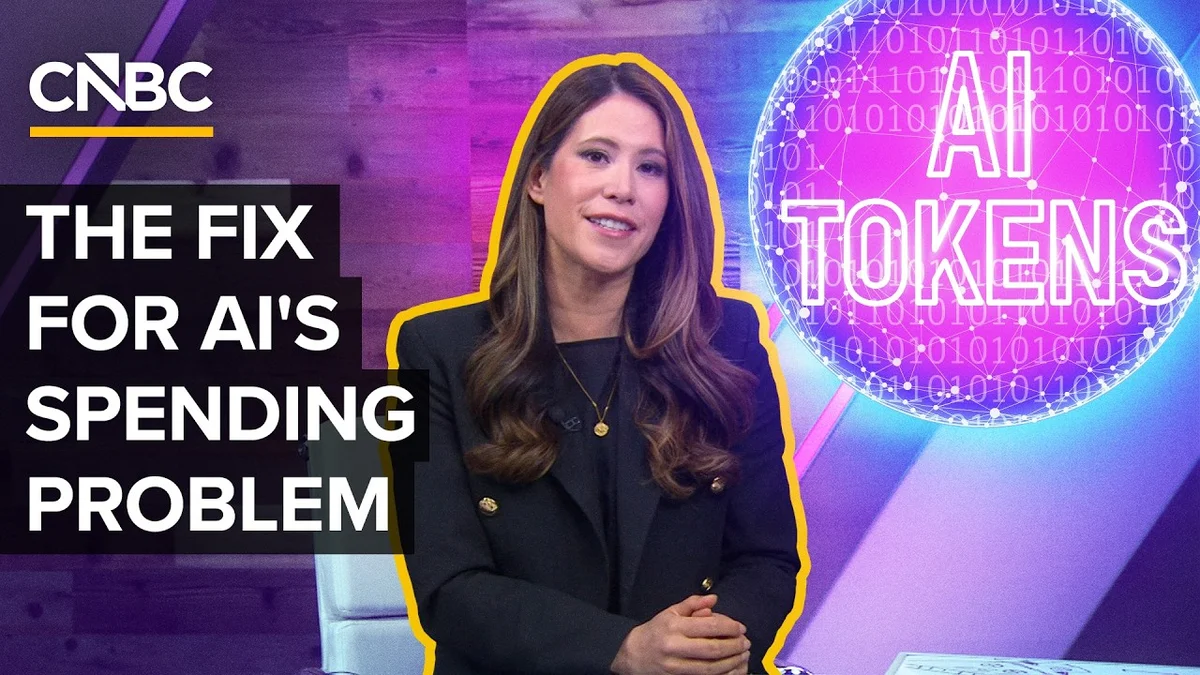
AI's Spending Problem: Why Fixes Hurt OpenAI, Anthropic

The high cost of AI development is forcing a rethink of spending strategies, potentially challenging the business models of OpenAI and Anthropic.

8 min read
Hands typing on a laptop displaying lines of code, representing AI development.
AI development requires significant resources, leading to the current spending challenges in the industry.· CNBC

The burgeoning field of artificial intelligence is grappling with a significant financial hurdle: the escalating cost of developing and deploying AI models. In a recent discussion, Deirdre Bosa of CNBC highlighted that the very solutions intended to rectify AI's notorious spending problem could inadvertently disadvantage major players like OpenAI and Anthropic. This revelation points to a complex interplay between innovation, cost, and market dynamics that is shaping the future of AI.

AI's Spending Problem: Why Fixes Hurt OpenAI, Anthropic - CNBC
AI's Spending Problem: Why Fixes Hurt OpenAI, Anthropic — from CNBC

Visual TL;DR. AI Spending Problem leads to Unsustainable Business Models. AI Spending Problem driven by Pursuit of Powerful AI. Pursuit of Powerful AI causes Unsustainable Business Models. Model Routing Solution causes Disadvantages Major Players. Disadvantages Major Players impacts Broader Market Impact. OpenAI & Anthropic affected by Disadvantages Major Players.

  1. AI Spending Problem: escalating cost of developing and deploying AI models
  2. Unsustainable Business Models: current models becoming unsustainable as demand grows
  3. Pursuit of Powerful AI: clashes with the need for fiscal responsibility
  4. Model Routing Solution: potential solution to rectify spending problem
  5. Disadvantages Major Players: fixes could inadvertently disadvantage OpenAI and Anthropic
  6. OpenAI & Anthropic: major players in the AI development landscape
  7. Broader Market Impact: shaping the future of AI and its economics

  8. Fiscal Responsibility: need for fiscal responsibility in AI development
Visual TL;DR
Visual TL;DR — startuphub.ai AI Spending Problem leads to Unsustainable Business Models. Model Routing Solution causes Disadvantages Major Players leads to causes AI Spending Problem Unsustainable Business Models Model Routing Solution Disadvantages Major Players From startuphub.ai · The publishers behind this format
Visual TL;DR — startuphub.ai AI Spending Problem leads to Unsustainable Business Models. Model Routing Solution causes Disadvantages Major Players leads to causes AI SpendingProblem UnsustainableBusiness Models Model RoutingSolution DisadvantagesMajor Players From startuphub.ai · The publishers behind this format
Visual TL;DR — startuphub.ai AI Spending Problem leads to Unsustainable Business Models. Model Routing Solution causes Disadvantages Major Players leads to causes AI Spending Problem escalating cost of developing anddeploying AI models Unsustainable Business Models current models becoming unsustainable asdemand grows Model Routing Solution potential solution to rectify spendingproblem Disadvantages Major Players fixes could inadvertently disadvantageOpenAI and Anthropic From startuphub.ai · The publishers behind this format
Visual TL;DR — startuphub.ai AI Spending Problem leads to Unsustainable Business Models. Model Routing Solution causes Disadvantages Major Players leads to causes AI SpendingProblem escalating cost ofdeveloping anddeploying AI models UnsustainableBusiness Models current modelsbecomingunsustainable as… Model RoutingSolution potential solutionto rectify spendingproblem DisadvantagesMajor Players fixes couldinadvertentlydisadvantage OpenAI… From startuphub.ai · The publishers behind this format
Visual TL;DR — startuphub.ai AI Spending Problem leads to Unsustainable Business Models. AI Spending Problem driven by Pursuit of Powerful AI. Pursuit of Powerful AI causes Unsustainable Business Models. Model Routing Solution causes Disadvantages Major Players. Disadvantages Major Players impacts Broader Market Impact. OpenAI & Anthropic affected by Disadvantages Major Players leads to driven by causes causes impacts affected by AI Spending Problem escalating cost of developing anddeploying AI models Unsustainable Business Models current models becoming unsustainable asdemand grows Pursuit of Powerful AI clashes with the need for fiscalresponsibility Model Routing Solution potential solution to rectify spendingproblem Disadvantages Major Players fixes could inadvertently disadvantageOpenAI and Anthropic OpenAI & Anthropic major players in the AI developmentlandscape Broader Market Impact shaping the future of AI and its economics Fiscal Responsibility need for fiscal responsibility in AIdevelopment From startuphub.ai · The publishers behind this format
Visual TL;DR — startuphub.ai AI Spending Problem leads to Unsustainable Business Models. AI Spending Problem driven by Pursuit of Powerful AI. Pursuit of Powerful AI causes Unsustainable Business Models. Model Routing Solution causes Disadvantages Major Players. Disadvantages Major Players impacts Broader Market Impact. OpenAI & Anthropic affected by Disadvantages Major Players leads to driven by causes causes impacts affected by AI SpendingProblem escalating cost ofdeveloping anddeploying AI models UnsustainableBusiness Models current modelsbecomingunsustainable as… Pursuit ofPowerful AI clashes with theneed for fiscalresponsibility Model RoutingSolution potential solutionto rectify spendingproblem DisadvantagesMajor Players fixes couldinadvertentlydisadvantage OpenAI… OpenAI &Anthropic major players inthe AI developmentlandscape Broader MarketImpact shaping the futureof AI and itseconomics FiscalResponsibility need for fiscalresponsibility inAI development From startuphub.ai · The publishers behind this format

The conversation delved into the core of AI's economic challenges, suggesting that the current business models are becoming unsustainable as the demand for more powerful and capable AI systems grows. Companies are finding themselves in a precarious position, where the pursuit of state-of-the-art AI development clashes with the need for fiscal responsibility.

Related startups

The AI Spending Conundrum

The fundamental issue lies in the immense computational resources and specialized hardware required to train and run advanced AI models. These costs, often measured in millions of dollars, are a significant barrier to entry and a constant drain on the resources of even the most well-funded AI labs. As AI capabilities expand, so does the appetite for more data and more processing power, creating a self-perpetuating cycle of increasing expenditure.

Scott Wu, Co-Founder and CEO of Cognition, a company focused on AI development, shared insights into this challenge. He noted that the traditional approach of simply picking the best model for every task is proving to be an inefficient strategy. Wu's company, for instance, has developed a system that optimizes AI model usage by routing tasks to the most appropriate model, whether it's a powerful, expensive one for complex problems or a more cost-effective model for simpler tasks. This approach, he argued, can lead to significant cost savings and improved efficiency.

Model Routing: A Potential Solution?

The concept of "model routing", as explained by Wu, is a tool that intelligently selects the right AI model for different tasks. This allows for the delegation of simpler jobs to less resource-intensive models, while reserving more powerful, and typically more expensive, AI for the tasks that truly require them. This strategy is designed to cut costs by directing easier computational loads away from premium AI models, thereby optimizing resource allocation. Wu highlighted that his company's platform has seen a five-fold increase in token processing over the last six months, indicating a growing adoption of such efficient AI management strategies.

However, the effectiveness of these cost-saving measures is not universally beneficial. While companies like Cognition are building solutions to manage AI expenses, the underlying trend of escalating costs could pose a direct threat to the business models of companies like OpenAI and Anthropic. These organizations, heavily invested in developing and maintaining large, frontier AI models, might find their revenue streams squeezed if the market shifts towards more distributed and cost-optimized AI solutions. The implication is that the very fixes being developed to tame AI spending could undermine the premium pricing strategies of the leading AI providers.

The Broader Market Impact

The increasing focus on AI efficiency is a direct response to the financial pressures felt across the enterprise sector. As companies become more sophisticated in their AI adoption, they are increasingly scrutinizing the return on investment for their AI expenditures. This scrutiny naturally leads to a demand for more cost-effective solutions and a re-evaluation of the value proposition offered by expensive, cutting-edge models.

The trend towards "tokenomics" and the broader commoditization of AI capabilities suggest a future where access to powerful AI might become more democratized, but potentially less lucrative for the pioneers who bore the initial development costs. This shift could force companies like OpenAI and Anthropic to adapt their strategies, perhaps by focusing on new avenues of revenue or by finding ways to demonstrate a clear, quantifiable ROI that justifies their premium pricing.

Ultimately, the challenge of AI spending is a critical one for the industry. As the demand for AI continues to surge, the ability to balance cost, performance, and strategic advantage will be key to sustainable growth and widespread adoption. The solutions being developed today, while potentially disruptive to established players, are indicative of a maturing AI market that is increasingly focused on practical, economic viability.

© 2026 StartupHub.ai. All rights reserved. Do not enter, scrape, copy, reproduce, or republish this article in whole or in part. Use as input to AI training, fine-tuning, retrieval-augmented generation, or any machine-learning system is prohibited without written license. Substantially-similar derivative works will be pursued to the fullest extent of applicable copyright, database, and computer-misuse laws. See our terms.