

AI's Next Frontier: Shared Cognition

AI's next evolutionary leap demands collective intelligence. Cisco's Outshift envisions an 'Internet of Cognition' to unlock distributed superintelligence.

Feb 26 at 5:36 PM3 min read
Abstract graphic visualizing a distributed artificial superintelligence network for shared cognition.

Today's AI agents are powerful, but isolated. Despite their growing capabilities, these digital geniuses operate in semantic silos, limiting their path to true artificial superintelligence (ASI). A new paper from Cisco's Outshift, authored by Vijoy Pandey, Ph.D., outlines a fundamental shift: moving beyond vertically scaling individual agents to horizontally scaling distributed superintelligence.

This next frontier demands a foundational infrastructure for collective intelligence. The proposed 'Internet of Cognition' aims to enable shared intent, shared context, and accelerated collective innovation. Such an architecture promises to unlock genuinely emergent capabilities in multi-agent human–AI systems, tackling complex problems with greater accuracy and robustness.

The Cognitive Evolution for Machines

Human intelligence evolved dramatically through two phases. An initial long period of individual scaling (Shift 1) was followed by an explosive cognitive evolution (Shift 2), driven by semantic communication, collective knowledge, and shared belief systems. This trajectory, Pandey argues, is now replaying in silicon.

Current AI agents exist in their own Shift 1, akin to early humans lacking mechanisms for cumulative knowledge. When a sales agent masters a complex negotiation, that insight often remains isolated. Other agents, even within the same organization, start from scratch on similar problems. The system lacks a 'ratchet effect'—the ability for insights to compound over time.

An Architecture for Distributed Superintelligence

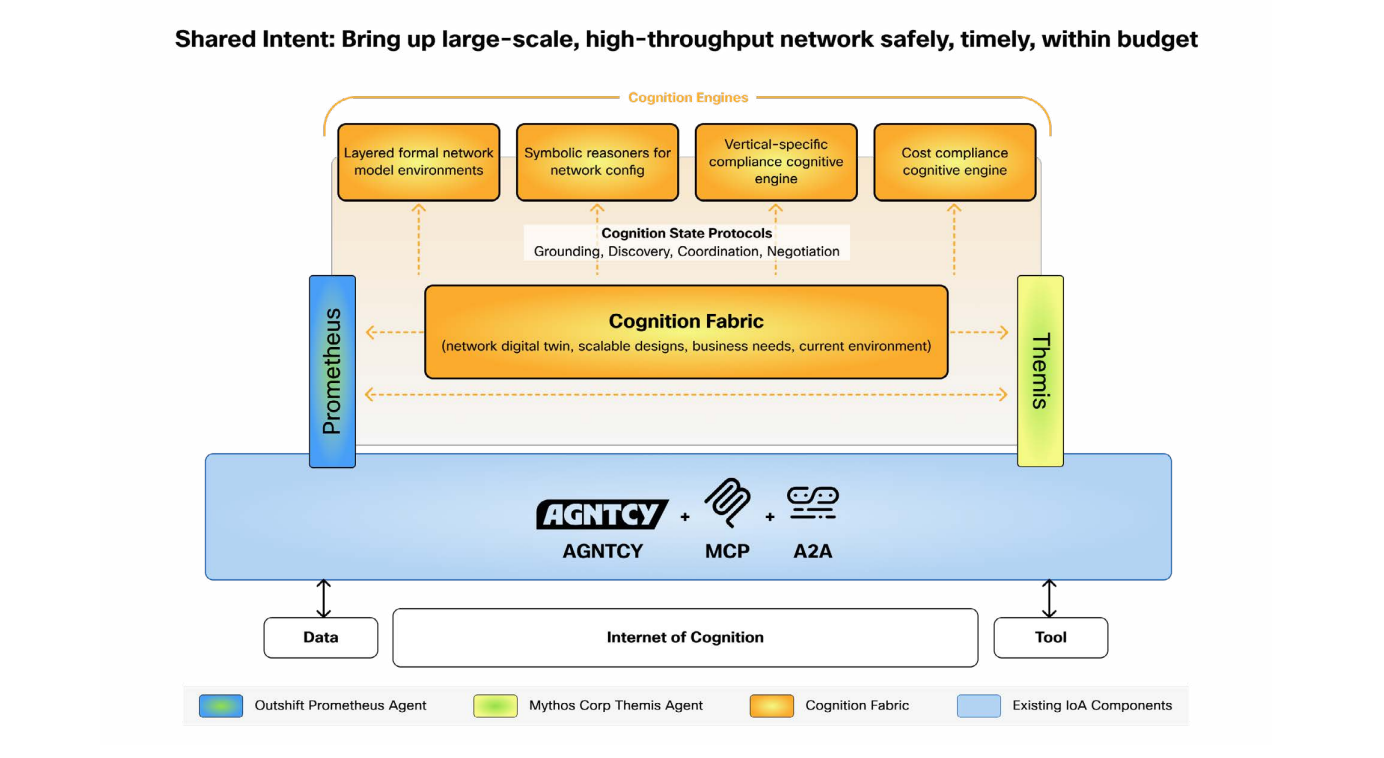
To bridge this gap, the 'Internet of Cognition' introduces three critical architectural components:

  • Cognition State Protocols: These foundational protocols enable agents to align on common objectives and coordinate decisions through semantic meaning, not just message passing. They operate at various granularities, from high-fidelity latent state transfer (LSTP) for unified execution to semantic state transfer (SSTP) for cross-vendor, human-auditable strategic coordination.

  • Cognition Fabric: A trusted, distributed, policy-governed mesh supports the storage, retrieval, and versioned updates of multi-agent-human context graphs, memory, and knowledge. This fabric reconciles state information, creates emergent context, and builds a consistent worldview with granular enterprise-level policies. It provides the shared memory necessary for insights to compound.

  • Cognition Engines: These enterprise-grade functions act as either cognitive amplifiers (COGs), providing privacy-preserving collective reasoning and exploration assistance, or guardrail technologies (GATs), enforcing security, cost, and compliance. They accelerate collective innovation within safe boundaries.

Real-World Impact: LEO Network Deployment

Consider the deployment of a first-of-its-kind low-Earth-orbit (LEO) satellite network. The team includes Outshift's Prometheus agent (network configuration), Mythos Corp's Themis agent (security and compliance), and Mythos Corp’s chief architect. Today, language barriers, differing regulations, and siloed institutional knowledge make true collaboration impossible.

With the 'Internet of Cognition,' these agents and humans can semantically coordinate on a singular shared intent. Cognition state protocols negotiate common goals despite language and regulatory differences. The cognition fabric captures and reconciles institutional knowledge from both organizations and the chief architect's business priorities. Cognition engines accelerate joint problem-solving while ensuring compliance with both US and Japanese requirements. This is distributed artificial superintelligence in practice.

The Call to Action

Scaling out superintelligence demands a unified commitment to building this foundational infrastructure in an open and interoperable manner. Organizations must adopt open cognition state protocols, explore distributed cognition fabrics for trusted shared memory, and deploy cognition engines for enterprise-grade accelerators and guardrails.

This vision enables a multi-agent-human future where agents and humans reason, innovate, and solve the world's most complex problems as one, accelerating our path toward true artificial superintelligence.