

AI's Math Prowess: From Novelty to Necessity

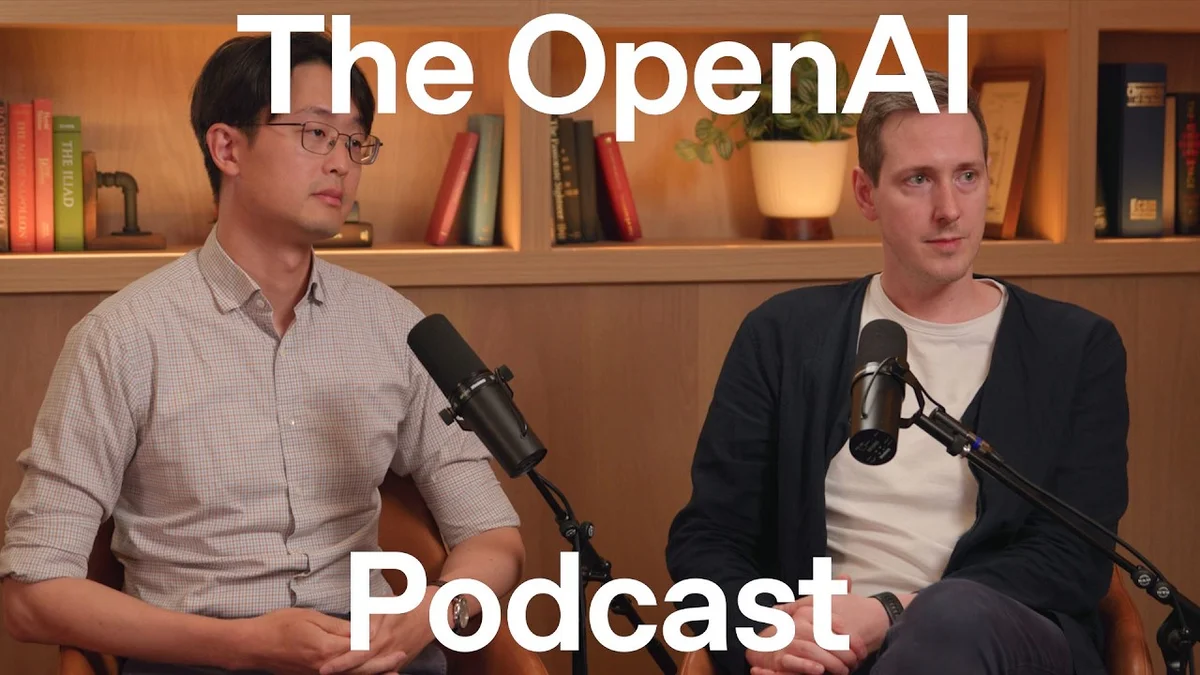
OpenAI researchers Sebastien Bubeck and Ernest Ryu discuss the rapid advancement of AI in solving complex mathematical problems and its implications for science.

Sebastien Bubeck and Ernest Ryu discussing AI in mathematics on The OpenAI Podcast.
Image credit: OpenAI· OpenAI Youtube

In a recent discussion on The OpenAI Podcast, researchers Sebastien Bubeck and Ernest Ryu delved into the astonishing progress of artificial intelligence in the realm of mathematics. The conversation highlighted how AI, once a hesitant participant in complex problem-solving, has transformed into a formidable force, capable of tackling challenges that push the boundaries of human mathematical understanding. This rapid evolution, particularly in the last few years, has surprised even those at the forefront of AI development, suggesting a paradigm shift in how we approach and solve mathematical problems.

Meet the Minds: Bubeck and Ryu

Sebastien Bubeck, a researcher at OpenAI, brings a deep background in optimization and machine learning to the conversation. His academic journey, including a professorship at Princeton, provided him with a foundational understanding of theoretical machine learning before he moved to Microsoft and eventually OpenAI. His work at OpenAI focuses on understanding how AI can aid in solving difficult mathematical problems, evaluating the progress made and the remaining challenges.

The full discussion can be found on OpenAI Youtube's YouTube channel.
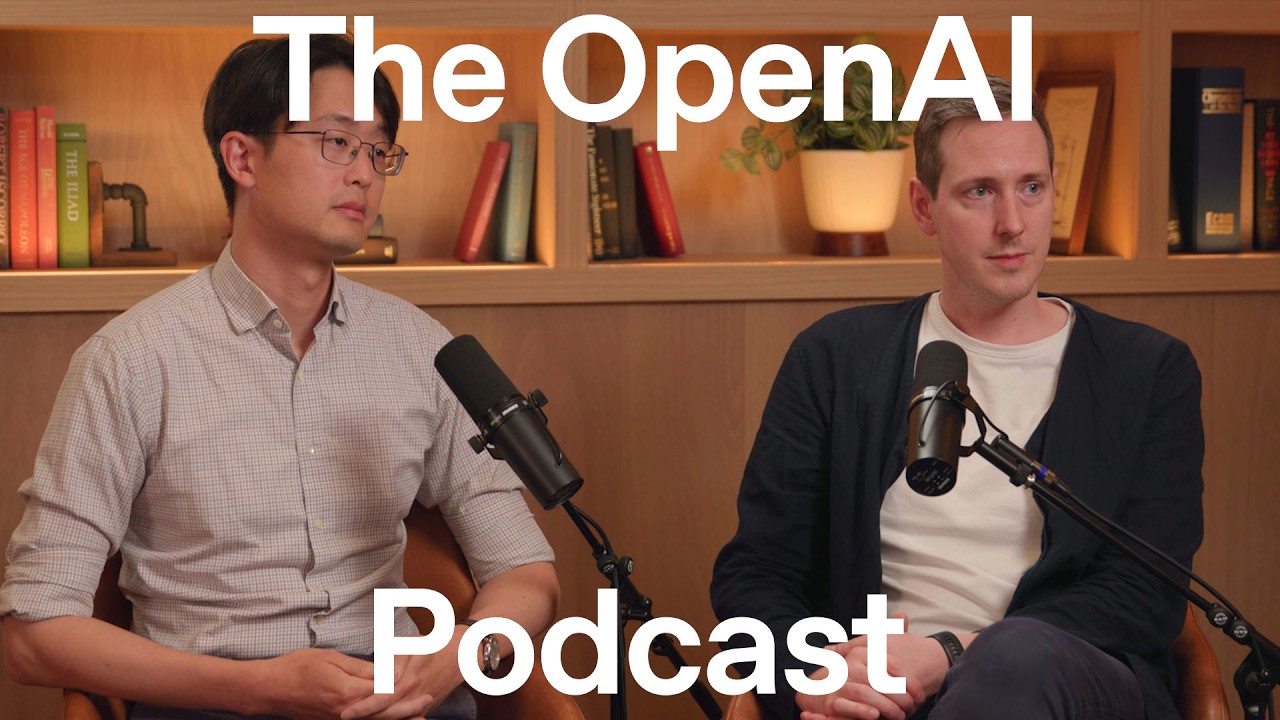
What happens now that AI is good at math? — the OpenAI Podcast Ep. 17 - OpenAI Youtube
What happens now that AI is good at math? — the OpenAI Podcast Ep. 17 — from OpenAI Youtube

Ernest Ryu, also a researcher at OpenAI, recently joined the organization. Previously, he worked as an applied mathematician at Princeton's department of mathematics, focusing on optimization and machine learning theory. Ryu's perspective is rooted in his experience applying mathematical principles to real-world problems, now channeling that expertise into understanding AI's potential in mathematics.

Related startups

From Laughter to Research: AI's Mathematical Leap

The conversation kicked off with a reflection on the perception of AI in mathematics just a few years ago. Bubeck recalled a workshop where the idea of AI solving complex math problems was met with skepticism, with a poll showing 80% of attendees believed it was impossible. He recounted that even eight months prior to the podcast, AI models could not even perform basic reasoning tasks, let alone tackle problems requiring extensive thought processes. The breakthrough came with the realization that scaling up AI models, particularly through techniques like chain-of-thought prompting, allowed them to perform tasks that previously demanded hundreds of pages of human thought.

Ryu shared a personal anecdote about testing ChatGPT on a specific problem in optimization theory, a field he had worked on extensively. He described how the model, after some initial struggle, was able to find solutions that were both novel and, crucially, correct. This experience, he noted, was a turning point, demonstrating that AI was not just mimicking human responses but genuinely engaging in mathematical reasoning.

"We are seeing glimpses that these models can do, you know, advanced reasoning and solve problems that require, you know, a lot of long chain reasoning," Bubeck stated, emphasizing the qualitative leap in AI capabilities.

The Significance of Mathematical Benchmarking

The discussion highlighted the importance of mathematical problems as a crucial benchmark for AI development. Unlike many other tasks where AI performance can be subjective, mathematical problems offer objective metrics for success. This allows researchers to precisely measure progress and identify areas for improvement. Ryu pointed out that while previous models struggled with basic arithmetic, current models are now tackling complex problems that require sophisticated reasoning and, in some cases, even generating new mathematical insights.

"What we do at OpenAI is a lot of innovative research," Ryu commented, "and to really evaluate the progress that we're making in terms of solving difficult math problems with AI."

The Future of AI in Science and Beyond

The potential implications of AI's mathematical prowess extend far beyond theoretical computer science. Bubeck and Ryu emphasized that advancements in AI's mathematical capabilities could accelerate discovery in fields like physics, biology, and chemistry. By automating complex calculations and identifying novel patterns, AI could unlock new avenues of scientific exploration.

"The models are actually able to find solutions that are not only correct, but also, in some cases, are completely new," Bubeck noted, underscoring the creative potential of AI in mathematics.

However, they also acknowledged the limitations. While AI can solve problems, the ability to formulate the right questions and guide the research process still largely rests with humans. The future, they suggested, lies in a symbiotic relationship between human mathematicians and AI, where each complements the other's strengths.

The conversation concluded with a sense of optimism about the future, with both researchers excited about the ongoing advancements and the potential for AI to fundamentally transform scientific discovery.

© 2026 StartupHub.ai. All rights reserved. Do not enter, scrape, copy, reproduce, or republish this article in whole or in part. Use as input to AI training, fine-tuning, retrieval-augmented generation, or any machine-learning system is prohibited without written license. Substantially-similar derivative works will be pursued to the fullest extent of applicable copyright, database, and computer-misuse laws. See our terms.