


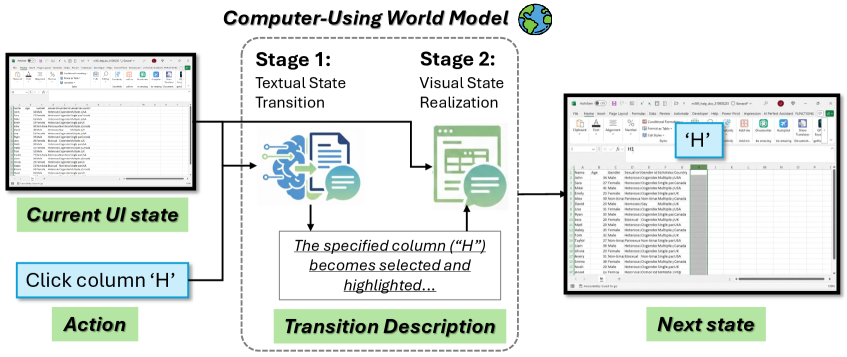
Navigating complex software environments is a hurdle for AI agents. A single wrong click can derail hours of work. Microsoft researchers have introduced a new AI system, the Computer-Using World Model (CUWM), designed to tackle this challenge.
Predicting the digital future
CUWM acts like a predictive simulator for desktop applications. It forecasts the next user interface (UI) state based on the current screen and a proposed action. This allows AI agents to 'test' actions in a simulated environment before committing to them in real software.
A two-stage approach to UI dynamics
The model breaks down UI changes into two steps. First, it predicts a textual description of what will change, like a text edit or a dialog box appearing. Second, it visually renders these predicted changes onto the current screen, creating a realistic preview of the next state.
This factorization, separating the 'what' from the 'how,' helps the model focus on critical UI elements rather than static background details. CUWM is trained on real-world interactions within Microsoft Office applications.
Refining predictions with AI
To ensure accuracy, CUWM undergoes supervised learning on recorded UI transitions. It's then refined with lightweight reinforcement learning. This stage uses an AI judge to align textual predictions with the structural requirements of software interfaces, encouraging concise and relevant descriptions.