

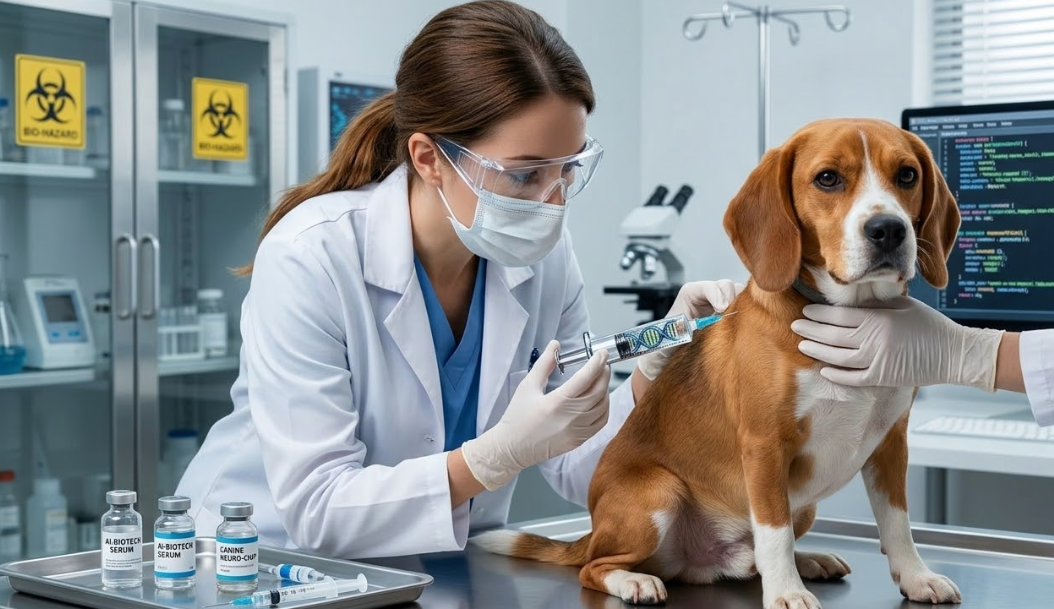
AI Designs Dog's Cancer Vaccine

An AI expert engineered a personalized mRNA cancer vaccine for his dying dog, Rosie, using advanced AI tools, resulting in significant tumor reduction.

Mar 15 at 1:56 PM3 min read
A Staffordshire-Shar Pei cross dog named Rosie looking alert and healthy.

When conventional veterinary medicine failed Paul Conyngham’s dog Rosie, the Australian tech entrepreneur turned to a radical solution: building a custom mRNA cancer vaccine with the help of AI. Rosie, a Staffordshire-Shar Pei cross, was diagnosed with aggressive mast cell tumors that had become unresponsive to standard treatments.

The Data Problem

Conyngham, a machine learning specialist, viewed Rosie’s cancer not as a biological dead end, but as a data problem. He aimed to design a personalized neoantigen vaccine, a complex immunotherapy approach.

This involves sequencing both healthy and tumor DNA, identifying unique mutations (neoantigens), and then training the immune system to target them.

AI as a Research Assistant

Conyngham leveraged large language models (LLMs) as advanced research assistants, exploring experimental oncology. This led him to the concept of personalized cancer vaccines.

He commissioned genomic sequencing of Rosie’s DNA and tumors to identify the specific genetic 'bugs' driving the cancer. This provided the crucial blueprint for his AI-driven approach.

Cracking the Code with AI

Identifying potential neoantigens required predicting how mutated proteins would fold. Conyngham utilized DeepMind's AlphaFold, a powerful AI tool for protein structure prediction. This allowed him to model the 3D structures of mutated proteins, a key step in neoantigen vaccine design.

He further refined his selection using AI to analyze protein structure confidence and predicted binding affinity to Rosie’s immune receptors. ChatGPT helped interpret complex scientific metrics.

This data-driven process identified 10 to 20 high-priority target peptides.

From Code to Serum

The selected peptide sequences were synthesized into an mRNA construct, mirroring the technology behind COVID-19 vaccines. This mRNA instructs the dog’s cells to produce specific tumor proteins, prompting the immune system to attack the cancer.

Conyngham collaborated with researchers and a specialized lab to produce the physical vaccine. The AlphaFold applications in this case demonstrated its versatility beyond engineering crops.

Extraordinary Results

The custom vaccine was administered as a high-risk, compassionate-use intervention. Remarkable results followed: Rosie’s tumors showed a 50% to 75% reduction in size, and her overall quality of life improved dramatically.

The Horizon of Personalized Medicine

Rosie's story is a powerful demonstration of 'citizen science' at the intersection of AI and biology. It proves that advanced AI tools can bridge the gap between raw genomic data and therapeutic design.

However, significant caveats exist. The 'N-of-1' nature of the trial means it cannot be generalized. Furthermore, the high cost and technical expertise required create substantial barriers to access.

The 'move fast and break things' tech ethos clashes with medicine's 'do no harm' principle, highlighting the need for rigorous safety and regulatory oversight.

This case offers a glimpse into a future where personalized, AI-designed treatments could redefine 'terminal' diagnoses.