

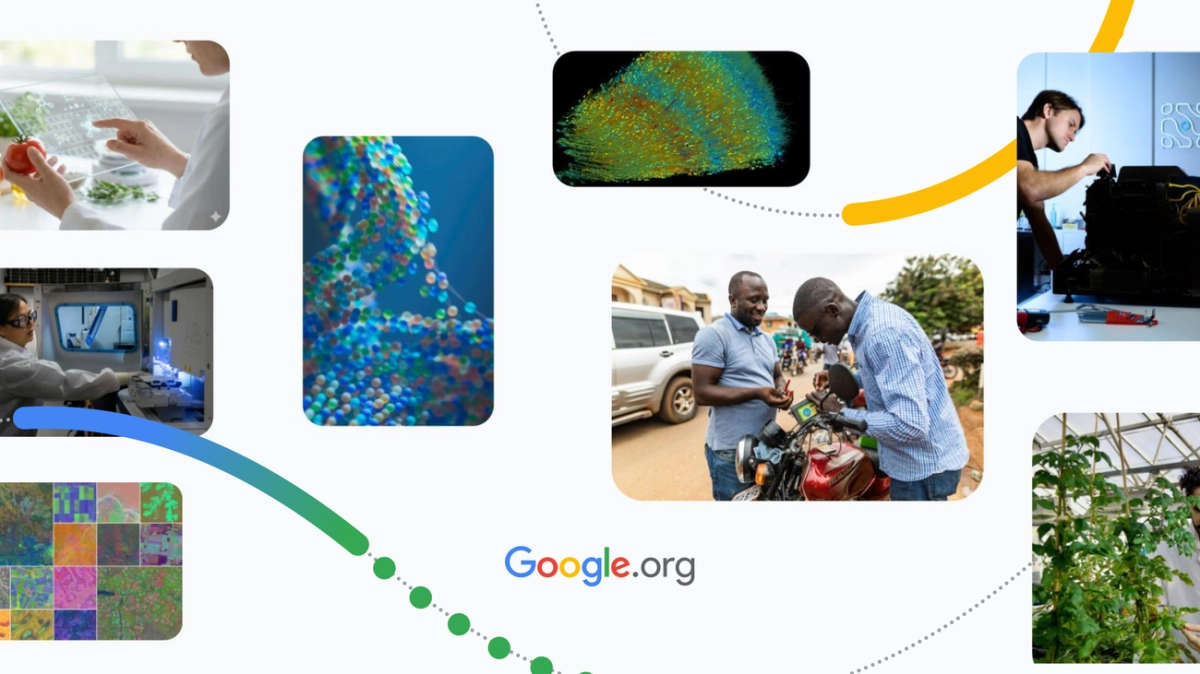
Google.org has finalized the recipients of its $20 million AI for Science fund, strategically deploying advanced machine learning tools to domains where traditional discovery has stalled. This initiative selects 12 academic and nonprofit organizations focused on translating complex biological and environmental data into actionable, real-world solutions. According to the announcement, the goal is to achieve in years what previously took decades, accelerating progress across health, food systems, and planetary resilience.
The investment is not merely philanthropic; it is a calculated move to expand the scientific application of Google's foundational AI models, particularly those derived from DeepMind. By mandating open science and the wide sharing of datasets and solutions, Google ensures that the resulting high-quality data feeds back into and validates their own AI infrastructure. This strategy effectively crowdsources the validation and refinement of tools like AlphaFold3, cementing Google's position as the primary engine for structural biology and materials science breakthroughs. The focus is on generating robust, open-source datasets that can power breakthroughs far beyond the initial applications.
The health recipients are tackling data complexity that has historically bottlenecked medical progress, moving from reactive treatment to predictive prevention. Projects like UW Medicine's effort to map the 99% of the human genome currently considered a mystery, or Cedars-Sinai's real-time neural data analysis, demonstrate a shift from passive data processing to active, AI-guided experimentation. The use of AI to predict malaria parasite evolution at Makerere University, or Spore.Bio’s goal to reduce drug-resistant bacteria detection from days to under an hour, highlights the immediate, life-saving impact of applying AI to high-throughput diagnostics.
The AI-Driven Frontier: Food and Climate
The fund is also tackling massive, systemic challenges where data scarcity and complexity are critical issues, specifically in agriculture and planetary resilience. Using AI to decode cow microbiomes for methane reduction (UC Berkeley) or mapping the "dark matter" of food nutrition (PTFI) shows a focus on optimizing global systems rather than just localized fixes. In conservation, organizations like UNEP-WCMC are leveraging large language models (LLMs) to scan millions of scientific records, filling critical "data deserts" to create definitive distribution maps for plant species. This demonstrates a powerful application of LLMs for rapid, large-scale data curation previously impossible for human scientists.
Perhaps the most ambitious project is the support for the Swiss Plasma Center at EPFL, where AI is being used to standardize global fusion energy data and experiments. By enabling AI models to learn from collective, worldwide experimental results, Google is directly supporting the acceleration toward a reliable, carbon-free future. Similarly, the University of Liverpool's "Hive Mind" approach, connecting autonomous lab robots with AI agents, represents the future of materials science discovery for global-scale carbon capture.