

AI Agents Poised to Reshape E-commerce and Advertising

ARK's Nicholas Grus and Varshika Prasanna discuss the shift to an 'agentic era' in AI, transforming e-commerce and advertising with AI agents, and projecting significant revenue growth.

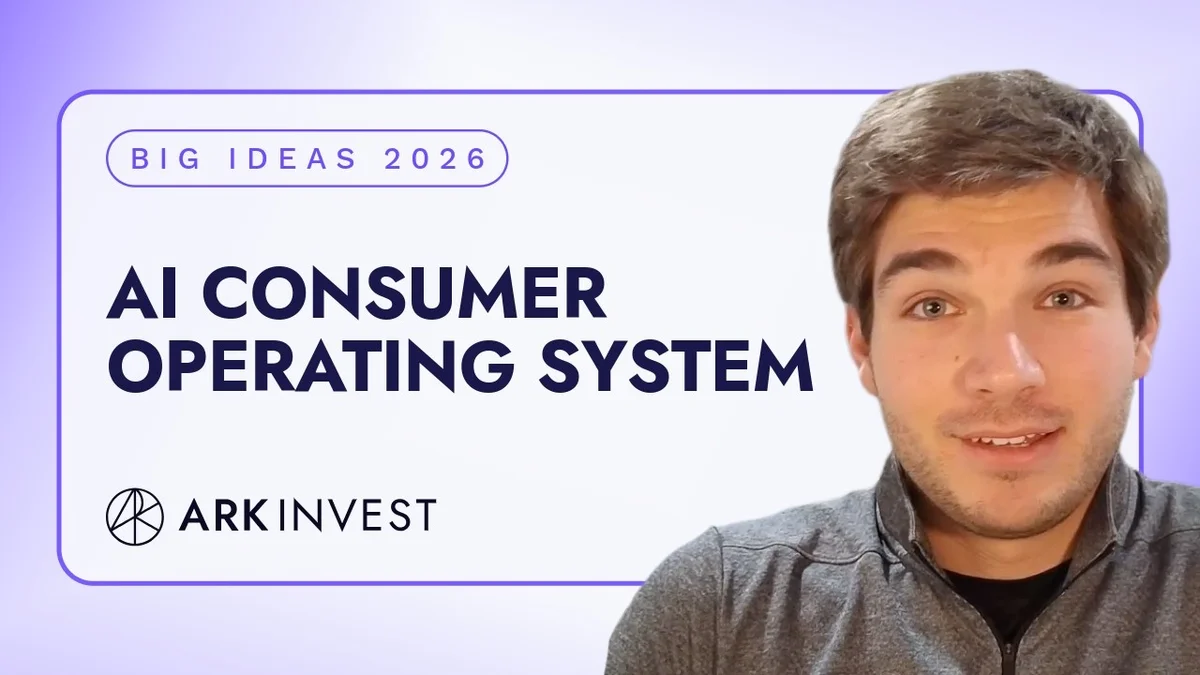
Nicholas Grus and Varshika Prasanna presenting on the AI Consumer Operating System
ARK Invest
Visual TL;DR
Query to ActionDriver
AI agents move beyond answers, taking direct action based on user queries
From the article 2 mentionsThey argue that the shift from a 'query to answer' model to a 'query to action' model, spurred by AI agents, will fundamentally alter e-commerce and advertising.
Agentic EraContext
new consumer operating system initiated by ChatGPT's launch, rapidly adopted
From the article 8 mentionsGrus outlines the evolution of consumer interaction with technology, moving from command-based interfaces to the web, then mobile, and now into the 'agentic era' initiated by the launch of ChatGPT.
AI AgentsCore
core technology enabling actions, reshaping e-commerce and advertising interactions
From the article 7 mentionsThis new era is characterized by AI agents that can take action based on user queries, marking a significant departure from the traditional question-and-answer format.
Rapid AI AdoptionContext
AI chatbots nearing 20% penetration within three years, outpacing internet
From the article 3 mentionsThis rapid adoption highlights the growing influence of AI in consumer behavior.
Reshape E-commerceEffect
agents fundamentally alter how consumers interact with online shopping platforms
From the articleThey argue that the shift from a 'query to answer' model to a 'query to action' model, spurred by AI agents, will fundamentally alter e-commerce and advertising.
New Ad OpportunitiesEffect
AI search and advertising create novel ways to reach consumers
Monetization StrategiesOutcome
direct and indirect approaches to capture value from agentic interactions
From the article 4 mentionsThe monetization of AI search is expected to grow substantially, even with a built-in lag for advertiser adoption.
Contents(6)

Nicholas Grus, Director of Research at ARK, and Varshika Prasanna, Research Associate, delve into the transformative potential of the AI consumer operating system. They argue that the shift from a 'query to answer' model to a 'query to action' model, spurred by AI agents, will fundamentally alter e-commerce and advertising.

The Agentic Era: A New Consumer Operating System

Grus outlines the evolution of consumer interaction with technology, moving from command-based interfaces to the web, then mobile, and now into the 'agentic era' initiated by the launch of ChatGPT. This new era is characterized by AI agents that can take action based on user queries, marking a significant departure from the traditional question-and-answer format.

The adoption rate of AI chatbots is remarkably fast, with penetration nearing 20% within three years, significantly outpacing the internet's adoption rate, which took seven years to reach a similar penetration level. This rapid adoption highlights the growing influence of AI in consumer behavior.

Transforming E-commerce with AI purchasing agents

Prasanna explains that 'agentic commerce' is becoming a reality in 2025, with AI purchasing agents playing a crucial role. These agents can compress the consumer shopping journey, from discovery and engagement to decision-making and purchase, by offering a high degree of personalization. This personalization is key, as 95% of the consumer journey often occurs before a purchase is even made.

The time it takes to complete a transaction is also shrinking dramatically. While a pre-internet purchase might have taken an hour, agentic transactions are predicted to occur in as little as 90 seconds. This acceleration is made possible by agentic protocols that allow retailers to connect their back-end systems, providing agents with the necessary context and data.

Key protocols enabling this shift include Anthropic's Model Context Protocol (MCP) for data access, and OpenAI and Stripe's Agentic Commerce Protocol (ACP), along with Google and Shopify's Universal Commerce Protocol (UCP) for transaction settlement. These protocols aim to unify the commerce stack, a significant improvement over the fragmented connections of the internet era.

The Economic Impact of AI Agents

The research forecasts a substantial economic impact, with AI agents expected to capture a larger share of digital transactions. This share is projected to grow from approximately 2% in 2025 to 25% by 2030, representing over $8 trillion in global online consumption. This growth is driven by consumers delegating more commerce activities to AI.

AI Search and Advertising Opportunities

Grus highlights advertising as another significant opportunity, particularly within the search domain. With search being a $350 billion market dominated by players like Google, AI is poised to disrupt this space by shifting search advertisements to the agentic world. AI search traffic is predicted to grow from 10% to 65% of global search traffic within five years.

While advertisers are historically slow to adopt new platforms, the growth of AI search and its advertising potential is undeniable. Companies like OpenAI are already exploring advertising within chatbot ecosystems, providing an early test case for this thesis. The monetization of AI search is expected to grow substantially, even with a built-in lag for advertiser adoption.

Monetization Strategies: Direct vs. Indirect

Currently, AI monetization is largely subscription-based. However, the research suggests that indirect monetization, through a take rate on commerce and advertising, presents a much larger opportunity. Drawing parallels with social media platforms, where indirect monetization drives the majority of revenue, AI platforms are expected to follow a similar path.

The combined market for AI-mediated lead generation, advertising, and commerce is projected to grow from $20 billion today to $900 billion by 2030. This growth is fueled by the new consumer operating system powered by AI agents, fundamentally changing how humans interact with computers and conduct commerce.

E-commerce market, from StartupHub data

11 new E-commerce companies entered the market in the last 90 days, about 0.9 a week. The 30-day figure (2) is a floor: registry detection lags registration by a couple of weeks.

E-commerce: notable companies in our database
CompanyWhat they doFunding / valuation
PayPalA global leader in digital payments, enabling individuals and businesses to send, receive, and manage money online.$9.9B
KlarnaKlarna is a global payments and shopping service that offers direct payments, pay after delivery options and instalment plans. It makes online shopping simple, $6.7
CoupangThe "Amazon of South Korea" offering a wide range of products and services.$45.5B
Amazon.comGlobal e-commerce, cloud computing, digital streaming, and artificial intelligence giant.$8.2B
ORBINA TECHNOLOGIESAI-powered assistant for e-commerce, finance, healthcare, and travel sectors.$7.0B
PinduoduoA leading Chinese social commerce platform focused on agriculture and value-for-money products.$6.4B
Newest E-commerce entrants (domain registered in the last 90 days)
CompanyRegisteredOne-liner
Pittopit2026-09-03PitToPit turns a tape measurement into a burned-in photo overlay and ready-to-paste listing text for Vinted and eBay sellers.
Sariko2026-08-30A node-based diaspora commerce platform connecting home cooks and entrepreneurs with their communities worldwide.
Atom2026-08-18An AI-native premium domain marketplace and branding platform for businesses to secure strong names and build brands.
Atom2026-08-16An AI-native premium domain marketplace and branding platform for startups and established businesses.
Minefirst2026-07-24Minefirst alerts you to authenticated matches on Vinted and eBay under your specified price.
Swipeagent2026-07-18AI that doomscrolls for you, surfacing viral videos and trending products in your niche.
Listsimply2026-07-01A platform for creating and managing product listings for e-commerce businesses.
Vibeflip2026-06-28Turns customer feedback into listing fixes, supplier instructions, and sales-closing answers.
© 2026 StartupHub.ai. All rights reserved. You may not republish this article in full without a license. Search engines and AI research tools may crawl and summarize for reference. Bulk reproduction or model training requires a license. See our terms.
Daniel Singer

Written by

Daniel Singer

Editor, StartupHub.ai

Daniel Singer is the editor of StartupHub.ai, a technology expert and thought leader on AI and its applications across sectors, from fintech and healthcare to developer tooling and consumer software. He writes and tests the tools covered here thoroughly and regularly, and built StartupHub.ai to give founders, operators and buyers a clearer read on what they are actually being sold.