



Visual TL;DR
Maersk agent deploymentCore
Dmitry Buykin reports on shipping operations agent built for global scale
From the articleThe Maersk case suggests the moat in production agents is not the model but the SOP corpus and the correction loop that enterprises actually control.
Tribal dungeons emergeDriver
Edge cases where one step fails and legacy systems go incoherent
From the article 2 mentionsThey fail in what Maersk practitioner Dmitry Buykin calls tribal dungeons.
Long tail dominates costsDriver
Exception work by experts across incomplete legacy systems exceeds base workflow
From the articleWhat remains is the long tail where happy paths break.
Loop harness encloses agentCore
System wraps agent with preconditions, back-end calls, validation, and evidence
From the article 2 mentionsSpikes and latencies range from a few minutes to 10 minutes, limited by legacy back ends, not the agent loop.
Corrections beat bigger modelsOutcome
100,000 human corrections outperformed scaling up model parameters for edge cases
From the articleThe Maersk case suggests the moat in production agents is not the model but the SOP corpus and the correction loop that enterprises actually control.
Maersk agent deploymentCore
Dmitry Buykin reports on shipping operations agent built for global scale
From the articleThe Maersk case suggests the moat in production agents is not the model but the SOP corpus and the correction loop that enterprises actually control.
Screenshots fail as SOPsContext
Legacy SOPs are click sequences lacking preconditions, validation, and recovery steps
From the articleBuykin said those legacy SOPs are a bunch of screenshots in sequence.
Tribal dungeons emergeDriver
Edge cases where one step fails and legacy systems go incoherent
From the article 2 mentionsThey fail in what Maersk practitioner Dmitry Buykin calls tribal dungeons.
Long tail dominates costsDriver
Exception work by experts across incomplete legacy systems exceeds base workflow
From the articleWhat remains is the long tail where happy paths break.
Loop harness encloses agentCore
System wraps agent with preconditions, back-end calls, validation, and evidence
From the article 2 mentionsSpikes and latencies range from a few minutes to 10 minutes, limited by legacy back ends, not the agent loop.
Corrections beat bigger modelsOutcome
100,000 human corrections outperformed scaling up model parameters for edge cases
From the articleThe Maersk case suggests the moat in production agents is not the model but the SOP corpus and the correction loop that enterprises actually control.
Harness not freedomContext
Agent constrained inside validated loop rather than given open-ended autonomy
20 to 1 corpus ratioContext
Each corrected workflow requires twenty supporting SOP documents in the knowledge base
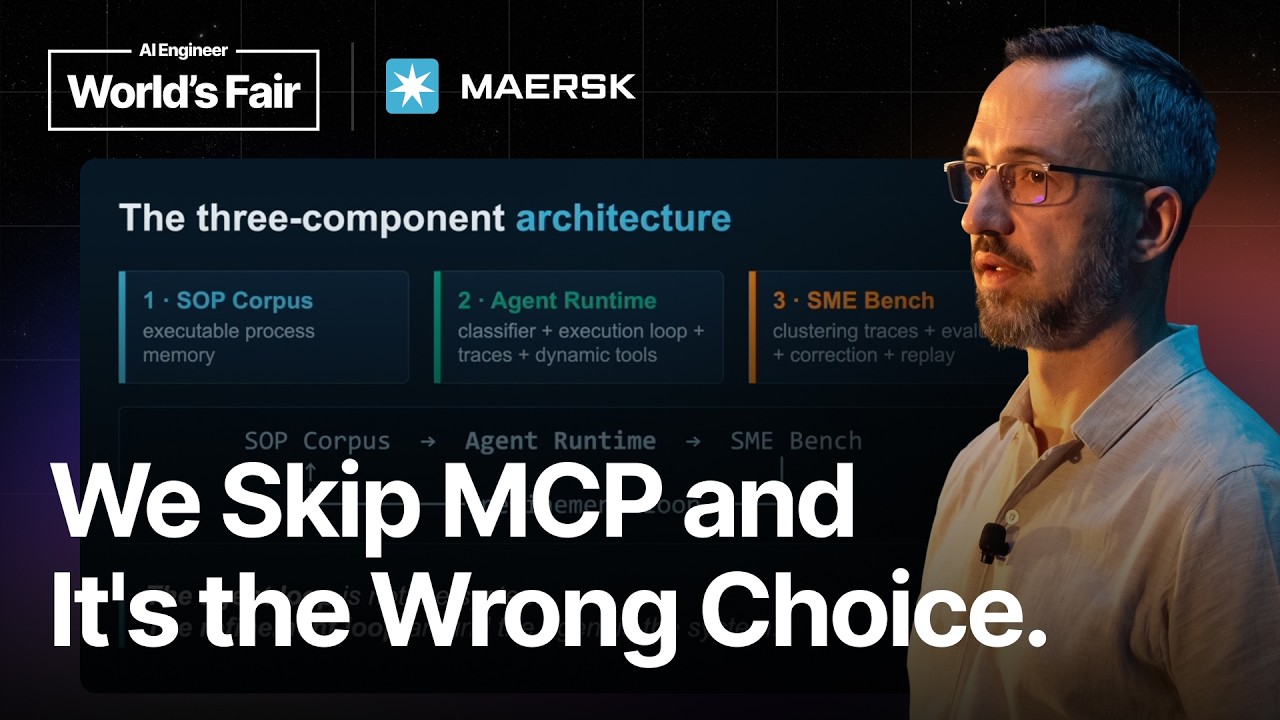
From the article 2 mentionsMaersk built three parts: SOP memory organized as a corpus, execution runtime, and feedback capture.