


Sander Dieleman, a Research Scientist at Google DeepMind, recently delivered a comprehensive talk on diffusion models and their application in image and video generation. With over a decade of experience in the field, Dieleman offered a deep dive into the intricate processes behind these powerful generative AI tools, covering everything from data handling to scaling across devices.
Understanding Diffusion Models
Dieleman began by outlining the core thesis: diffusion models represent a dominant paradigm for generating audiovisual data, offering significant advantages over previous methods like autoregression, especially in their ability to capture complex spatial and temporal dynamics. He emphasized that while autoregressive models are excellent for sequential data like language, diffusion models excel in areas where spatial relationships and temporal coherence are paramount, such as in image and video generation.
Key Components of Diffusion Model Engineering
The presentation was structured around eight key stages involved in developing and deploying diffusion models:
- Data: Dieleman stressed the critical importance of data curation for achieving high-quality results. He noted that while pre-packaged datasets and benchmark comparisons are common in the research community, the time spent improving data distribution often yields significant benefits.
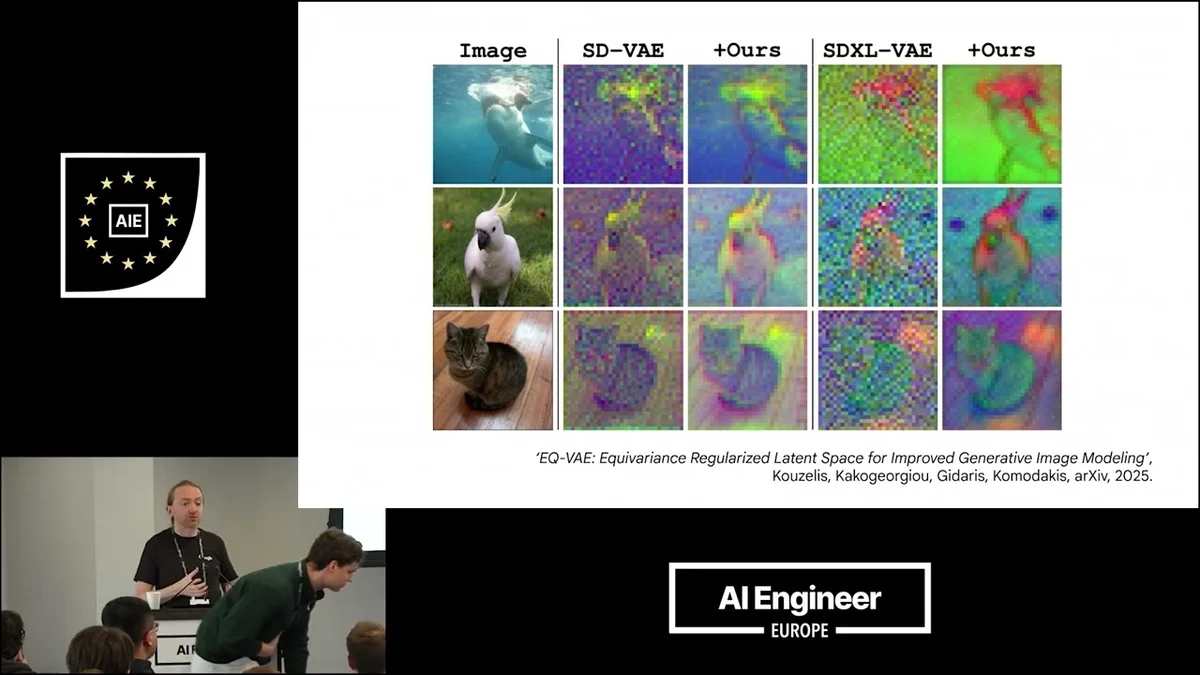
- Representation: Unlike language models that process data sequentially, diffusion models operate on representations like pixel grids for images or 3D tensors for video. The scale of these representations can be enormous, necessitating efficient methods like latent space representations to make training feasible.
- Modeling: The core of a diffusion model involves a denoising process. This is typically achieved through neural networks, often U-Nets or Transformer architectures, which learn to predict and remove noise from corrupted data over multiple steps.
- Training: The training process for diffusion models is often a two-stage approach. The first stage typically involves training an encoder-decoder architecture to reconstruct the original data from its latent representation. The second stage then uses this learned representation to train an iterative generator, which can be either autoregressive or diffusion-based.
- Sampling: Once trained, diffusion models generate samples by starting with random noise and iteratively denoising it, guided by the learned model, until a coherent output is produced.
- Distillation: To speed up the sampling process, which can be computationally intensive due to the iterative nature, model distillation techniques are employed. This involves training a smaller, faster model to mimic the behavior of the larger, original model.
- Guidance: A crucial technique called classifier-free guidance allows for trading off sample quality for diversity. By leveraging the model's understanding of the data distribution, guidance can steer the generation process to produce outputs that are more aligned with specific conditions or prompts, enabling models to perform beyond their basic capabilities.
- Control: Finally, various control mechanisms are used to fine-tune the generation process, ensuring that the model produces outputs that meet specific criteria or adhere to desired styles.
The Role of Architecture: U-Nets and Transformers
Dieleman highlighted the prevalence of U-Net and Transformer architectures in diffusion models. U-Nets, originally designed for tasks like image segmentation, are effective due to their ability to capture multi-scale spatial information through their contracting and expanding paths. Transformers, on the other hand, have shown remarkable success in processing sequential data and are increasingly being adapted for image and video tasks due to their powerful attention mechanisms, allowing them to effectively model long-range dependencies.
Scaling Diffusion Models
Addressing the challenge of training these large models, Dieleman discussed the importance of parallelism and sharding. Data parallelism, where the batch is split across multiple devices, is a common technique. However, as models grow in size, model parallelism, where the model itself is distributed across devices, becomes more crucial. Tools like PyTorch's JIT (Just-In-Time) compilation help in managing this complexity. The overarching rule of thumb is to minimize communication overhead between devices, ensuring efficient scaling.