

Gaza Mortality Survey Under Fire

A new analysis casts doubt on the reliability of the Gaza Mortality Survey's population-level death estimates, citing sampling irregularities and quality control failures.

2 min read
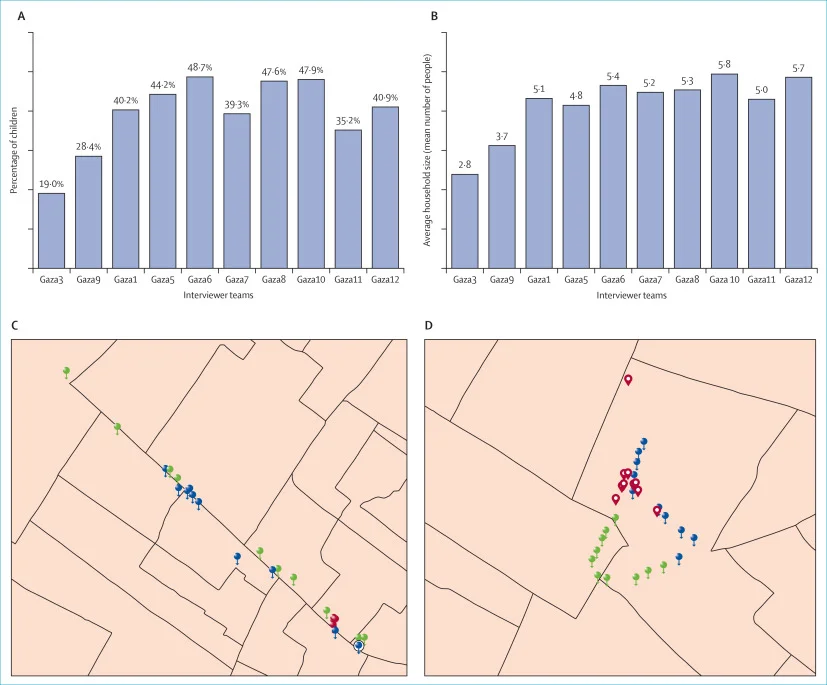
Gaza mortality survey data analysis showing population representativeness challenges
Examining population representativeness and interviewer heterogeneity in the Gaza Mortality Survey.

A new analysis challenges the reliability of the Gaza Mortality Survey, raising significant concerns about its reported population-level death estimates. The survey, published in The Lancet Global Health, claimed a population-representative sample to extrapolate 393 reported violent deaths to 75,200 at the population level.

Sampling Integrity Questioned

Independent re-analysis of the publicly released microdata reveals multiple deviations from the declared protocol. Sergio DellaPergola and Mark Zlochin's findings highlight substantial interviewer-level outliers that compromise the sample's representativeness.

Related startups

Specifically, two interviewer teams, Gaza9 and Gaza3, recorded data that diverged materially from the rest of the sample. Team Gaza9 alone accounted for a quarter of all violent deaths from just 8% of the total sample.

Excluding Gaza9's data reduced the central violent-death estimate from 75,200 to 64,100. Further excluding Gaza3's data, which also showed elevated mortality and demographic differences, lowered the estimate by another 5,000 deaths, totaling a 16,000-death reduction. Such sensitivity to just two teams is inconsistent with a properly implemented population-representative design.

Quality Control Failures and GPS Discrepancies

The survey's real-time monitoring and quality-control procedures, designed to detect anomalies, failed to identify these critical issues during fieldwork. The concentration of violent deaths and demographic structural differences in the Gaza9 and Gaza3 data went unflagged.

GPS tracing further indicated departures from the declared sampling procedure. Issues included teams repeatedly surveying the same primary sampling unit (PSU) and sampling along main roads, potentially missing social diversity. These deviations suggest convenience sampling over a rigorous probability-based design, distorting inclusion probabilities and compromising estimate unbiasedness.

Discrepancies in Imprisonment Data

Additional concerns arise from the survey's estimate of imprisoned individuals. The survey reported 9,580 imprisoned individuals (95% CI 6,260, 12,900). However, external figures from the Public Committee Against Torture in Israel indicated 3,436 detainees from Gaza as of January 2025.

This externally verified figure is roughly a third of the survey's point estimate and falls below its 95% confidence interval. This discrepancy further amplifies concerns about the sample's representativeness and, consequently, the validity of the derived mortality figures. The Gaza Mortality Survey reliability concerns underscore the need for rigorous methodology.

These significant departures from the declared protocol undermine the representativeness of the realized sample. Therefore, the population-level estimates presented in the study should not be considered reliable measures of conflict-related deaths.

© 2026 StartupHub.ai. All rights reserved. Do not enter, scrape, copy, reproduce, or republish this article in whole or in part. Use as input to AI training, fine-tuning, retrieval-augmented generation, or any machine-learning system is prohibited without written license. Substantially-similar derivative works will be pursued to the fullest extent of applicable copyright, database, and computer-misuse laws. See our terms.