Amazon's Proteus Robot Gets Smarter in Europe

Amazon's next-gen Proteus robot understands natural language as part of a €10 billion European investment in its fulfillment network.

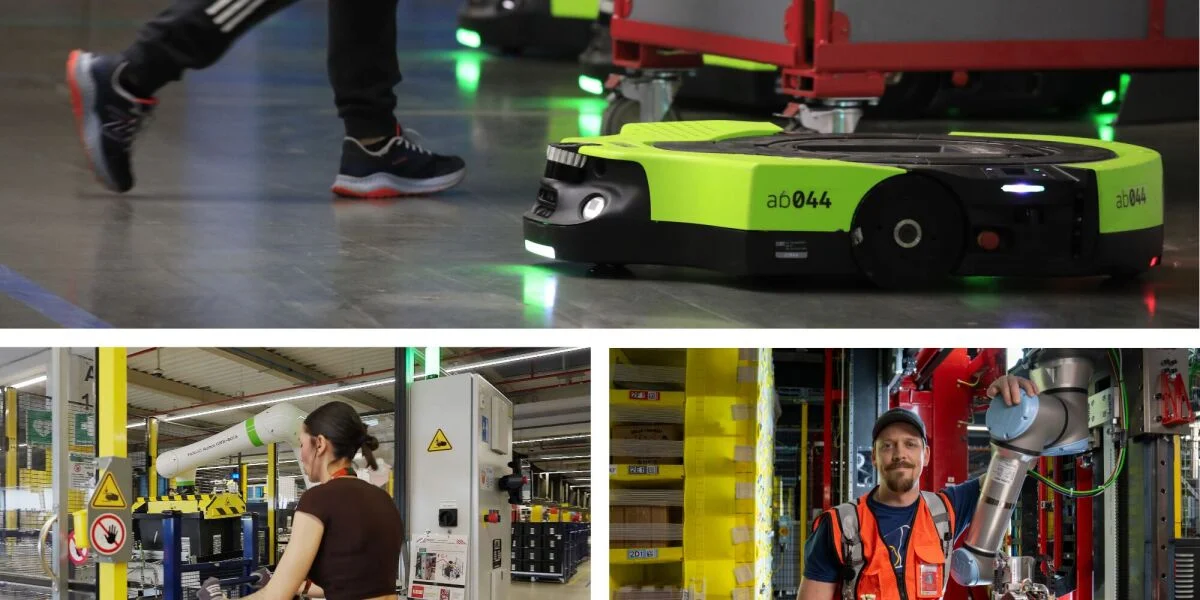
Amazon Proteus robot moving in a fulfillment center.
Amazon's Proteus robot is being upgraded with natural language capabilities.· Amazon News
Visual TL;DR
Amazon's European InvestmentDriver
From the article 2 mentionsThis development is part of a broader €10 billion investment aimed at modernizing Amazon's European fulfillment network over the next few years.
Next-Gen Proteus RobotCore
From the article 2 mentionsAmazon has unveiled its next-generation Proteus robot, a significant upgrade to its autonomous mobile robot fleet.
Broader Robotics ExpansionContext
Other robotic systems also growing in Europe
Natural Language UnderstandingCore
Robot understands conversational employee instructions
From the articleThe integration of AI, particularly in understanding natural language commands for robotics, marks a key evolution for Proteus.
Vulcan RobotCore
From the article 5 mentionsVulcan, the company's first robot equipped with a sense of touch, allows for simultaneous perception and manipulation in cluttered environments.
Enhanced Task CapabilitiesEffect
Moves heavy carts, transports items across sites
Employee Role ShiftEffect
Frees up humans for more complex tasks
Contents(5)

Amazon has unveiled its next-generation Proteus robot, a significant upgrade to its autonomous mobile robot fleet. This enhanced version can now understand conversational instructions, allowing employees to direct it using plain language, much like communicating with a colleague. This development is part of a broader €10 billion investment aimed at modernizing Amazon's European fulfillment network over the next few years.

Companies working on this

StartupHub profiles of the companies this article names, with funding and a one-liner from our database.

Amazon
$35.0B
Global e-commerce, cloud computing, digital streaming, and artificial intelligence company.
Stark
$8M
Stark is a platform that helps teams build accessible digital products.

The new Amazon Proteus robot is designed to take on physically demanding tasks, freeing up human workers for more complex roles. These tasks include moving heavy carts and transporting items across fulfillment centers and delivery sites, extending its operational range beyond the dock areas where the original Proteus was confined.

Robotics Expansion in Europe

Beyond Proteus, Amazon is expanding other robotic systems across Europe. Vulcan, the company's first robot equipped with a sense of touch, allows for simultaneous perception and manipulation in cluttered environments. STARK, a collaborative robotic tote-handling system, is also set to deploy more widely. These advancements are part of Amazon's strategy to improve operational efficiency and employee support.

A €10 Billion Bet on Europe

This robotics push is underpinned by a substantial investment of over €10 billion in European fulfillment centers. Amazon also plans to create 25,000 new jobs across the region in the coming years. This investment signals a commitment to leveraging technology to enhance its logistics infrastructure while growing its workforce.

Natural Language and AI Integration

The integration of AI, particularly in understanding natural language commands for robotics, marks a key evolution for Proteus. Employees can now simply tell the robot what needs to be done, and it will determine the priority, route, and timing. Scott Dresser, vice president of Amazon Robotics, described Proteus as an "assistant for material movement."

Broader Robotics Roadmap

Amazon continues to develop its robotics capabilities, focusing on collaborative technologies and precise manipulation. The STARK system, born from an employee suggestion, works alongside humans to handle repetitive heavy lifting. This expansion includes plans for STARK to reach 15 European sites by 2027, following its initial pilot in Barcelona. The company is also investing in roles like reliability, maintenance, and engineering to support these new technologies.

The company is also expanding its use of Vulcan, which was developed to handle complex picking tasks and has already been deployed in Germany. This multi-faceted approach to robotics aims to redefine fulfillment operations.

© 2026 StartupHub.ai. All rights reserved. You may not republish this article in full without a license. Search engines and AI research tools may crawl and summarize for reference. Bulk reproduction or model training requires a license. See our terms.
Daniel Singer

Written by

Daniel Singer

Editor, StartupHub.ai

Daniel Singer is the editor of StartupHub.ai, a technology expert and thought leader on AI and its applications across sectors, from fintech and healthcare to developer tooling and consumer software. He writes and tests the tools covered here thoroughly and regularly, and built StartupHub.ai to give founders, operators and buyers a clearer read on what they are actually being sold.

More from Daniel Singer