

Perplexity's Agent API Unifies LLM Access

Perplexity's new Agent API offers a unified interface to multiple LLM providers, simplifying development with integrated search and tools.

Perplexity's Agent API Unifies LLM Access
Key Takeaways
  • 1
    Perplexity's Agent API offers a unified interface to access models from multiple LLM providers.

  • 2
    It integrates real-time web search and tool configuration for enhanced LLM application development.

  • 3
    The API aims to simplify development by abstracting away provider-specific complexities and offering transparent pricing.
Contents(5)

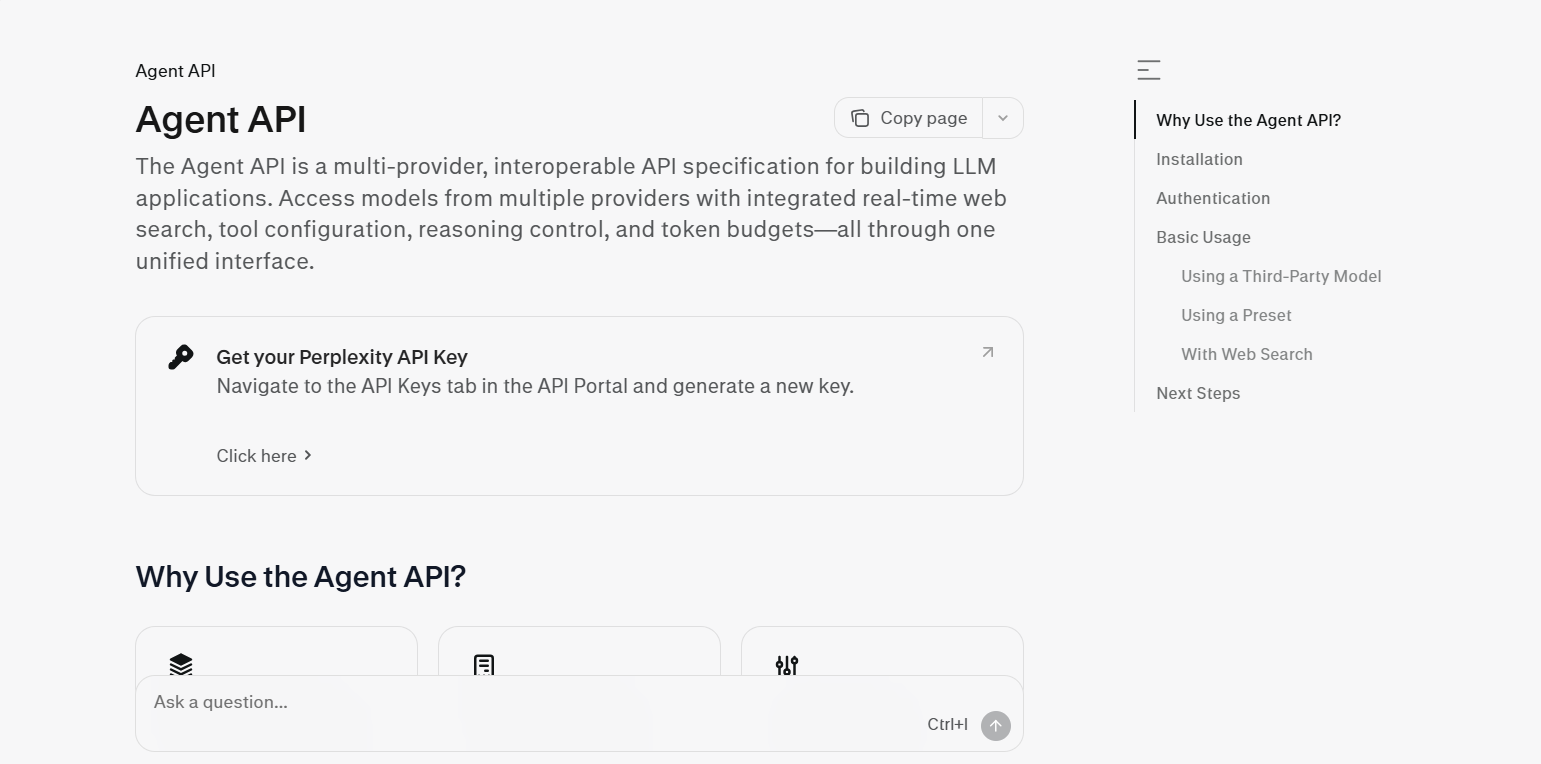
Perplexity has launched its Agent API, a new offering designed to streamline the development of large language model (LLM) applications. This multi-provider LLM API aims to consolidate access to models from various leading providers, including OpenAI, Anthropic, and Google, under a single, standardized interface.

Unified Access and Control

The Agent API promises developers a unified way to interact with diverse LLM capabilities. It integrates features like real-time web search, configurable tools, and controlled reasoning processes. This approach eliminates the need for developers to manage multiple API keys and SDKs for different providers.

Developer Benefits

Key advantages highlighted by Perplexity include multi-provider access, transparent pricing based on direct provider costs without markups, and granular control over models, reasoning parameters, and token budgets using consistent syntax. The company recommends using its official SDKs for a more streamlined and type-safe interaction.

The API endpoint is available at POST https://api.perplexity.ai/v1/agent, with an alias POST /v1/responses for OpenAI SDK compatibility.

Installation and Authentication

Developers can install the necessary SDKs via pip for Python or npm for TypeScript. Authentication is handled by setting the PERPLEXITY_API_KEY environment variable, which the SDKs automatically detect. Explicit key passing is also supported.

Core Functionality Examples

The documentation showcases basic usage, including making requests with specific third-party models like NVIDIA's Nemotron-3. It also details the use of 'presets,' pre-configured settings optimized for specific tasks such as 'pro-search,' which automatically leverages web search capabilities.

Web search functionality can be explicitly enabled by including {"type": "web_search"} in the tools parameter, allowing LLMs to access current information. This feature is crucial for applications requiring up-to-date data.

Broader Context and Future

This initiative positions Perplexity as a facilitator in the increasingly complex LLM ecosystem. By abstracting away provider-specific challenges, the Agent API could lower the barrier to entry for building sophisticated AI applications. This move echoes efforts seen in other areas, such as LLM API integration and standardized protocols like MCP.

Perplexity also offers various resources for further exploration, including guides on tools, models, presets, and output control.

© 2026 StartupHub.ai. All rights reserved. You may not republish this article in full without a license. Search engines and AI research tools may crawl and summarize for reference. Bulk reproduction or model training requires a license. See our terms.
Daniel Singer

Written by

Daniel Singer

Editor, StartupHub.ai

Daniel Singer is the editor of StartupHub.ai, a technology expert and thought leader on AI and its applications across sectors, from fintech and healthcare to developer tooling and consumer software. He writes and tests the tools covered here thoroughly and regularly, and built StartupHub.ai to give founders, operators and buyers a clearer read on what they are actually being sold.